Delhi AQI Today: Air Quality Improves To Poor Category, Check Latest Pollution Levels
Synopsis
Delhi AQI Today: Delhi's air quality showed signs of improvement on November 11, with the overall AQI dropping below 300. However, several monitoring stations continued to report very poor pollution levels across the city
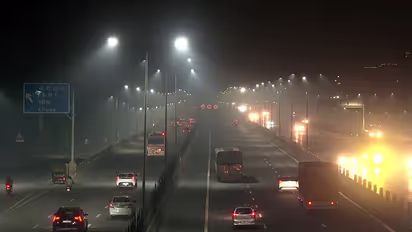
Delhi residents witnessed some relief from worsening air pollution on Wednesday, November 11, as the city's overall Air Quality Index (AQI) dropped below 300, placing it in the 'poor' category.
The improvement comes after several days of very poor and severe air quality across the national capital. According to available data from 59 monitoring stations, 29 stations continued to record very poor air quality, while the remaining stations reported readings in the poor category.
Notably, none of the monitoring stations recorded severe air quality levels on Wednesday. Increasing wind speed is also expected to help disperse pollutants, potentially bringing further relief to residents over the next few days.
According to the Central Pollution Control Board (CPCB), an AQI between 201 and 300 falls under the poor category. Readings between 301 and 400 are classified as very poor, while anything between 401 and 500 is considered severe.
Chhawla records highest AQI, several areas remain highly polluted
Despite the overall improvement, pollution levels remained significantly high in several parts of Delhi. Chhawla emerged as the most polluted monitoring location, recording an AQI of 396.
Chandni Chowk followed with an AQI of 379, while IIT Delhi recorded 375. Other locations, including Delhi Technological University (DTU) and North Campus of Delhi University, also reported elevated pollution levels.
Here are the 10 monitoring stations with the highest AQI readings on November 11:
Monitoring station AQI
Chhawla 396
Chandni Chowk 379
IIT Delhi 375
DTU 375
North Campus, DU 374
ITO 367
Burari Crossing 362
Pusa 359
NIH Narela 352
NSUT Jaffarpur 351
PM2.5 and PM10 were among the prominent pollutants recorded at these locations.
Meanwhile, the CPCB has clarified concerns surrounding differences between AQI readings displayed on private applications and its official platform. The board attributed these variations to differences in pollution measurement methods and the time periods considered.
According to the CPCB, private applications may reflect sharp hourly pollution spikes, whereas the National Air Quality Index (NAQI) considers exposure over the preceding 24 hours. The national AQI system was introduced in 2015 to communicate complex pollution data through a simplified index.
Delhi weather forecast: Fog expected, temperatures to remain below 30°C
Alongside the improvement in air quality, Delhi is expected to experience relatively stable weather conditions over the coming days.
According to the India Meteorological Department (IMD), early morning fog or mist is likely between November 11 and November 16. Daytime temperatures are expected to remain between 28°C and 29°C, while minimum temperatures may fluctuate between 14°C and 16°C.
On November 11 and 12, the maximum temperature is likely to settle around 28°C, with minimum temperatures ranging from 15°C to 16°C.
The mercury could rise slightly, with maximum temperatures reaching 29°C between November 13 and November 15. However, nights are expected to remain relatively cool, with minimum temperatures hovering between 15°C and 16°C.
By November 16, the maximum temperature may drop to 28°C, while the minimum could fall to 14°C.
The IMD has not issued any weather warnings for Delhi during this period.
With early morning mist expected and pollution levels still elevated in several neighbourhoods, residents should continue monitoring local air quality updates, particularly before spending extended periods outdoors.
Stay updated with the Breaking News Today and Latest News from across India and around the world. Get real-time updates, in-depth analysis, and comprehensive coverage of India News, World News, Indian Defence News, Kerala News, and Karnataka News. From politics to current affairs, follow every major story as it unfolds. IMD cities weather forecastsRain Cyclone Asianet News Official App