Deleting voter names without hearing strikes at democracy: SC Judge
Synopsis
SC Judge Ujjal Bhuyan said deleting a voter's name from an electoral roll without a fair hearing strikes at India's constitutional democracy. He emphasised that the right to vote is tied to citizenship and cannot be detached, calling it a soul from the body.
Supreme Court Judge Justice Ujjal Bhuyan said that the deletion of a citizen's name from an electoral roll without a fair hearing strikes at the core of India’s constitutional democracy.
Right to Vote is the Soul of Citizenship
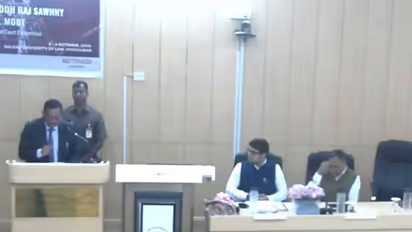
Speaking at the valedictory ceremony of the 19th NALSAR BRS Moot Court Competition in Hyderabad, Justice Bhuyan emphasised that the right to vote is fundamentally tied to Indian citizenship. "A citizen to be a voter and to vote is of the greatest importance and forms the foundation of free and fair elections. Section 22 of the Representation of the People Act 1950 permits deletion of an entry in the voters list. But only after the said voter has been given a reasonable opportunity of being heard. Except in the case of a dead man, the name of a voter once enlisted in the electoral roll cannot be deleted without notice and hearing," he said.
"From the persona of an Indian citizen, the right to vote or the right to be included in the voters list cannot be detached. It will be like taking out the soul from the body," he added.
Disenfranchisement Violates Constitution
He noted that the Indian Constitution does not provide for two classes of citizens, one class of citizens with voting rights and the other class of citizens without voting rights. "Any process which leads to wholesale disenfranchisement of Indian citizens, making them citizens without voting rights, in my view, would be outrightly violative of Articles 326 and 14 of the Constitution of India," he said.
He further warned that any procedure that leads to the disenfranchisement of millions of citizens and turning individuals into "second-class citizens" without voting rights is "intrinsically arbitrary". "If any process results in disenfranchising millions and millions of Indian citizens, making them second-class citizens in their own country, in the sense of being citizens without a voting right, such a process is intrinsically arbitrary. No amount of whataboutery can justify it," he noted.
No Authority Above the Constitution
Justice Bhuyan declared that no authority can take away the right to vote from any citizen, saying, "no court can endorse it or condone it." He reiterated that no individual or institution stands above the Constitution.
"It is a negation of the constitutional order which we have adopted based on the Constitution of India. Indian citizens' right to vote is intertwined with India's long years of struggle against foreign rule. Article 326 cannot be tinkered with at all. No authority can do it. No court can endorse it or condone it. No one is above the Constitution," he said. His remarks come in the background of the ongoing controversy over the Election Commission of India (ECI) and Special Intensive Revision (SIR) of electoral rolls, with opposition targeting Chief Election Commissioner Gyanesh Kumar and demanding his resignation. (ANI)
Stay updated with the Breaking News Today and Latest News from across India and around the world. Get real-time updates, in-depth analysis, and comprehensive coverage of India News, World News, Indian Defence News, Kerala News, and Karnataka News. From politics to current affairs, follow every major story as it unfolds. IMD cities weather forecastsRain Cyclone Asianet News Official App