DDWS holds 11th Peyjal Samvad to accelerate Jal Jeevan Mission 2.0
Synopsis
The Department of Drinking Water & Sanitation organised the 11th Peyjal Samvad to accelerate Jal Jeevan Mission 2.0. The meeting focused on sharing best practices, source sustainability, and community-led management of rural water supply systems.
Accelerating Jal Jeevan Mission Implementation
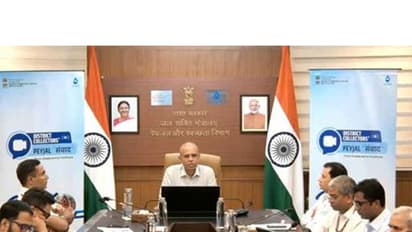
The Department of Drinking Water & Sanitation (DDWS), Ministry of Jal Shakti, organised the 11th edition of the District Collectors' Peyjal Samvad on Tuesday through video conferencing, bringing together senior officials, District Collectors/ District Magistrates/ Deputy Commissioner to deliberate on accelerating the implementation of Jal Jeevan Mission (JJM) 2.0 and sharing of best practices. The meeting was chaired by Ashok KK Meena, Secretary of DDWS, Kamal Kishore Soan, Additional Secretary & Mission Director, National Jal Jeevan Mission (NJJM) and senior officers from the State Water Sanitation Mission (SWSM) and DDWS were also present during the Samvad, according to a release from the Ministry of Jal Shakti.
Addressing the occasion, Meena emphasised the pivotal role of the Department of Drinking Water & Sanitation (DDWS) as the primary institutional mechanism and urged districts to conduct regular monthly meetings and upload meeting proceedings on the JJM IMIS portal. He also called upon districts to leverage the Decision Support System (DSS) for scientific assessment of source sustainability.
Highlighting the importance of water conservation during the monsoon season, he encouraged districts to intensify the 'Catch the Rain - Jal Sanchay Jan Bhagidari' campaign through active participation of Gram Panchayats, VWSCs, Self-Help Groups, schools, colleges and community institutions to promote rainwater harvesting, groundwater recharge and long-term water security, the release noted.
He urged districts to expedite Jal Arpan ceremonies for completed schemes after the prescribed commissioning process and mandatory trial run, enabling formal handover of assets to GPs. Noting that over 2 lakh villages and more than 1 lakh GPs across the country have achieved Har Ghar Jal certification, which should now be translated into sustained community-led management of rural water supply systems.
The release further said that he also emphasised convergence with programmes such as VB-G RAM G for source sustainability and greywater management, effective utilisation of 16th Finance Commission tied grants for water and sanitation, and collection of user charges at the GP level to support O&M of village water supply infrastructure.
DDWS also had a detailed presentation on "Sujalam Shakti" implementation roadmap, which focuses on establishing women-led village support groups to strengthen water quality monitoring, community participation and source sustainability.
Innovative Best Practices shared by Four Districts
The progress and best practices of four selected districts, Uttara Kannda (Karnataka), Khowai (Tripura), Didwana Kuchaman (Rajasthan), and Chatra (Jharkhand) were also presented by the respective District Collectors/District Magistrates to facilitate cross-learning and support other districts in strengthening implementation under JJM 2.0, the release said. Innovative Best Practices shared by Four Districts through Presentations by the respective District Collector/ District Magistrate/ Deputy Commissioner
Uttara Kannda, Karnataka
K Lakshmi Priya, Deputy Commissioner and Dileesh Sasi, CEO, Zilla Panchayat, showcased the district's comprehensive approach towards sustainable rural water supply service delivery in a geographically challenging district comprising coastal, forest and hilly terrains. The district highlighted its extensive source sustainability initiatives by mapping lakes, open wells, borewells, and preparation of sustainability plans in GPs by leveraging geospatial data, groundwater assessments and local resource mapping to develop long-term water security plans and is promoting convergence with VB-G RAM G over the next five years, the release said. Regular coordination with the Forest Department obtained forest and wildlife clearances for Multi-Village Schemes. Capacity building of Panchayat Development Officers (PDOs), regular VWSC meetings, joint inspections by engineers and Panchayat functionaries have strengthened local governance and accountability. Information related to water supply schemes, infrastructure created, and service delivery status is publicly accessible at the Gram Panchayat level, while actively engaging communities through Gram Sabhas and participatory planning processes.
Khowai, Tripura
Rajat Pant, District Magistrate and Collector, showcased the district's integrated approach towards sustainable rural drinking water service delivery through regular DWSM and DISHA meetings, geo-tagged monitoring, third-party quality audits, and structured handover of schemes to GPs through Jal Arpan. He highlighted convergence of 15th FC grants and MPLADS funds for drinking water supply in remote tribal habitations, extensive IEC activities involving schools, SHGs and line departments, and School Water Clubs where SHG women train students in water quality testing using FTKs. Awareness campaigns are being promoted through the district mascot "Nirmal Modi", while over 6,000 SHG women are engaged in community mobilisation. Source sustainability interventions include catchment protection, afforestation, groundwater recharge structures, greywater management by building soak pits in convergence with SBM-G, 15th FC and VB-G RAM-G and farmer outreach through Krishi Vigyan Kendra to strengthen long-term water security. All 860 AWCs have rainwater harvesting structures (RHS) through dovetailing, the release noted.
Didwana Kuchaman, Rajasthan
Avdhesh Meena, District Collector highlighted the district's efforts to address the long-standing challenge of fluoride- and salinity-affected groundwater, which had historically resulted in cases of dental and skeletal fluorosis. To ensure access to safe drinking water, the district has strengthened surface water-based regional water supply systems and significantly expanded rural tap water coverage. The release stated that the district also emphasised source sustainability through convergence with MGNREGA and other programmes, promoting traditional water conservation and groundwater recharge interventions, including construction and rejuvenation of Tankas, restoration of water bodies, and rainwater harvesting measures in water-scarce areas. Further showcased its SCADA-enabled monitoring system for real-time tracking of reservoirs, water treatment facilities, pump houses and village-level distribution networks, enabling efficient water management and improved service delivery.
Chatra, Jharkhand
Ravi Anand, Deputy Commissioner presented a convergence-led model for strengthening rural drinking water service delivery. A key highlight of the presentation was the district's innovative "Peyjal Samasya Nivaaran Pakhwada", a special campaign undertaken to identify and resolve drinking water issues through coordinated field action involving district administration, technical departments, Panchayati Raj Institutions and local communities. The initiative enabled rapid resolution of grievances related to hand pumps, village water supply schemes, water shortages and source sustainability, while strengthening community ownership and accelerating restoration of drinking water services. The district holds regular monitoring through DISHA and Panchayat-level reviews, IoT-enabled remote monitoring of water supply schemes, village-level capacity building of youth as pump operators and plumbers, and women-led water quality surveillance through Jalsahiya cadres, the release from the Ministry said. Convergence with MGNREGA and other funding sources has supported construction of over 5,300 soak pits, rainwater harvesting structures, and rejuvenation of ponds and reservoirs to strengthen groundwater recharge and long-term water security. Extensive IEC activities, Jal Shakti Samvads, Jal Yatras and community engagement initiatives are further promoting Jan Bhagidari and sustainability of rural water supply systems.
Strengthening Planning and Service Delivery
Additional Secretary & Mission Director of National Jal Jeevan Mission Kamal Kishore Soan emphasised the critical role of regular DWSM meetings, district dashboards, and District Technical Units (DTUs) in strengthening planning, monitoring, and service delivery. He urged District Collectors to leverage data-driven decision-making, ensure effective functioning of DTUs, and promote capacity building through convergence with RSETIs, SRLMs, and Skill Development. He also highlighted the importance of training women under Sujalam Shakti and strengthening local technical capacities to ensure long-term sustainability of rural water supply services.
The release noted these presentations showcased achievements, mitigating steps taken for challenges and best practices under JJM, underlining the diversity of approaches adopted to accelerate progress for achieving Har Ghar Jal. (ANI)
(Except for the headline, this story has not been edited by Asianet Newsable English staff and is published from a syndicated feed.)
Stay updated with the Breaking News Today and Latest News from across India and around the world. Get real-time updates, in-depth analysis, and comprehensive coverage of India News, World News, Indian Defence News, Kerala News, and Karnataka News. From politics to current affairs, follow every major story as it unfolds. IMD cities weather forecastsRain Cyclone Asianet News Official App