Assam villages beyond border fence pin hope on minister's visit
Synopsis
Two Indian villages in Assam's Dhubri district, Bhogdanga and Feskarkuti, are isolated beyond the Indo-Bangladesh border fence. Residents hope an upcoming visit by Guardian Minister Ashok Singhal will address their decades-old challenges.
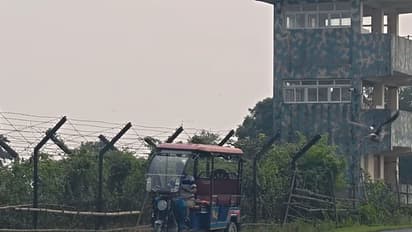
Two Indian villages in Assam's Dhubri district continue to live under a unique and challenging reality. Bhogdanga and Feskarkuti, located in the Golakganj border sector, are geographically part of India but lie beyond the Indo-Bangladesh border fencing, leaving their residents effectively isolated from the Indian mainland after sunset.
Hope Pinned on Minister's Visit
The villagers are now looking forward with renewed hope as Assam Cabinet Minister and newly appointed Guardian Minister of Dhubri district, Ashok Singhal, is scheduled to visit the Bhogdanga border area on Thursday. Residents believe the visit could bring long-overdue attention to their decades-old concerns.
Decades of Isolation Beyond the Fence
Following the 1985 Assam Accord, border fencing was erected along large stretches of the Indo-Bangladesh border to strengthen security. However, due to geographical and administrative constraints, Bhogdanga and Feskarkuti remained outside the fenced area. In recent years, security concerns surrounding the villages have gained significance, particularly in light of political instability in Bangladesh and the growing influence of radical groups across the border.
The Daily Struggle for Access
Situated between Border Pillars 1021 and 1022 and now falling under the Dhubri Assembly constituency after constituency delimitation, the two villages together cover approximately 662 bighas of land. Nearly 90 percent of their residents belong to the Koch-Rajbongshi community. The villages are surrounded on all sides by Bangladeshi settlements, including Kacherkuti, Sarerkuti, Khunurgaon, Shiber Hat, Balabari, and Anglerkuti in Bangladesh's Kurigram district.
The only access to the Indian mainland is through a special gate in the border fence, known as Gate No. 50, which remains open from 6 a.m. to 6 p.m. Residents require gate passes and special permission to cross the gate, which is guarded round the clock by the Border Security Force (BSF). Once the gate is locked in the evening, the villages are virtually cut off from the rest of India. Although BSF personnel open the gate during medical emergencies or other urgent situations, the sense of isolation remains a daily reality.
Beyond that gate number 50, a narrow earthen road leads first to Bhogdanga and then to Feskarkuti, crossing a small bridge over the Kaldeo River. Despite being located just 14 kilometres from Golakganj town, the villages face numerous challenges arising from their unusual location. A Border Guard Bangladesh (BGB) observation post and Bangladeshi settlements lie within about 100 metres of the villages. Yet there is no permanent BSF camp inside either Bhogdanga or Feskarkuti. As a result, residents often express concerns about illegal infiltration, theft, and other border-related security issues.
A Plea to be Heard
Despite these hardships, the people of Bhogdanga and Feskarkuti continue to exercise their democratic rights as Indian citizens. However, many villagers also harbour resentment over promises made by successive governments and elected representatives that have largely remained unfulfilled.
For the residents, the story of Bhogdanga and Feskarkuti is more than a border issue. It is the story of Indian citizens who must struggle every day simply to remain connected with their own country. As Minister Ashok Singhal is scheduled to visit the area tomorrow around 3 pm, villagers hope their voices will finally be heard and that meaningful steps will be taken to address the unique challenges faced by these two forgotten Indian villages beyond the border fence.
Stay updated with the Breaking News Today and Latest News from across India and around the world. Get real-time updates, in-depth analysis, and comprehensive coverage of India News, World News, Indian Defence News, Kerala News, and Karnataka News. From politics to current affairs, follow every major story as it unfolds. IMD cities weather forecastsRain Cyclone Asianet News Official App