Nearly 60 years ago, a routine United States Air Force patrol over the Arctic turned into one of the most dangerous nuclear accidents of the Cold War. What began as a normal surveillance mission ended with a bomber crashing into the ice of Greenland, spreading radioactive material and causing political damage that lasted for decades, according to a report in Daily Mail.
The incident took place on January 21, 1968, near Thule Air Base in Greenland. A US B-52G Stratofortress, carrying four thermonuclear weapons, caught fire mid-air and crashed into the frozen bay below. Though a full nuclear explosion was avoided, the accident contaminated a wide area and exposed secret nuclear operations that Denmark had publicly banned.
The bomber took off from Plattsburgh Air Force Base in New York on a cold Sunday morning. Captain John Haug was in command of the seven-man crew.
The mission was part of a top-secret Strategic Air Command programme called Hard Head, under Operation Chrome Dome. This operation kept nuclear-armed bombers in the air at all times, ready to respond if a nuclear war with the Soviet Union began.
The aircraft climbed to 35,000 feet and began circling above Thule Air Base. The area was considered critical because any Soviet missile aimed at North America would pass over Greenland.
The crew’s job was to watch for signs of a communications blackout, which could signal a system failure or the start of a nuclear attack.
Inside the plane’s forward bomb bay were four B28FI thermonuclear weapons. Each bomb was about 12 feet long, weighed roughly 2,300 pounds, and carried enough power to destroy a major city.
At the time, these weapons were part of America’s nuclear deterrent strategy. The goal was simple but dangerous: always be ready to strike back.
According to Military.com, the bombs were live and fully armed, though designed with safety systems to prevent accidental nuclear detonation.
The flight from New York to Greenland took around six hours. The temperature inside the aircraft was extremely cold.
Major Alfred D’Amario came up with an idea to make the cabin warmer. Before take-off, he placed foam cushions near a heating vent and opened an engine bleed valve to push hot air inside.
However, the aircraft’s systems failed to cool the air properly. The cushions overheated and caught fire.
Soon, a strong smell of burning rubber filled the plane.
Navigator Curtis Criss went searching for the source. When he opened a lower compartment, he saw flames bursting out from behind a metal box.
Criss quickly emptied two fire extinguishers, hoping to stop the blaze. But the fire only grew stronger and spread further through the aircraft.
The flames damaged the electrical systems, cutting power and filling the cockpit with thick black smoke.
At 3:22 pm, about 90 miles south of Thule, Captain Haug radioed an emergency and asked to land immediately.
Just five minutes later, the situation became hopeless.
With smoke filling the cockpit and systems failing, Captain Haug gave the order to evacuate the aircraft.
Major D’Amario later confirmed the bomber was directly above the runway lights of Thule Air Base when the crew prepared to jump.
Six crew members successfully ejected from the plane into the freezing Arctic darkness.
However, co-pilot Leonard Svitenko did not have an ejection seat. He tried to escape through a lower hatch, hit his head, and was unable to survive the fall. His body was later found north of the base.
At 3:39 pm local time, the unmanned B-52 plunged into the ice of North Star Bay near Thule.
The impact triggered the conventional explosives inside all four nuclear bombs. While this did not cause a nuclear blast, it shattered the weapons and scattered radioactive material across miles of ice.
Plutonium, uranium, americium, and tritium were released into the environment.
Jeffrey Carswell, a shipping clerk working for a Danish contractor at Thule, recalled the moment clearly.
“The massive building shook as if an earthquake had hit,” he said.
The crash caused serious damage to relations between the United States and Denmark.
Since 1957, Denmark had enforced a strict nuclear-free policy, banning nuclear weapons on its soil and in its territories, including Greenland.
The Thule crash exposed the fact that the US had been secretly flying nuclear-armed bombers over Greenland for years, in direct violation of that policy.
Worse still, one of those missions had now contaminated a Greenland fjord with radioactive debris.
The Danish government demanded that the US remove all wreckage and radioactive material from the crash site.
At first, the US refused, arguing that full cleanup was unnecessary.
The standoff continued until a Danish scientist warned that the future of Thule Air Base itself could be at risk if contamination spread.
Only then did the US agree to a massive cleanup operation.
The US Air Force activated its Disaster Control Team within hours of the crash.
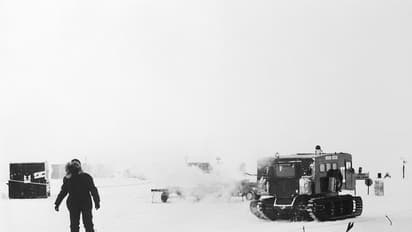
Crews worked in extreme Arctic conditions. Ice roads were carved across the frozen bay, and temporary buildings and decontamination stations were set up.
One general later remarked on the irony that cleaning up one of the world’s most advanced weapons required almost primitive tools and methods.
Workers swept the ice shoulder to shoulder, collecting everything from twisted aircraft parts to tiny radioactive fragments.
They scraped away inches of contaminated ice and packed debris into containers.
More than half a million gallons of radioactive waste were shipped back to the United States.
Many workers handled the material with little or no proper protective gear.
The impact had burned deep into the ice, spreading radioactive material over a wide area.
Scientists feared that when the ice melted, radioactive fuel could rise to the surface and drift along Greenland’s coast, harming wildlife and people.
In some areas, contamination levels were extreme.
Despite these risks, the cleanup pushed on day and night.
The operation ended on September 13, 1968. It cost $9.4 million at the time, roughly $90 million today.
Officials claimed that 90 percent of the plutonium had been recovered.
But soon, serious questions emerged.
Shortly after the crash, US officials said all four bombs had detonated completely. This statement later proved to be false.
Three weeks later, investigators found components from only three of the four bombs.
A classified report from July 1968 confirmed that most parts had been recovered, including nearly all the uranium from three weapons.
However, the fusion stage of the fourth bomb, the part responsible for a hydrogen bomb’s massive explosion, was never found.
This revelation raised fears that part of a nuclear weapon could still be buried under Greenland’s ice.
After the crash, Danish officials told the public the flight was an isolated emergency.
Later declassified documents showed that the flights had been quietly approved by Danish authorities, despite public denials.
The full truth remained hidden for decades.
In 1995, a new investigation uncovered secret government approvals and years of deception.
The findings triggered a political scandal known as Thulegate.
The scandal caused public outrage in Denmark and renewed debate about nuclear weapons, transparency, and national sovereignty.
The Thule crash remains one of the most serious nuclear accidents in history.
It showed how close the world came to disaster, not because of war, but because of routine operations, human error, and secrecy.
Even today, the incident stands as a warning about the dangers of nuclear weapons and the importance of honesty between nations.
Check the Breaking News Today and Latest News from across India and around the world. Stay updated with the latest World News and global developments from politics to economy and current affairs. Get in-depth coverage of China News, Europe News, Pakistan News, and South Asia News, along with top headlines from the UK and US. Follow expert analysis, international trends, and breaking updates from around the globe. Download the Asianet News Official App from the Android Play Store and iPhone App Store for accurate and timely news updates anytime, anywhere.