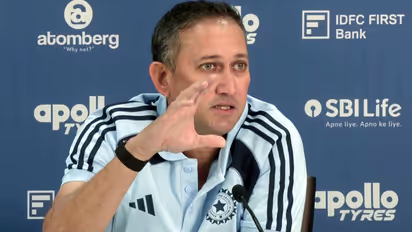
Former India pacer Ajit Agarkar’s tenure as the Board of Control for Cricket in India (BCCI) chief selector officially came to an end on October 4. Pragyan Ojha taking over as the interim chief selector and announcing India’s squad for the T20I series against New Zealand confirmed Agarkar’s exit from the selection committee.
Ajit Agarkar served as the chief selector from July 2023 to October 4, with his last selection announcement coming for the white-ball series against the visiting West Indies. The former India pacer, who earlier served as chief selector of the Mumbai Cricket Association (MCA), became part of India’s transformative era.
During his tenure at the helm of the selection committee, Ajit Agarkar apparently witnessed two sides of elite Indian cricket: unmatched glory on the international stage accompanied by relentless scrutiny behind closed doors.
Ajit Agarkar’s exit from the selection committee following the expiration of his term was quiet rather than abrupt. There has been no official statement from the BCCI or anyone from the selection committee about Agarkar’s departure from the top post.
The BCCI was already tight-lipped on a contract extension for Agarkar as chief selector, potentially till the 2027 ODI World Cup, with secretary Devajit Saikia saying the board would take a decision after his tenure ended on October 4, but the former pacer eventually decided against seeking an extension.
On Tuesday, soon after announcing the India squad for the New Zealand T20Is, BCCI invited applications to fill a vacant post on the selection committee, confirming Ajit Agarkar’s departure and setting the stage for a new head to take charge of India's selection panel.
Also Read: Pragyan Ojha set to replace Ajit Agarkar as interim chief selector
During Ajit Agarkar’s four-year tenure as the chief selector, Indian cricket entered one of its most dominant and golden phases on the global stage.
Under his guidance, the selection committee oversaw a period of remarkable success, headlined by 2024 and 2026 T20 World Cup triumphs, the 2025 Champions Trophy, two Asia Cup titles in 2023 and 2025, and two Asian Games gold medals in 2023 and 2026, alongside a stellar run to the final of the 2023 ODI World Cup, where the Men in Blue lost to Australia in Ahmedabad.
Agarkar worked alongside three coaches: Rahul Dravid, VVS Laxman (interim), and Gautam Gambhir, and four captains, including Rohit Sharma, Suryakumar Yadav, Shreyas Iyer, and Shubman Gill, navigating a dynamic leadership landscape across formats while steering the team through major transitional milestones.
More or less, Ajit Agarkar’s tenure as chief selector is likely to be remembered for taking bold calls as part of the squad transition. His selection committee was particularly focused on giving opportunities to young, emerging talent and seamlessly weaving them into the national setup.
Appointments of Shubman Gill as Test and ODI captain and Shreyas Iyer as T20I captain, alongside the decision to move on from senior stalwarts Rohit Sharma and Virat Kohli in Tests, showed the selection committee’s willingness to make difficult calls while building for India’s next generation.
Reportedly, over 20 new players were introduced or given international caps during Agarkar’s tenure, reflecting a clear mandate to build a deep talent pool across formats. However, these decisions did not come without friction.
Also Read: 'History will be kinder to you': Gambhir lauds outgoing selector Agarkar
One of the defining shifts during Agarkar’s tenure was the absolute emphasis placed on domestic cricket as a mandatory baseline for national selection. Following India’s disastrous Border-Gavaskar Trophy series in Australia, the selection committee decided that turning out for domestic red-ball competitions was no longer optional for centrally contracted players.
Over the last year, several contracted players, including Rohit Sharma, Virat Kohli, Rishabh Pant, Shubman Gill, Abhishek Sharma, Sanju Samson, Suryakumar Yadav, and Yashasvi Jaiswal, were encouraged to prioritise domestic cricket whenever available. Ishan Kishan toiled hard in domestic cricket after losing the central contract before making a comeback to the national side last year.
The domestic cricketers, including Anshul Kamboj, Sarfaraz Khan, Dhruv Jurel, Mukesh Kumar, Akash Deep, Mayank Yadav, Auqib Nabi, Gurnoor Brar, Manav Suthar, and Sarash Jain, reaped the rewards of this rigorous merit-based filter, highlighting the selection committee’s emphasis on rewarding domestic performances and building a wider talent pool for India across formats.
While the silverware filled the BCCI trophy cabinet, the Ajit Agarkar-led selection committee was often itself at the center of intense public scrutiny. One of the debates that put Agarkar in the spotlight was the handling of Rohit Sharma and Virat Kohli’s Test retirements in May last year, with questions raised over the transition from India’s long-standing senior core to a new generation of players.
The exclusion of Shubman Gill from the T20 World Cup 2026 squad and the removal of Suryakumar Yadav from the T20I squad as a player as well as captain, despite leading Team India to a successful title defence, sparked heavy debate among fans and experts alike. The friction with Mohammed Shami over his fitness issues also added another layer of scrutiny.
India’s Test series whitewash at the hands of New Zealand and South Africa, a 0-2 T20I series defeat to Ireland, and the 0-4 T20I whitewash followed by a 1-2 ODI series loss to England further exposed the challenges of the transition under Agarkar’s tenure, placing even greater pressure on the selection panel during a transitional phase.
Also Read: Rohit Sharma's 2027 World Cup dream in focus for West Indies ODIs