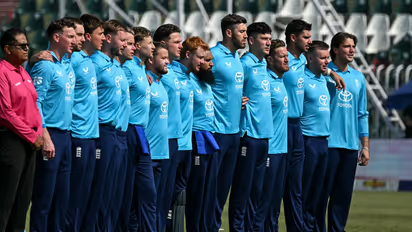
England’s campaign in the ongoing ODI Tri-Series involving host Pakistan and Sri Lanka has lurched from bad to worse, raising alarming questions about the state of their 50-over game. Led by Harry Brook, the Three Lions have suffered three losses, two against Pakistan and one against Sri Lanka, putting them on the verge of an early exit.
England’s chances of winning their second match against Sri Lanka in Rawalpindi, where they posted a total of 429/4, courtesy of Harry Brook’s record-breaking 114-ball double century, came crashing down as Sri Lanka pulled off a record chase of 430/8, with England's bowling attack failing to execute under pressure.
In the second face-off against Pakistan in the league stage of the ODI Tri-Series, the Three Lions suffered another agonising defeat, losing by 1 wicket in a thriller at the Gaddafi Stadium in Lahore, as Shadab Khan’s 113-run knock and a historic 89-run 10th-wicket partnership with Haris Rauf sealed a nail-biting victory.
England’s performance in the ongoing ODI Tri-Series, despite having a strong batting lineup, has apparently unmasked the deep structural rot in their 50-over blueprint. Three back-to-back defeats have put the spotlight on the Three Lions’ inability to balance raw aggression with sustained 50-over game management.
Since 2023, England have played 59 ODI matches, of which they lost 34 times, while winning on 24 occasions, with a win percentage of 40.67%, a stat that underscores a severe downfall for the side that once set the benchmark in 50-over cricket. This year, the Three Lions have played 12 ODI matches so far, winning six and losing as many games, reflecting an inconsistent 50% record.
The ongoing ODI tri-series has further exposed deep-seated flaws in the side's ability to defend high totals and close out nail-biting finishes under pressure.
Also Read: Cheteshwar Pujara Unveils His Ultimate ODI World XI Playing Squad
England cricket’s dominance in red-ball has appeared to be fading, given that the side has struggled to maintain consistency across home and away ODI series over the post-2022 cycle. England’s ODI record at home since 2023 has been decent, winning 14 matches in 23 outings, with a win percentage of 60.87%, showing relative comfort on home soil.
However, their performance away from home during the period has plummeted drastically. In 36 matches across India, West Indies, Bangladesh, Sri Lanka, South Africa, New Zealand, and Pakistan, they won 10 and lost 26 outings, with a dismal win percentage of 27.78%, underscoring England's mounting difficulties on foreign soil and in subcontinental conditions.
England’s poor 2023 ODI World Cup and 2025 Champions Trophy campaigns, alongside double series defeats at the hands of West Indies in 2023 and 2024, against Australia, South Africa, India, and New Zealand, have all pointed to a wider systemic slump.
England cricket has been considered one of the dominant forces to be reckoned with, especially during Eoin Morgan’s tenure, transforming the side into world champions with an ultra-aggressive, high-risk, high-reward approach.
During the 2019–2022 period, England maintained a winning percentage of 55.77%, compared to their 40.67% record since 2023, highlighting their significant decline in consistency and effectiveness in the 50-over format at the international level.
Also Read: Pakistan Cricket Board Holds Back NOCs for Nepal Premier League Stars
Following the conclusion of the ODI tri-series, England will play 16 matches in the lead-up to the 2027 ODI World Cup. The Three Lions will play a three-match series against Australia and South Africa away from home in November and January 2027, respectively, followed by two five-match home series against Pakistan and New Zealand.
Sitting in eighth position in the Men’s ODI Rankings, behind Afghanistan and Sri Lanka, England face a challenging road to redemption ahead of the 2027 ODI World Cup. The upcoming 16 matches will offer Harry Brook’s side an opportunity to address its tactical shortcomings.
However, England need to find the right balance between aggression and match awareness rather than relying on their attacking approach, which has been their tactical blueprint over the last few years.
Though qualified for the marquee event in South Africa, Zimbabwe, and Namibia as one of the top 8 teams in Men’s ODI Rankings as of 30th September 2026, England cannot afford complacency.
The disappointing 2023 ODI World Cup campaign, finishing seventh in the league stage, apparently triggered England’s deepest white-ball crisis for nearly a decade. The tours of Australia and South Africa could give The Three Lions the ultimate proving ground to test whether their revamped, measured aggression can withstand hostile foreign conditions.
Under Harry Brook’s leadership, England now faces a defining period in white-ball cricket, as the pressure mounts to rewrite their tactical blueprint before their upcoming overseas assignments.