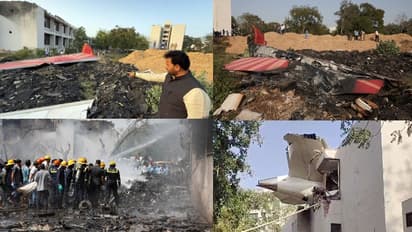
Published : Jun 12, 2025, 11:03 PM ISTUpdated : Jun 12, 2025, 11:23 PM IST
Ahmedabad plane crash: Experts suspect dual engine failure or bird hit led to fatal Air India crash shortly after takeoff from Ahmedabad, killing 241 of 242 people onboard.
The fatal crash of a London-bound Air India Boeing 787-8 shortly after takeoff from Ahmedabad — which claimed all 241 lives on board, including former Gujarat Chief Minister Vijay Rupani — may have been triggered by a dual engine failure or a possible bird strike, according to aviation experts. While the cause remains under investigation, early assessments by senior pilots point to severe thrust loss in both engines during the aircraft’s initial climb.
212
Experts Point to Loss of Thrust in Both Engines
Three senior wide-body pilots, who are also certified instructors, reviewed publicly available crash footage and flagged serious concerns regarding the aircraft’s thrust during take-off.
"Looking at the videos of the crash available publicly, it seems that the engines could not gain the required thrust needed for the take-off, resulting in a fatal crash into the residential area seconds after it took off," they were quoted as saying in a PTI report.
312
Single Engine Failure Ruled Out
One commander ruled out the possibility of a single engine failure, saying, “It does not seem to be the case of one engine failure because in such a scenario, the aircraft would have been swinging but here, the aircraft was steady.”
“So, there is the possibility of both the engines failing... there could have been a loss of thrust in both engines. But these are only possibilities,” the commander said, adding that visuals suggested “either the flaps were up or landing gear was down at the time of take-off.”
The second commander echoed similar concerns. “The way the aircraft went down indicated that there was a lack of thrust in both the engines,” he noted.
“This could happen if both engines had flameout due to a bird hit,” the commander said.
A third commander speculated that both engines may have lost power, and operational missteps could have played a role. “One engine might have failed and possibly due to the landing gear being not retracted after take-off, the second engine might not have had adequate power,” he said.
512
Aircraft Weight Not Likely a Factor, Say Pilots
There were also questions raised on whether the aircraft’s weight was above the permissible limit, possibly impacting take-off performance. One commander, however, dismissed this theory: “If that was the case, then the take-off itself would not have been possible.”
The weight of the aircraft directly affects the V1 speed—or the critical take-off decision speed. “If the calculated speed is lower than required, the engines will struggle to get the plane airborne,” a commander explained.
612
Amit Shah Meets Lone Survivor
Union minister Amit Shah, who met the lone survivor of the fatal crash, said that the temperature in the Air India plane which crashed in Ahmedabad was so high due to burning fuel that there was no chance to save anyone.
“There was 1.25 lakh litre of fuel inside the plane and it caught heat so it was impossible to save anyone,” Shah told reporters.
The entire nation is in deep shock following the tragedy, he said.
“The number of those killed will be officially released by the authorities after DNA test and identification of the victims,” Shah said.
"The good news is that one person survived the crash. The process of collecting DNA samples from bodies of those killed in the plane crash is over. Forensic Science Laboratory and National Forensic Sciences University in Gujarat will conduct DNA tests of the victims,” he added.
712
MAYDAY Call Made, But No Response After Initial Alert
The ill-fated aircraft, a Boeing 787-8 Dreamliner with registration VT-ANB, was operating flight AI 171 from Ahmedabad to London Gatwick. It took off from runway 23 at the Ahmedabad airport.
According to the Directorate General of Civil Aviation (DGCA), the aircraft made a MAYDAY call soon after departure. “Aircraft, immediately after departure from runway 23, fell on ground outside the airport perimeter,” the DGCA said in a statement, adding that there was no further response from the cockpit after the initial distress signal.
812
Air India CEO: “We Are Doing Everything We Can”
In a video message, Air India CEO and Managing Director Campbell Wilson said, "Investigations will take time but anything we can do now we are doing."
The Aircraft Accident Investigation Bureau (AAIB) is leading the probe into what is now one of the deadliest aviation disasters in India in recent years. Detailed findings are expected in the weeks to come.
912
First-Ever Fatal Accident Involving Boeing 787 Dreamliner
The tragic crash of Air India flight AI171 also marks a grim milestone for aviation. It is the first-ever fatal accident involving Boeing’s 787 Dreamliner series since the aircraft's debut 14 years ago. This is also the third major aviation disaster in India in the past 15 years.
Boeing's 787 Dreamliners entered service 14 years ago, and until Thursday, had maintained a fatality-free record. “Globally, the Ahmedabad crash is the first time that hull loss has happened for a Boeing 787 (B787) aircraft,” an official said.
According to Boeing, the 787-8 has a range of up to 13,530 kilometres and features a wingspan of 60 metres. It is part of the Dreamliner family, which also includes the 787-9 and 787-10 variants.
A few years ago, the US Federal Aviation Administration (FAA) had paused deliveries of the 787 due to manufacturing issues, but the aircraft series had never been involved in a fatal incident—until now.
1012
Details of the Aircraft and Air India’s Fleet
The ill-fated aircraft was 11.5 years old and had logged more than 41,000 flying hours and nearly 8,000 cycles (takeoffs and landings), including 700 cycles in the last year alone, according to aviation analytics firm Cirium.
Cirium said the aircraft first flew on December 14, 2013, and was delivered to Air India on January 28, 2014. “The aircraft had 18 business class seats and 238 economy class seats,” Cirium added.
1112
Air India Operates 27 B787-8 Boeing Aircrafts
Of the 34 Boeing 787s currently operated by Air India, 27 are legacy B787-8 aircraft, including the one involved in the crash. The remaining seven B787-9s were inducted after the Vistara-Air India merger. Air India plans to begin retrofitting its legacy 787-8s starting July.
At the time of the crash, Air India had a fleet of 190 aircraft with an average age of 8.4 years, including 34 Boeing 787s. The airline also has 20 more Dreamliners on order and holds a letter of intent for an additional 24.
1212
India’s Third Major Crash in 15 Years
The Ahmedabad crash is India’s third major air tragedy in the last decade and a half. In August 2020, an Air India Express aircraft crash-landed in Kozhikode, killing 21 people including both pilots. In 2010, another Air India Express plane crashed and caught fire in Mangalore, resulting in the deaths of 158 people.