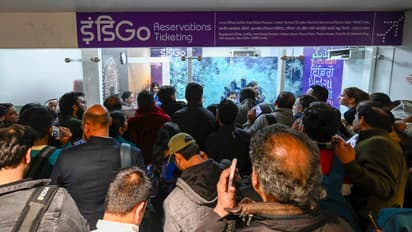
IndiGo faces its worst-ever meltdown as over 900 flights across two days are cancelled amid crew shortages and FDTL chaos, triggering passenger anger, political attacks and a government crackdown.
Across India’s airports, stranded passengers were united in frustration as IndiGo—long known for punctuality and reliability—plunged into its worst-ever operational meltdown.
Over 550 flights were cancelled on Thursday, followed by more than 400 on Friday. Hundreds more were delayed, leaving flyers exhausted, angry and out of options.
210
Delhi, Bengaluru, Hyderabad Lead the Chaos
At Delhi’s IGI Airport, over 220 flights simply didn’t take off or land. Bengaluru saw more than 100 cancellations. Hyderabad, over 90.
Airports looked like makeshift dormitories. Travellers slept on floors. Business trips collapsed. Families missed weddings. Parents ran out of milk and formula for toddlers.
The common sentiment: “Why didn’t IndiGo tell us earlier?”
As the crisis deepened, the political chorus grew louder. Congress leader Rahul Gandhi declared that the airline meltdown was symptomatic of a deeper malaise.
“IndiGo fiasco is the cost of this Govt's monopoly model. Once again, it's ordinary Indians who pay the price - in delays, cancellations and helplessness,” he said in a post on X.
He added:
“India deserves fair competition in every sector, not match-fixing monopolies.”
His remarks struck a chord with many stranded travellers who felt the weight of depending on a single dominant carrier.
What Triggered the Freefall? The FDTL Domino Effect
At the heart of the disruption lies a technical but crucial set of rules: the Flight Duty Time Limitations (FDTL) — norms that cap how long pilots can operate before taking mandatory rest.
IndiGo admitted to the aviation regulator that its planning went awry during the rollout of the second phase of the FDTL norms.
The airline told DGCA that the chaos was primarily due to:
Misjudgment
Planning gaps
Underestimation of crew requirements
With night landing limits tightened and duty hours recalibrated, IndiGo suddenly needed more pilots than anticipated — a shortage that grew rapidly.
The numbers provided by the airline paint a stark picture:
December availability: 2,357 captains, 2,194 first officers
November requirement: 2,422 captains, 2,153 first officers
October requirement: 2,186 captains, 1,948 first officers
The mismatch, especially during peak travel season, was enough to break the system.
510
Pilots’ Bodies Slam IndiGo: “Proactive Planning Failed”
Pilot unions didn’t mince their words. The Airline Pilots' Association of India (ALPA) commented that the disruptions showed a failure in “proactive resource planning” by dominant carriers. The Federation of Indian Pilots (FIP) went further, alleging IndiGo had enforced a hiring freeze despite having two years to prepare for the norms.
According to FIP, the airline “inexplicably” halted new recruitment, worsening the shortage.
There were also murmurs within pilot circles that the airline might be using the crisis to pressure DGCA into diluting the new norms — a claim the regulator hasn’t endorsed.
610
Civil Aviation Ministry Steps In: “Displeasure” and Direct Monitoring
Civil Aviation Minister K Rammohan Naidu held a high-level review meeting and expressed strong disapproval of IndiGo’s handling of the transition.
The ministry said officers had been deployed inside IndiGo’s operational control centres for real-time monitoring, while a DGCA team inspecting Delhi’s Terminal 1 found the airline’s ground staff “inadequate to manage disruption-induced crowding”.
IndiGo was instructed to:
Inform passengers well in advance about cancellations
Strengthen manpower at terminals
Ensure no spike in airfares amid disruptions
Submit a detailed roadmap on crew recruitment, roster restructuring and safety risk mitigation
File fortnightly progress reports
It was an unprecedented level of oversight for a private airline — evidence of how deeply the crisis had cut into India’s aviation ecosystem.
710
IndiGo’s Ask: Temporary Relaxation of FDTL Norms
In a move likely to stir debate in pilot communities, IndiGo requested temporary exemptions from specific FDTL requirements for its A320 fleet until February 10, 2026.
DGCA will review the request, but it is clear the airline is attempting to stretch existing resources without compromising safety norms.
The airline told the regulator that operations would be “fully stabilised” only by February 10, acknowledging that more cancellations are expected until December 8, after which flight schedules will be trimmed to reduce chaos.
810
The CEO’s Candid Memo: “Not an Easy Target”
In a message to employees, IndiGo CEO Pieter Elbers offered a sober assessment:
Normalising operations and bringing back punctuality will not be an “easy target”.
Internally, the airline continues firefighting mode — rerostering pilots, rescheduling flights, reallocating aircraft and trying to maintain transparency with both regulators and passengers.
910
The Human Cost: Passengers Left Exhausted and Angry
Behind all the numbers and official statements lies the real impact: families missing weddings, business trips collapsing, stranded travellers spending nights on airport floors.
For many, it wasn’t just the cancellations — it was the silence. Passengers complained of:
No proactive communication
Delayed refunds
Lack of ground staff
Minimal assistance for rebooking
The disruption, now stretching into days, has shaken customer trust that IndiGo took years to build.
1010
What Happens Next?
The next few days are expected to remain turbulent as IndiGo trims schedules and readjusts crew duties. The airline’s request for FDTL relaxations, if approved, could ease pressure but may invite scrutiny from pilot bodies.
What is certain is that India’s aviation sector — from regulators to passengers — will look at IndiGo differently. A brand built on clockwork precision is now grappling with reputational turbulence.