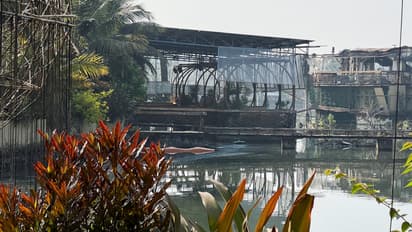
A packed Goa nightclub turned into a deadly firetrap as fireworks during a dance act sparked a blaze, killing 25 and injuring 6. Survivors recall chaos, suffocation and shocking safety violations.
A Night of Music, Dance — and a Firestorm Waiting to Ignite
It was just past midnight in Arpora. Music pulsed across the backwaters, dancers took the stage, and a packed crowd swayed under the lights at Birch by Romeo Lane, one of North Goa’s trendiest weekend hotspots.
In minutes, that same stage turned into an inferno.
“Dancers were performing when fireworks were set off. This might have caused the blaze. There was complete chaos and a stampede-like situation,” recalled Riya, a tourist from Delhi who escaped with her life — but without her phone, her shoes, or any sense of normalcy. “God saved me.”
For 25 others, there was no escape.
27
Survival Through Smoke and Panic
The club was heaving with an estimated 80–100 people when the flames erupted. Most visitors thought it was part of the performance — until they couldn’t breathe.
According to fire officials, suffocation, not burns, caused most deaths. The victims — many of them workers — were trapped on the ground floor as toxic smoke and flames closed in.
“There was a temporary construction made up of palm leaves which easily caught fire,” said Fatima Shaikh, a tourist from Hyderabad. She remembers the moment the crackle of flames cut through the music. “There was a sudden commotion as the flames started erupting. We rushed out of the club only to see that the entire structure was up in flames.”
Those unable to flee ran downstairs — straight into the kitchen. It became their tomb.
37
A Deadly Mix: Illegal Structure, No Safety, Blocked Access
Questions swirl around how the club operated at all. The nightclub, officials admit, did not have an NOC from the fire department, nor permissions to serve liquor. A Congress leader alleged it operated entirely without basic regulatory approvals.
Access for fire trucks was nearly impossible. The narrow lanes forced vehicles to stop 400 metres away, officers said — a delay that cost lives.
Arpora-Nagoa sarpanch Roshan Redkar, now detained, claimed the structure was illegal and had already been issued a demolition notice. “We had inspected the premises and found that they did not have the permission to construct the club,” he said.
What began as a tragedy quickly escalated into a political firestorm.
Rahul Gandhi condemned it bluntly: “This is not just an accident; it is a criminal failure of safety and governance.”
AAP leaders declared the Sawant government had lost the “moral right” to stay in power, questioning why repeated warnings in the Assembly went ignored.
Chief Minister Pramod Sawant, facing mounting outrage, announced a magisterial inquiry. “We will take action against the club management and also against the officials who allowed it to operate despite flouting safety norms,” he said.
57
Families in Agony: ‘We Won’t Accept the Bodies’
From Jharkhand to Assam, distraught families rushed to the Goa Medical College morgue. Many waited in silence, unsure whether their loved ones were among the dead.
Some refused to accept the bodies.
Four men from a village in Jharkhand — helpers and cooks at the nightclub — never returned home. Their relatives demanded that the owner arrange transportation of the remains.
A senior police official said identification and post-mortems would take at least a day. “Only after that,” he said, “will the bodies be handed over.”
67
The Owners Under Scrutiny — and More Trouble at Vagator
Police have registered an FIR under relevant sections of the Bharatiya Nyay Sanhita against owners Saurabh and Gaurav Luthra, the club manager, and event organisers.
Hours after the tragedy, district officials sealed Romeo Lane, the Vagator shack owned by the same promoters. It, too, was reportedly illegally constructed on government land.
77
A Night That Exposed Goa’s Darker Underbelly
Goa’s nightlife is its most seductive promise — but also its greatest risk. Experts say unregulated clubs, temporary wooden structures, poor fire preparedness, narrow lanes, and corruption form a combustible mix.
On Sunday, that mix turned deadly.
As residents and tourists gathered along the Arpora river backwaters today, the charred remains of what was once a sought-after party venue stood as a stark reminder: this tragedy wasn’t an accident waiting to happen. It was an accident long in the making.
For survivors like Riya, the memory won’t fade anytime soon. “We left our phones and shoes inside as we scrambled to get out. It was chaos. It felt like the end.”
Twenty-five families now live with the knowledge that for their loved ones, it was.