How Bollywood's love stories evolved from grand dreams to Gen Z's reality
Synopsis
Filmmakers and actors discuss Bollywood's evolving portrayal of romance, shifting from the grand, dreamy love of the 90s to more realistic, authentic stories that resonate with Gen Z's focus on independence and emotional clarity in relationships.
From the iconic romances of the 1990s marked by films such as 'Aashiqui', 'Pyaar Kiya To Darna Kya', 'Kuch Kuch Hota Hai' and 'Dilwale Dulhania Le Jayenge' to contemporary narratives, Bollywood has consistently portrayed love as grand, emotional and larger than life. Romance has held a special place in Hindi cinema, shaping some of its most memorable stories and characters. From heroes fighting all odds to protect their beloved to songs mounted on lavish sets and picturesque foreign locales, the depiction of romance is often seen to be dramatic and dreamy in Bollywood films.
By the early 2000s, films like 'Hum Tum' introduced a degree of realism, depicting misunderstandings and ego clashes while retaining innocence and emotional depth. However, today's generation has redefined the language of love. Growing up in a world shaped by smartphones, social media and dating apps, Gen Z approaches relationships with a different perspective. They prioritise independence, open-mindedness and choosing love that feels right, not just looks right. With this changing perception, filmmakers are portraying stories and emotions in a more mature and realistic manner. They are seeking to connect with audiences through projects like 'Saiyaara', 'Tere Ishk Mein', 'Call Me Bae' and 'Tu Yaa Main', presenting narratives where love is rooted in authenticity, emotional well-being and the complexities of modern-day relationship dynamics.
Filmmakers Weigh In on Evolving Romance
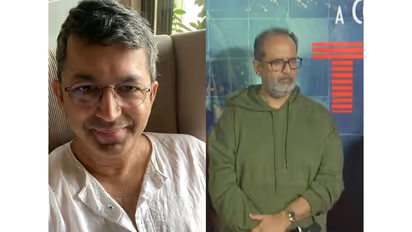
"Romance is always the same. It's the presentation that changes," ace filmmaker Kunal Kohli told ANI. Speaking about terms such as "situationship", he said, "These are just names. Earlier, situationship was called confused. People have not changed. Labels have changed."
Kunal Kohli, who directed the 2004 romantic comedy 'Hum Tum', said that in the attempt to appear modern, filmmakers may sometimes overlook innocence in storytelling. "In trying to be modern, we are losing innocence, which is not nice. But innocence never dies. It's just not being made. If 'Hum Tum' was remade exactly the same way today, it would still be a blockbuster," he said.
Director Kohli also added that Gen Z should not be over-analysed. "They are not some species from Mars. When we were 18, we didn't know what we wanted. Gen Z ko khud nahi pata kya chahiye. We never know what we really want. So we exaggerate and say Gen Z is like this or like that. Ultimately, everything is the same."
Furthermore, Filmmaker Aanand L Rai, known for love stories such as 'Raanjhanaa' and 'Tere Ishk Mein', said Gen Z experiences emotions as intensely as earlier generations, though they express them differently. "As filmmakers and writers, we are trying to understand exactly what this generation wants, what their definition of love is, and how they respond emotionally to situations," Rai said.
However, he asserted that Gen Z is "as sensitive as we are. They might have a different way of reacting, but the emotional quotient is the same. So, as makers and writers, we are trying to understand them better," Rai added.
Actors' Take: Redefining On-Screen Romance
Actor Taha Shah Badussha said Gen Z has not diminished romance but refined it. "Earlier, love was about proving something to the world. Today, it's about understanding yourself first. Grand gestures still matter, but now they must come from emotional clarity," he said.
For him, the shift is not about reducing intensity but about redefining it. "On screen, I see love becoming more layered. It's not just 'I can't live without you.' It's 'I choose you, even when I'm whole on my own.' That shift is powerful. It makes romance deeper, not smaller," he added.
Belonging to the 1990s generation, Badussha said he still believes in the "die-hard love" of that era. "Cinema must reflect this digital reality, the ghosting, the 'seen' messages, the curated personas, but without losing the timeless poetry of connection and flow. That sudden spark, that bouncing happiness, that magic. Because even in the age of swipes, when two people really fall in love... it still feels ancient. And that's the only kinda love I ever want," he said.
The 'Heeramandi' actor noted that Gen Z audiences connect more with flawed characters. "Flawed characters feel honest. Gen Z has grown up around filters and curated lives, so they instantly connect with what feels real. When characters are confused, guarded, or imperfect in love, it mirrors how relationships actually feel today. And when such characters still choose love, that choice feels more meaningful... because it's not coming from perfection, but from courage."
He added that Gen Z still seeks emotional depth. "Stories where love grows slowly, where emotional connection matters more than grand drama. Romance that allows space for healing, self-growth and timing," he added.
The Impact of Exposure and a Craving for Honesty
'Pyaar Ka Punchnama' actor Ishita Raj said exposure has significantly changed how romance is perceived. "In the '70s, '80s and '90s, we didn't have so much exposure, so everything was not that connected. That's why larger-than-life grandness canvas big songs in the snow in Switzerland looked unreal and looked dreamy, so the idea of love was dreamier because it was larger than life and people pursued that because that was not accessible. Now in today's time, because of social media, connectivity is more; everybody can be connected to anybody from any corner of the world through social media, so because of that, the exposure is too much. So dreamy is not as fascinating as real is fascinating," she said.
She also pointed out that patience in relationships has reduced over time. "Old school love had patience. If you liked someone, you pursued them. ..Today, the patience level has dropped... the genuineness sometimes feels missing, that's the reason attachments are becoming harder to develop in relations nowadays," she said.
According to Ishita, audiences today connect strongly with honest storytelling. "The reason the on-screen love where you see real emotion coming out, no matter if it's not grand gestures, if it's not great visuals, if it's not exotic, the canvas is not bigger, but still the story has a grip of communicating affection, love or any emotion in just true sense and in as real as you feel it, audiences connect to that one more. So that's the reason Gen Z is changing the idea of love on screen is because we're looking for more real things rather than more dreamy things," added Ishita.
Emphasising that love remains cinema's most powerful emotion, the 'Sonu Ke Titu Ki Sweety' actor added, "No matter how many thrillers or horrors you make, the legendary cult films remembered over time are romantic films. You see DDLJ, you see 'Darr,' you see 'Qayamat Se Qayamat Tak', 'Maine Pyar Kiya'... audiences connect to love the quickest."
"Any film that conveys emotion honestly and makes the audience feel it deeply, you have a blockbuster in hand. There is not one way to love. Love can be complicated, incomplete, timeless or tragic. But if it feels real, it works," Ishita said. (ANI)
(Except for the headline, this story has not been edited by Asianet Newsable English staff and is published from a syndicated feed.)