Director Kei Ishikawa discusses his Kazuo Ishiguro adaptation at IFFI
Synopsis
At the 56th IFFI, Japanese director Kei Ishikawa discussed his film 'A Pale View of Hills,' an adaptation of Kazuo Ishiguro's novel. He shared his experience of telling a post-war story and the collaborative process behind the film's ending.
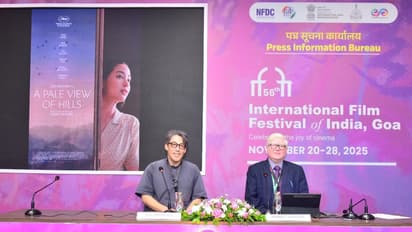
Japanese director Kei Ishikawa spoke about his second directorial work, 'A Pale View of Hills', which was screened this year at the 56th International Film Festival of India (IFFI) in Goa as part of the 'Country Focus: Japan' section.
The 'Country Focus: Japan' spans an exceptional spectrum of genres ranging from intimate dramas that explore memory, identity, and belonging, to historical epics, psychological thrillers, children's narratives, and abstract, non-linear experiments that challenge and expand the boundaries of cinematic form, as per the press release shared by the Ministry of Information and Broadcasting.
Director on tackling post-war narratives
While opening up about his visit to India and the idea behind his project, he noted, "This is my first visit to India, and I have truly enjoyed the experience. The film is based on the Nobel Prize-winning author Kazuo Ishiguro's 1982 novel of the same name. This year, many Japanese films are exploring this subject, as it marks 80 years since the end of the Second World War. I, too, have always wanted to speak about this topic, but I found it challenging to find the right language, since I did not experience that period firsthand. When I discovered this novel, the subject became much more accessible to me, and it gave me the confidence to tell this story."
Unraveling post-war memories
The plot follows a young Japanese-British aspiring writer who attempts to reconstruct her mother Etsuko's post-war Nagasaki memories. Etsuko, still haunted by the suicide of her older daughter, recalls 1952 when she was a pregnant young mother. Her recollections centre on Sachiko, a woman planning a new life abroad with her daughter Mariko, whose unsettling memories hint at deeper trauma. As the writer pieces together fragments and mementos, she uncovers disturbing inconsistencies between Etsuko's recollections and the reality they suggest.
Creative process and thematic focus
He shared that what drew him to this story was that it is not only about the atomic bomb, but also about women across different eras. He explained that he chose to write the script himself and also edited the film, as he considers editing to be the final stage of the writing process, as per the press release shared by the Ministry of Information and Broadcasting.
A collaborative ending: Balancing cultural perspectives
He went on explaining that the team had to balance the perspectives of three countries Japan, the UK, and Poland, while determining the most suitable ending for the film. Each brought a different sensibility: the British producers preferred a clearer, more defined conclusion, while the Polish producers felt that too much explanation would dilute the impact. The Japanese perspective lay somewhere in between. He shared that he truly enjoyed this collaborative process and the extensive discussions that ultimately led to the movie's proper ending, as per the press release.