Union Budget must back mineral processing, recycling: Deloitte India
Synopsis
Deloitte India noted the upcoming Union Budget should expand focus beyond exploration to support processing and recycling of critical minerals, along with risk-mitigation for overseas assets to achieve self-sufficiency and reduce import reliance.
The upcoming Union Budget should expand its focus beyond exploration and mining to include targeted support for processing and recycling of critical minerals and rare earths, along with risk-mitigation mechanisms for overseas mineral assets to achieve self-sufficiency and stem reliance on imports, noted Deloitte India.
Expanding Focus for Critical Mineral Self-Sufficiency
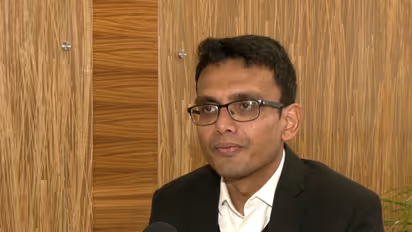
Speaking with ANI, Deloitte India Partner Anish Mandal said, "What could be allocated now is also a particular fund around processing of these minerals, or recycling of these minerals from spent magnets." He added, "Similarly, recycling of lithium and nickel is something that could be looked at, and budgetary support around that would be something industry is expecting."
Mandal also highlighted the need for government support to help Indian companies acquire mineral assets overseas, particularly in jurisdictions with higher political or operational risk. While Khanij Bidesh India Ltd (KABIL) has been set up to facilitate overseas sourcing of critical minerals under a government-to-government framework, Mandal said additional risk-mitigation mechanisms could be considered. "There could be schemes or budgetary support around things like insurance funds, especially in cases of force majeure or political unrest," he said, adding that such frameworks would encourage Indian companies to invest in overseas mines.
Building on Existing Government Initiatives
He said that the recent government initiatives such as the National Critical Minerals Mission (NCMM) and the Rare Earths Mission were positive first steps, but stressed that the next phase of budgetary support must focus on end-to-end value chain development, including downstream processing and recycling.
The government has announced an allocation of Rs 7,820 crore for the Rare Earths Mission, while the National Critical Minerals Mission has been provided around Rs 5,000 crore, Mandal noted. These allocations, he said, have been welcomed by industry, particularly for strengthening domestic capabilities in exploration and mine development. However, he cautioned that without parallel investments in processing and recycling infrastructure, India risks remaining dependent on external supply chains. Mandal added that recycling of rare earth magnets and battery materials is becoming increasingly important globally, both from a supply-security and sustainability perspective, and India should embed this into its budget planning.
Catalysing the Broader Energy Transition
Beyond critical minerals, Mandal placed India's broader budget priorities in the context of the energy transition, where public funding plays a catalytic role in mobilising private capital.
Referring to the power sector, Mandal said that overall budgetary support in the last Union Budget was around Rs 1 trillion, which he described as the current benchmark for public funding. "Anything more than or equivalent to Rs1 trillion is a welcome step," Mandal said, adding that while the majority of investment would come from the private sector, public spending remains critical to crowd in capital across clean energy, transmission, and storage.
He linked this need for sustained public support to India's long-term energy and climate commitments, including its pledge to achieve net zero emissions by 2070. According to estimates cited during the discussion, India's energy transition could require USD 14-16 trillion in cumulative investment by 2070, translating into USD 300-350 billion of investment annually. Mandal stressed that while these figures represent total investment needs, budgetary support plays a foundational role in enabling scale.
Role of R&D and Innovation
He also welcomed the government's recently announced Rs1 lakh crore Research, Development and Innovation (RDI) Fund, describing it as an important enabler for next-generation energy technologies. "The technology for the future is very different from what we have today," Mandal said. "Any spend on R&D and associated infrastructure is a welcome move from an industry perspective."
As India prepares for the next Union Budget, Mandal said clarity on execution, value-chain integration and risk-sharing mechanisms would be as important as headline allocation numbers, particularly in strategic sectors such as critical minerals and clean energy. (ANI)
(Except for the headline, this story has not been edited by Asianet Newsable English staff and is published from a syndicated feed.)Stay updated with all the latest Business NewsShare Market NewsIPOsGold PriceDA Hike8th Pay CommissionAsianet News Official App