Robotics set to expand beyond surgery in medicine, says Jitendra Singh
Synopsis
Robotics is set to expand beyond surgical procedures into diagnostics, treatment and therapy, Union Minister Jitendra Singh said. He added that robotics, along with AI, will create a larger ecosystem for precision health and medicine delivery.
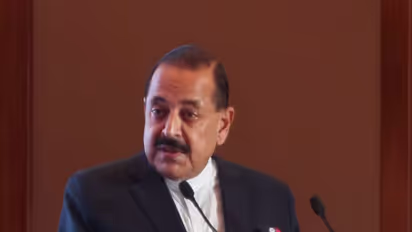
Robotics is set to expand beyond surgical procedures and become an increasingly important tool across different medical specialities, including diagnostics, treatment and therapy, Union Minister of State for Science and Technology Jitendra Singh said on Friday.
Addressing the inaugural session of the International Conference of the Society of Robotic Surgery, Singh said robotics, along with AI and nanoscience, would create a larger ecosystem for precision health delivery and precision medicine. He said robotics should not be viewed as a technology limited to surgery and would increasingly find applications across different branches of medicine. “It’s a tool. It will happen everywhere,” Singh said, adding that while the current focus is on robotic surgery, the future could see the emergence of robotic medicine, robotic endocrinology and robotic cardiology, similar to the expanding use of AI across medical specialities.
Precision Medicine and Advanced Technologies
The Minister said medicine is entering a new phase driven by technologies such as AI, biotechnology, nuclear medicine, quantum technologies, nanomedicine and robotics. He said precision medicine would increasingly require treatment to be tailored to individual patients, even when they are diagnosed with the same disease. Genetic profile, environmental conditions, lifestyle and dietary patterns could increasingly influence medical decision-making, he added.
Referring to the Genome India Programme, Singh said 10,000 individuals have already been sequenced and expressed hope that India could eventually move towards gene sequencing for every newborn. He said carrying out genetic sequencing on a population of 1.4 billion would require the optimal use of AI and robotics.
The Role of Nanomedicine
Singh also highlighted the potential of nanomedicine in addressing healthcare challenges. Referring to efforts towards developing oral insulin, he said advances at the nano level could help overcome some limitations associated with conventional drug delivery and create new possibilities for treatment.
Improving Access with Tele-robotics
The Minister also highlighted the potential of tele-robotics in improving access to specialist healthcare, particularly in a country as geographically diverse as India. Sharing his experience with robotic ultrasonography, Singh said he had performed an ultrasound on a person located 10,000 kilometres away in Antarctica, demonstrating the possibilities of remotely enabled medical technologies.
“Instead of the patient being referred to the doctor, it will be the doctor being referred to the patient,” he said.
Singh said tele-robotics could allow specialist expertise to reach patients across geographical boundaries, reducing the need for patients to travel to specialists for advanced medical care.
Addressing India's Changing Disease Profile
He also pointed to India's changing disease profile, where infectious diseases continue to coexist with metabolic and lifestyle-related disorders. Diseases traditionally associated with later stages of life are increasingly being seen among younger people, he said.
The Minister said India's scale and diversity make technologies such as AI, robotics and tele-robotics particularly relevant for healthcare delivery and could support the transition towards more precise and personalised medicine. (ANI)
(Except for the headline, this story has not been edited by Asianet Newsable English staff and is published from a syndicated feed.)Stay updated with all the latest Business NewsShare Market NewsIPOsGold PriceDA Hike8th Pay CommissionAsianet News Official App