Pune Metro Phase-2 gets green light for Line 4 and 4A expansion
Synopsis
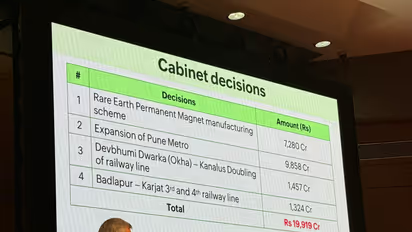
The Union Cabinet approved Pune Metro's Line 4 (Kharadi-Khadakwasla) and 4A (Nal Stop-Warje) under Phase-2. The 31.6 km project, with 28 stations, will cost Rs 9,857.85 crore and aims to enhance connectivity across Pune's key areas.
Pune is set for another significant boost in its public transport network as the Union Cabinet on Wednesday approved Line 4 (Kharadi-Hadapsar-Swargate-Khadakwasla) and Line 4A (Nal Stop-Warje-Manik Baug) under Phase-2 of the Pune Metro Rail Project. This is the second major project approved under Phase 2, following the sanction of Line 2A (Vanaz-Chandani Chowk) and Line 2B (Ramwadi-Wagholi/Vitthalwadi). The Union Cabinet was chaired by Prime Minister Narendra Modi.
Project Scope and Funding
Together spanning 31.636 km with 28 elevated stations, Line 4 and 4A will connect IT hubs, commercial zones, educational institutions, and residential clusters across East, South, and West Pune. The project will be completed within five years at an estimated cost of Rs 9,857.85 crore, to be jointly funded by the Government of India, the Government of Maharashtra, and external bilateral/multilateral funding agencies, as per a government statement.
Integration and Connectivity
These lines are a vital part of Pune's Comprehensive Mobility Plan (CMP) and will seamlessly integrate with operational and sanctioned corridors at Kharadi Bypass & Nal Stop (Line 2), and Swargate(Line 1). They will also provide an interchange at Hadapsar Railway Station and connect with future corridors towards Loni Kalbhor and Saswad Road, ensuring smooth multimodal connectivity across metro, rail, and bus networks.
Key Corridors and Impact on Congestion
From Kharadi IT Park to Khadakwasla's scenic tourist belt, and from Hadapsar's industrial hub to Warje's residential clusters, Line 4 and 4A will knit together diverse neighbourhoods. Traversing Solapur Road, Magarpatta Road, Sinhagad Road, Karve Road, and the Mumbai-Bengaluru Highway, the project will ease congestion on Pune's busiest routes while improving safety and promoting green, sustainable mobility.
Projected Ridership Growth
According to projections, the combined daily ridership on Lines 4 and 4A is expected to be 4.09 lakh in 2028, rising to nearly 7 lakh in 2038, 9.63 lakh in 2048, and over 11.7 lakh in 2058. Of this, the Kharadi-Khadakwasla corridor will account for 3.23 lakh passengers in 2028, growing to 9.33 lakh by 2058, while the Nal Stop-Warje-Manik Baug spur line will rise from 85,555 to 2.41 lakh passengers over the same period. These projections highlight the significant growth in ridership expected on Line 4 and 4A over the coming decades.
Implementation Details
"The project will be implemented by Maharashtra Metro Rail Corporation Limited (Maha-Metro), which will carry out all civil, electrical, mechanical, and systems works. Pre-construction activities such as topographical surveys and detailed design consultancy are already underway," the statement read.
A Greener, More Connected Future for Pune
With this latest approval, Pune Metro's network will expand beyond the 100 km milestone, a significant step in the city's journey towards a modern, integrated, and sustainable urban transit system. With Line 4 and 4A, Pune will not just get more metro tracks, it will gain a faster, greener, and more connected future. These corridors are designed to save commuters hours of commuting time, reduce traffic congestion, and provide citizens with a safe, reliable, and affordable alternative. In the years ahead, they will emerge as the true lifelines of Pune, reshaping urban mobility and redefining the city's growth story. (ANI)
(Except for the headline, this story has not been edited by Asianet Newsable English staff and is published from a syndicated feed.)
Stay updated with all the latest Business NewsShare Market NewsIPOsGold PriceDA Hike8th Pay CommissionAsianet News Official App