India's proactive diplomacy key in riding out Hormuz energy crisis
Synopsis
India successfully rode the energy crisis from the Strait of Hormuz closure without consumer rationing. Experts credit proactive energy diplomacy, diversifying supplies, and a special relationship with the UAE for ensuring stability and averting shortages.
After nearly four months of conflict, a tenous peace deal between Iran and the United States has seen the crucial energy chokepoint of the Strait of Hormuz open to sea traffic. Oil tankers and other vessels with critical Oil supplies are now transiting freely through the Strait. India, which is largely dependent on energy imports, was able to ride the crisis successfully without any emergent measures imposed on the people.
On March 23, Prime Minister Narendra Modi told Parliament that the closure of the Strait of Hormuz is unacceptable, a statement he would echo on the world stage. When the United States told the world that they need to fend for themselves, India secured bilateral passage through direct diplomacy.
Proactive Energy Diplomacy
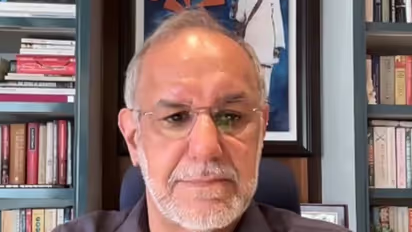
Navdeep Suri, former Indian Envoy to the UAE, says that India was able to pivot towards non-traditional energy suppliers even as the traditional ones were strengthened during this period, showcasing proactive energy diplomacy. "I was very pleased to see that during the visit of Prime Minister Modi to Abu Dhabi on the 15th of May, one of the important takeaways was an agreement with Abu Dhabi National Oil Company (ADNOC) to grow our strategic petroleum reserves to 30 million barrels. I mean, I was the ambassador in UAE when the strategic petroleum reserves agreement was first signed and we started establishing those in partnership with ADNOC in 2018. But now we've come to the stage where we need to grow this and I'm very happy that again ADNOC is going to be a proactive partner in this. But it wasn't just the issue of strategic petroleum reserves, I think it's also some really proactive energy diplomacy that was pursued by the government at a very critical juncture. I've said this almost three months back in the course of an interview that in a sense we are lucky that we have a seasoned accomplished diplomat at the helm of the Ministry of Petroleum and Natural Gas because not only does he have a very nuts and bolts understanding of energy flows and trade flows, but he's also got a global network of relationships. And he's been able to put these into play to pivot us towards non-traditional energy suppliers," he told ANI.
Special India-UAE Partnership
Suri says India's special relationship with the UAE worked to an advantage in ensuring that critical energy supplies would be maintained. "I was in Abu Dhabi a couple of weeks back for a book that I'm writing on India-UAE relations and it was quite interesting to hear from senior Emirati officials about midnight conversations taking place between Minister Hardeep Puri and Dr. Sultan Al Jaber who is the chief executive officer of ADNOC and how this feeling of real trust and confidence that has been established by the two sides meant that you could pick up the phone call somebody even at midnight and with the confidence that he would respond. And the other interesting thing that I heard was how ADNOC very quietly without any publicity actually took risks to send much needed cargoes to us knowing that if things go wrong they could be under attack from Iranian drones and so on. "But I think that's one of those special situations where friends are recognized from just the casual sort of partnerships that we may have. And I think what India and UAE demonstrated during the last four months and including through Prime Minister Modi's visit right in the middle of the crisis that it's truly a partnership that we can both be proud of. It wasn't just the UAE supplying us critical LPG cargoes and crude oil and gas but it was also us creating an air bridge virtually and a sea bridge to make sure that there was no shortage of essential foodstuffs and toiletries and medicines and the supermarkets in UAE also remained well stocked throughout this period. So it's really a very strong bilateral relationship," Suri said.
India's Resilience vs Global Struggles
During the four-month long conflict several countries took emergent measures to overcome the enegry crisis they faced. Sri Lanka ordererd mandatory petrol rationing, a four-day government week and Wednesday closures for schools and state offices. South Korea imposed fuel price caps for the first time in three decades, the Philippines shortened the working week and imposed price controls, while in the United Kingdom the prices of petrol went up and household energy bills rose.
India on the other hand saw no consumer rationing, no fuel holiday, no shortened week, no school closures and no driving curbs. Household cylinders and pumps were supplied throughout the period with the smallest price rise of any major economy and among the first to normalise the same.
"You have countries which have had to go on a four-day week, you had countries that had to shut down their schools like Pakistan, you had a situation in Bangladesh where they actually had to deploy military personnel at gas stations to make sure that there's no law and order issue. So when you compare with them you can see that yes we had minor instances of migrant workers for example facing shortages in the initial stages and some panic buying and queues but by and large and I live in Amritsar and I can tell you from my personal experience that there wasn't a single day that you could say that there was a gas station without supplies. There was one particular day when there was a bit of a panic and there were long queues but by and large things remain under control. And yes initially migrant workers did face a problem and I think it took the government a couple of days to move rapidly and address their peculiar requirements. And so I think there will be lessons from India in terms of how we've managed a difficult situation with a lot of competence being demonstrated and almost in some cases a whole of government approach because you also had the Ministry of External Affairs, the Prime Minister's Office, the National Security Advisor's Office in some cases and others who were involved at one step or the other," Navdeep Suri told ANI.
Future Strategy: Diversifying Supply Routes
Suri says that in the future, countries will need to reduce their dependence on the Strait of Hormuz, while India will continue its strategy of diversifying its supply routes. "Countries like UAE and Saudi Arabia have recognized that they must reduce their dependence on the Strait of Hormuz. So both UAE which has an outlet at Fujairah which is outside the Strait of Hormuz has announced that it's doubling its pipeline capacity from the current 1.7 million barrels a day to about 3.5 million barrels a day to make sure that the bulk of its oil crude supplies are not impacted even by a closure of the Strait of Hormuz. The Saudis again have an outlet at Yanbu which is on the Red Sea and they again are doubling down on expanding capacity. So you're seeing an effort by some of the Gulf countries that have the possibility to do so to reduce their dependence on the Strait of Hormuz. But you're also seeing parallel efforts by India which is such a major consumer, the third largest in the world, to diversify its supplies. And I think one of the remarkable things to me in terms of our energy diplomacy over the last year in particular is the way we first pivoted towards Russia and started getting large amounts of crude oil and gas from Russia, in fact for some time it became our largest supplier of both oil and gas, and then pivoted to the US when the Gulf was closed. And I don't think many countries in the world have that latitude that you can pivot to Russia on one year and to the US in the second year even while you are exploring new markets," he said
"It's not a coincidence that we had the leaders of Venezuela, the acting president, visit India, you had the prime minister from Gabon... these are oil rich countries and you can see energy diplomacy at play in the way we have reached out to not just major producers like Venezuela or Nigeria but also to lesser ones like Gabon and Equatorial Guinea and Guyana and others across Africa and Latin America...India in its energy diplomacy is going to be a beneficiary because of our close relationship with UAE. And that's why I think one of the things you saw during the Prime Minister's visit was UAE also signing up a long-term contract with Indian Oil for supply of LPG. And I think so these are some of the trends that I witness, doubling down on countries that are closest to you. I think Iran coming into the market will again be a very interesting development for us in terms of our energy security," Navdeep Suri added.
India's layered, consumer-first response during the crisis, combined with a sharp lift in domestic production, an excise cushion on petrol and diesel, aggressive supply diversification and energy diplomacy, and a whole-of-government demand-management effort, saw it ride the crisis effectively. (ANI)
(Except for the headline, this story has not been edited by Asianet Newsable English staff and is published from a syndicated feed.)Stay updated with all the latest Business NewsShare Market NewsIPOsGold PriceDA Hike8th Pay CommissionAsianet News Official App