Indian economy set for robust growth, stronger markets after May 1: WTC
Synopsis
MVIRDC WTC Chairman Vijay G Kalantri says the Indian economy will enter a robust growth phase after May 1 due to easing global energy prices and geopolitical tensions. He notes strong corporate results and healthy fundamental indicators for expansion.
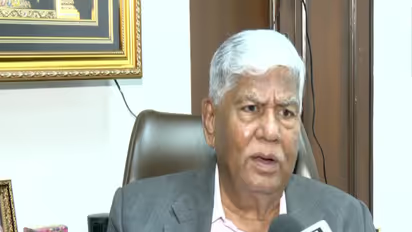
The Indian economy is set to enter a phase of robust growth, stronger markets, and increased employment after May 1 as global energy volatility subsides and geopolitical tensions show signs of diffusing, according to Chairman of the MVIRDC World Trade Center Vijay G Kalantri.
Economic Fundamentals and Positive Outlook
Speaking to ANI, Kalantri, who is also President, All India Association of Industries (AlAl), noted that despite the pressures of a global war zone and temporary supply shortages, the country's fundamental indicators remain healthy. He observed that corporate quarterly results are strong, providing a resilient base for upcoming expansion.
"Fundamentals are strong. And I feel that some hiccups came because of the gas shortage, oil and gas problem. But I think that it will not happen. I think after May 1, we will see good market, good economy, and growth. We will also see better employment and exports," Kalantri said.
Easing Global Energy Prices
According to him, global oil prices already show a downward trend, falling below USD 95, while gas prices drop near USD 12. With the OPEC cartel lifting production restrictions, the industrialist anticipates oil prices will slide further to the USD 70 or USD 80 range within the next month, returning to normalcy.
On West Asia Conflict and India-Iran Relations
Regarding the ongoing West Asia conflict and the ceasefire, Kalantri stated that the dialogue process between major powers remains the only path forward. He emphasized that both sides recognize destruction yields no results, even as discussions involve sensitive issues like nuclear capabilities and raw materials.
"Destruction is not the answer to the war. You [US] are saying they [Iran] will not make nuclear [weapons]. They're [Iran] saying we are not making nuclear [weapons]. There is no proof. They have uranium, that's true. They have raw material, but it's natural. So now they [US] are saying you [Iran] will not use the raw material. They [Iran] are saying, okay, we will not use it for destruction purposes, but for the use of power and other things for our consumption, they [Iran] can use it," Kalantri explained.
Speaking about the safe passage of India oil ships from Iran, Kalantri stated that India has good relations with Iran and with the ongoing war, economics and politics should be kept separate and not mixed with each other. "Strait of Hormuz is not as straight as it looks. But we feel that Iran will allow the passage for Indian ships. What one or two episodes happened, let's not go by that. But we have good relations with US, Israel, as well as Iran. And we have been buying oil from Iran. We have been supplying various goods to Iran, pharma and all. We had about USD 20-30 billion trade with them on energy, you know. The sanctions have to go. See, in politics, economics will not come. Economics and politics will be separate and not mixed with each other," he said.
Call to Finalise US-India Trade Agreement
On the subject of the US-India Bilateral Trade Agreement (BTA), Kalantri indicated that the draft has already been discussed and remains on the table for both nations. He urged for the swift signing of the agreement to move past existing trade irritants, noting that the United States remains India's largest trading partner. "As it is, USA is our biggest trading partner and investor in India. So let's move forward with the intention of doing business together and with a clear mind rather than having some hiccups or irritants in the way," he said.
Boosting Domestic Capacity and Energy Policy
Highlighting the domestic capabilities of India, the industrialist mentioned the country's capacity-building efforts through "Make in India" and energy efficiency projects. "See, we are going into solar. We were thinking of 500 gigawatts. We already achieved 250 gigawatts. In cars as well, we are achieving success. Now we are going towards EV. Same thing, energy efficiency projects will come up. Same thing, we should now explore our own energy. Wherever we have explored in Rajasthan, in various other parts, we've been able to get energy. Now, our Prime Minister has come out with an energy policy. We have come out with a rare earth policy. So I think all this will lead towards the future," he said.
The Path Forward: Deregulation and Governance
Steel production capacity is currently rising from 140 million tons toward a target of 180 million tons. Kalantri noted that achieving these goals requires a shift in how the government interacts with the private sector. "The Indian government will have to tighten their belt, reduce regulatory powers, reduce the bureaucracy and allow the industry to flourish. And really the government's slogan of minimum government better governance, should be put into practice in letter and spirit," Kalantri stated. (ANI)
(Except for the headline, this story has not been edited by Asianet Newsable English staff and is published from a syndicated feed.)Stay updated with all the latest Business NewsShare Market NewsIPOsGold PriceDA Hike8th Pay CommissionAsianet News Official App