India's economic resilience built on fiscal prudence, reforms: Sitharaman
Synopsis
Union FM Nirmala Sitharaman said India's economic resilience is built on a decade of fiscal prudence, infra creation, and reforms. She highlighted the ability to absorb shocks without derailing growth, citing stable inflation and banking sector.
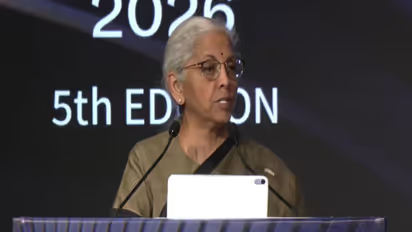
Addressing the 5th Kautilya Economic Conclave, Sitharaman said resilience meant the ability to absorb shocks without losing the growth path and retaining sufficient policy space to respond to future disruptions. “The evidence of resilience lies largely in the counterfactual, in the outcomes that did not materialise: an inflation spiral that did not take hold, queues that did not form at fuel outlets, banking stress that did not surface and a fiscal correction that was never forced,” she said.
Economic Fundamentals Remain Intact
Referring to Kautilya's Arthashastra, Sitharaman cited the principle “kosha-purvah sarva-arambhah”, meaning all undertakings depend first on the treasury, and said sound public finances provide the State with the freedom to act when economic conditions deteriorate. She said India had navigated the shocks of the past four years with its fundamentals intact, citing 7.8 per cent real GDP growth in Q1 FY27, CPI inflation of 4.82 per cent in August 2026, a current account deficit of 0.5 per cent of GDP in Q1 and foreign exchange reserves of about USD 766 billion.
Pillars of Resilience Built Since 2014
Listing the foundations of resilience built since 2014, the Finance Minister highlighted the Jan Dhan-Aadhaar-Mobile trinity and Direct Benefit Transfer, along with initiatives such as PM Awas Yojana, Swachh Bharat, Ujjwala, Ayushman Bharat and food security measures. She also pointed to more than 52 crore collateral-free loans sanctioned under PM MUDRA Yojana, banking-sector reforms and an 18.8 per cent growth in non-food credit in the year to August 2026.
Focus on Infrastructure Development
On infrastructure development, Sitharaman said capital expenditure for FY27 had been budgeted at Rs 12.22 lakh crore. She added that the national highway network had expanded by about 61 per cent and the number of operational airports had more than doubled since 2014.
Looking Ahead: Strategic Priorities
Looking ahead, Sitharaman identified strategic resource security, open and predictable global trade, skill development and increased private investment in research and innovation as key priorities. She said India must reduce fragile single-source dependencies through initiatives including the National Critical Mineral Mission, Rare Earth Corridors, India Semiconductor Mission 2.0 and development of small modular reactors.
“Resilience is not a one-time exercise,” Sitharaman said, adding that India must continue strengthening its foundations to achieve higher productivity, better employment and wider opportunity on the path towards Viksit Bharat by 2047. (ANI)
Stay updated with all the latest Business NewsShare Market NewsIPOsGold PriceDA Hike8th Pay CommissionAsianet News Official App