India's AI boom needs more green power, warns Union Minister
Synopsis
Union Minister Jitin Prasada warned that green power generation is not keeping pace with AI's rapid growth. He said India is rolling out a data centre policy but must ensure that the expansion does not increase electricity costs for consumers.
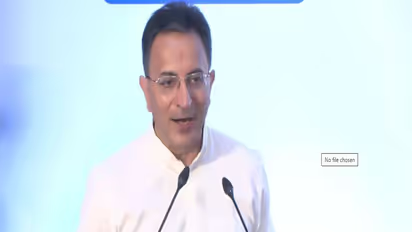
Union Minister of State for Electronics and Information Technology Jitin Prasada on Wednesday warned that green power generation was not keeping pace with the rapid growth of artificial intelligence (AI) and related technologies, highlighting the need to strengthen electricity infrastructure as India prepares to roll out a policy for data centres.
Addressing the Central Electricity Authority's (CEA) Brainstorming Conclave on 'Making Indian Power Sector AI Enabled', Prasada said the growing demand for computing capacity and data centres would require a corresponding increase in electricity supply. "The technology is moving faster, but power generation, especially green power, is not moving as fast as the requirements that are going to come in the future," he said.
Data Centre Policy and Consumer Impact
Highlighting the government's plans to support AI infrastructure, the minister said India was preparing to introduce a policy for data centres. "We are rolling out a policy for data centers because we think India is a very fertile ground for hyperscaler data centers," Prasada said. However, he cautioned that the expansion of energy-intensive data centres should not increase electricity costs for ordinary consumers. "In some countries, the data centers are taking away the power used by consumers. So what happens there, the consumers have to pay more for the power. So we don't want to get into that," he said.
The remarks come as India's push to expand AI infrastructure raises questions about electricity availability and the need to balance growing industrial demand with affordable power for households.
Green Power as a Competitive Edge
Prasada also said access to green electricity would play an important role in determining where future AI investments are made. "Whichever country has green power generation, that country will have the edge over these technologies," he said.
Expressing confidence in India's potential, the minister said, "India is very well placed. We are going to ramp up production."
Push for Domestic Self-Reliance
He also stressed the need to strengthen India's domestic semiconductor ecosystem to reduce dependence on foreign suppliers, while continuing to collaborate with other countries.
The minister said building domestic capabilities was particularly important amid global uncertainties and supply-chain disruptions, citing the shortage of semiconductor chips during the COVID-19 pandemic that affected automobile production. His remarks highlight the challenge of expanding India's AI infrastructure while ensuring adequate electricity supply and protecting consumers from higher power costs.
Stay updated with all the latest Business NewsShare Market NewsIPOsGold PriceDA Hike8th Pay CommissionAsianet News Official App