India on track for 500 GW renewable energy goal by 2030: Pralhad Joshi
Synopsis
Union Minister Pralhad Joshi expressed firm confidence that India is on track to achieve its 500 GW renewable energy target by 2030, stating that the government is addressing transmission and manufacturing hurdles to meet the deadline.
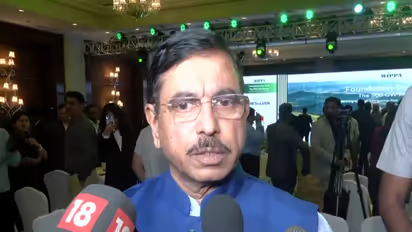
Union Minister of New and Renewable Energy Pralhad Joshi on Wednesday expressed firm confidence that India remains on track to achieve its ambitious target of 500 gigawatts (GW) of renewable energy capacity by 2030. Speaking to the media on the sidelines of the Wind Independent Power Producers Association (WIPPA) Foundation Day 2026, the minister emphasised that the government is systematically addressing transmission and manufacturing hurdles to ensure the deadline is met.
The minister noted that the country has already reached a significant milestone of 272 GW through non-fossil sources. He highlighted that the expansion of the national grid and financial support mechanisms are playing a central role in this growth.
"If you go in the same direction and whatever the amendment brought in the small atomic reactors in the recent past altogether, as far as clean energy is concerned, our target of 500 GW, we're going to achieve it by 2030 and I'm very confident on that," the minister added.
"As far as the target is concerned, it is an ambitious target. We are quite on track. Our transmission capacity is also continuously increasing under the leadership of Prime Minister Narendra Modi. We are providing funds for the transmission and also for the PLI, for the manufacturing. Along with that, the ease of doing policy, overall capacity addition, now it is, all put together, we have reached 272 GW through non-fossil sources," Joshi said.
Recent Green Energy Additions
The current financial year has seen substantial additions to the green energy portfolio. According to the minister, wind energy additions for 2025-26 reached 6.05 GW, while total renewable additions for the same period stood at approximately 45 GW.
Geopolitical Situation an 'Opportunity'
The minister further categorised the current global geopolitical situation as an opportunity for the domestic energy sector. He mentioned that the availability of natural resources like sunlight, wind, and water allows India to generate power domestically without relying on external energy imports.
"Regarding the current geopolitical issue, I feel, as far as my ministry is concerned, it is an opportunity for us. Because we can, whatever energy we can generate, this can be generated domestically because sunlight is here, wind is here, water is here. So, we need not import anything," he stated.
Challenges in Domestic Manufacturing
Touching upon the manufacturing of solar cells, the minister noted that while imports are currently more economical, the domestic industry is expected to reach a surplus state similar to other sectors.
"Whatever concerns are there, we are talking to them because ultimately, industry and government as such, ministry as such, together, only we should work. We are talking to them. There are diverse opinions. That's what I'm explaining. Some people are saying that it should be done in June. And some people are telling a phased manner," the minister added. (ANI)
(Except for the headline, this story has not been edited by Asianet Newsable English staff and is published from a syndicated feed.)Stay updated with all the latest Business NewsShare Market NewsIPOsGold PriceDA Hike8th Pay CommissionAsianet News Official App