Hydraulic failure caused Air India A320's 300-foot drop: Probe
Synopsis
An Air India Airbus A320 from Phuket to Delhi dropped 300 feet after a temporary loss of hydraulic pressure. The incident on Aug 4, 2026, caused injuries to 24 people. Airbus has issued technical recommendations for a full investigation.
As investigation continue into the sudden 300-foot altitude drop on an Air India Airbus A320 aircraft from Phuket to Delhi on August 4, 2026, official sources said that a temporary loss of hydraulic pressure was the primary factor behind the incident.
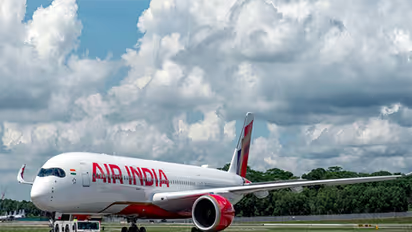
The technical evaluation followed the decoding of the flight data recorder from Air India flight AI2379, an Airbus A320 aircraft with MSN 08470 and registration VT-EXO. The aircraft experienced the sudden loss of altitude while operating from Phuket to Delhi on August 4, 2026, before the crew recovered control and completed a safe landing in Delhi.
Technical Breakdown of the Failure
According to the preliminary findings, the aircraft temporarily lost hydraulic pressure sequentially across its Green, Blue, and Yellow systems. These hydraulic lines power the primary flight controls of the airframe, including the elevators that control pitch attitude, the ailerons that manage roll, and the spoilers. The official sources noted that the elevators and ailerons became unavailable for roughly four seconds following the pressure loss. During this brief window, the pitch attitude changed unexpectedly, the autopilot disconnected, and the plane dropped altitude before the systems recovered and the pilots regained manual command.
Airbus's Assessment and Recommendations
In its technical assessment, Airbus stated that the event reflected mechanical control responses rather than an electronic system glitch. "This behaviour matches what happens when hydraulic pressure is lost," Airbus said, noting that the flight control surfaces entered a damping mode during the drop. Airbus does not see a primary flight control computer fault; the problem appears to stem from the hydraulic side.
As per the official sources, Airbus submitted technical recommendations to Air India. The planemaker asked the airline to run a series of operational tests on the Green, Yellow, and Blue hydraulic systems, pressure switches, and transducers. It further directed the carrier to remove and check specific pressure transducers and leak-measurement switches. Airbus also requested Air India to provide the recent maintenance history of the hydraulic systems, alongside detailed data records from the flight guidance and flight augmentation computers covering the exact timeframe of the incident. Additionally, the manufacturer recommended comprehensive structural inspections because the sudden manoeuvre generated high loads on the airframe, alongside clearer reports from the flight crew regarding what they observed and felt during the incident.
Ongoing Investigation and Impact
Sources noted that a full investigation covering systems and structural integrity remained complex and would take longer than a normal aircraft-on-ground technical evaluation.
The flight was carrying 137 passengers, including three infants, alongside eight crew members comprising two pilots and six cabin crew. The sudden movement over Odisha resulted in injuries to 20 passengers and four cabin crew members. (ANI)
Stay updated with all the latest Business NewsShare Market NewsIPOsGold PriceDA Hike8th Pay CommissionAsianet News Official App