India's coal demand to hit 1.6B tonnes by 2030, coal exchange eyed
Synopsis
India's coal demand is expected to reach 1.6 billion tonnes by 2030. As the nation moves from scarcity to surplus, the government plans a coal exchange for efficient, market-driven trading, said Coal Secretary Vikram Dev Dutt in Mumbai.
India's coal demand is projected to rise to around 1.6 billion tonnes by 2030, prompting a shift towards more efficient and market-driven mechanisms for coal trading as the country moves from a scarcity to a surplus scenario, Coal Secretary Vikram Dev Dutt said on Friday.
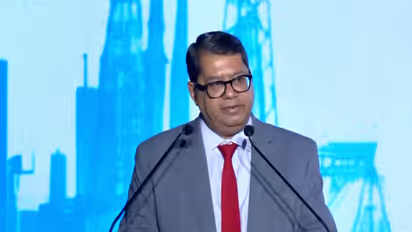
Speaking at the Global Commodity Conclave 2026 in Mumbai, Dutt said the coal exchange would create a transparent marketplace for buyers and sellers and eventually lay the foundation for a coal derivatives market.
Production Milestone and Self-Reliance
"Coal demand is projected to rise further to an estimated 1.6 billion tonnes by 2030, and under this situation, where the country has moved from a scarcity scenario to a surplus scenario, a shift that underscores the need for more efficient, transparent and market-driven mechanisms for coal trade," he said. The secretary said domestic coal production crossed 1 billion tonnes for the first time in 2024-25 and remained above that level for a second consecutive year in 2025-26. He said the achievement reflected India's growing self-reliance in energy and its ability to ensure an uninterrupted fuel supply.
A New Market-Driven Trading Platform
Against this backdrop, the government is seeking to move beyond the existing one-to-many sales model towards a many-to-many trading platform through the coal exchange. The exchange will allow buyers and sellers to bid simultaneously, enabling competitive price discovery and bringing multiple coal sales channels into a standardised trading framework, he said.
It will also give commercial and captive coal miners access to a wider market and allow consumers to source coal from multiple domestic producers, reducing dependence on a single supplier.
"Coal exchanges will also allow the exchange to function as a central counterparty for clearing and settlement, thereby improving risk management for both buyers and sellers," the secretary said.
The platform could also make it easier for buyers to meet unplanned or short-term coal requirements, he added.
Future Roadmap and Broader Reforms
Going forward, Dutt said the coal exchange could eventually support the development of a derivatives market, allowing producers and consumers to manage price risks.
"This will also lay the foundation for the development of a coal derivatives market in India at the right point of time," he said, adding that coal could become an active part of the convergence between physical and financial commodity markets.
The secretary said the government would engage with exchanges, regulators, market infrastructure institutions, financial intermediaries and industry stakeholders as the coal exchange framework is operationalised in the coming months. He said the broader reform agenda was aimed at greater transparency, faster project execution, wider private participation and a more efficient and self-reliant coal ecosystem. (ANI)
(Except for the headline, this story has not been edited by Asianetnews Editorial staff and is published from a syndicated feed.)Stay updated with all the latest Business NewsShare Market NewsIPOsGold PriceDA Hike8th Pay CommissionAsianet News Official App