Global markets in turmoil after US naval blockade of Strait of Hormuz
Synopsis
Trump's naval blockade of the Strait of Hormuz has sparked market volatility and a spike in oil prices. The move threatens to make Iran a landlocked nation and disrupts 20% of global oil supply, with experts warning of market manipulation.
Global financial markets have entered a period of intense volatility after President Trump announced a naval blockade of the Strait of Hormuz. The move led to immediate reactions in Asian markets where Japanese and Korean stocks opened lower. Crude oil prices reacted with a sharp spike, with both Brent and WTI rising between 6 and 8 per cent to trade well above USD 100 per barrel.
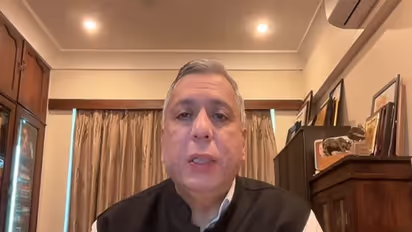
"There is a risk of a move after the collapse of the negotiations and also Trump escalating into a blockade, and this evening, late evening in India, all Iranian ports will face a blockade. That's basically a full shutdown of the Strait of Hormuz because Iran won't allow other countries' ships to transit, and Trump won't allow Iranian flagships to either come or go, or anyone supplying to Iranian ports will not be allowed," Banking and Market expert, Ajay Bagga, told ANI.
Economic and Logistical Fallout
The logistical impact is already visible as "flight trackers record a heightened presence of US transport planes heading toward the Middle East." Bagga pointed out that the blockade threatens to make Iran a landlocked nation, relying solely on Caspian Sea ports and overland routes that handle a fraction of its usual throughput. This economic pressure hits an Iranian economy already struggling with 48 per cent inflation and a currency that has plummeted to 15 lakh Rials per dollar.
"It makes Iran a landlocked country without any access to the world. The overland routes and the Caspian Sea ports are the only routes left for Iran. A little bit of commerce will come through that. The bigger risk is that Iran then lashes out, saying, 'Okay, we are going down, we will take the Gulf nations also down with us.' That's the big risk of escalation," Bagga noted.
Global Supply Shock and Inflation Fears
The current disruption of 20 per cent of the global oil supply is significantly larger than the shocks seen in 1973, 1979, or the 1990 Kuwait invasion. Bagga mentioned that while the United States has emerged as a major producer outside OPEC, the physical supply shock is of such a magnitude that it risks forcing central banks to implement aggressive rate increases to curb inflation.
Market Volatility and Investor Risk
"US banks will report about USD 40 billion of trading profits this quarter. So banks are using the volatility from currency to commodities to stocks to make a lot of money. Retail investors get butchered in this kind of scenario," Bagga states.
Warning Against Market Manipulation
The market remains sensitive to the timing of official announcements, with concerns that Trump's posts are being used to manipulate market positions. "There is a full scale market manipulation. Informed people are taking positions. So even that is a possibility. So what we are suggesting to investors is don't try to trade this market. Only the institutions can trade this market. Otherwise markets are moving on a dime. They are moving on very fast," Bagga suggested.
Advice for Retail Investors
Investors are advised to avoid attempting to time the market volatility. "Not the time to trade. Invest, do your discipline monthly investment through the SIP route. Do not try to time this market because I don't think the bottom has formed, but nobody knows when the bottom will be formed," said Bagga.
(ANI)
(Except for the headline, this story has not been edited by Asianet Newsable English staff and is published from a syndicated feed.)Stay updated with all the latest Business NewsShare Market NewsIPOsGold PriceDA Hike8th Pay CommissionAsianet News Official App