AI raises value of workers, not a replacement: CEA V A Nageswaran
Synopsis
CEA V. Anantha Nageswaran asserts AI enhances, not replaces, professionals. At a CII summit, he said well-run centers leverage tech to raise human value. He urged India to shape AI as a tool, noting its large GCC and AI talent base.
Artificial intelligence raises the value of each working professional rather than replacing them, Chief Economic Advisor (CEA) to the Government of India, V. Anantha Nageswaran, said on Thursday.
AI as a Tool to Enhance Human Value
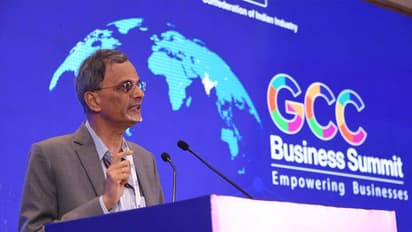
Speaking at the GCC Business Summit hosted by the Confederation of Indian Industry (CII), Nageswaran addressed emerging anxieties surrounding automation and outlined the evolving trajectory of India's capability hubs. The CEA acknowledged that while routine, repetitive, and rule-bound tasks face exposure to cheap automation, well-run centers are leveraging technology to enhance human roles. He emphasized that artificial intelligence requires human oversight to design, train, test, and govern the systems.
"AI does not therefore empty these centers. In the centers that are run well, the AI raises the value of each person who works there. So the risk is there, but that is not destiny. The centers that stand still will suffer. The centers that move up will thrive," Nageswaran said.
"A country that treats a powerful technology as fate will end up being shaped by it. A country that treats AI as a tool will shape it instead. India must be in the second group," he added.
India: The World's GCC and AI Talent Hub
The CEA highlighted that India currently hosts approximately half of the world's GCCs, spanning over 2,000 centers that employ more than 2 million professionals. Sector revenues have crossed USD 60 billion, contributing nearly 2 per cent to the national gross domestic product (GDP).
He noted that more than 1,200 of these centers perform advanced work in artificial intelligence and machine learning, establishing India as the second largest enterprise AI talent base globally.
From 'Cost Advantage' to 'Capability Advantage'
Nageswaran mentioned that global firms "first came to India for cost. They stayed for capability. That's an important difference. A cost advantage can be copied by the next low-cost country. A capability advantage is harder to build and harder to lose as well."
He highlighted that global banks run trading platforms in Mumbai and Bengaluru, car makers design embedded systems in Chennai and Pune, and semiconductor firms conduct chip design locally. He cited German firm Merck's new campus in Bangalore, which holds the company's largest concentration of digital capability worldwide, making India its fourth largest workforce hub.
A Warning Against Complacency
"Success can breed complacency. The advantage we hold today was built over time, but it can also erode. Other countries are watching us and copying us. Our costs are rising. In some skills, our talent is already scarce," Nageswaran cautioned.
From Back Office to Global Decision-Making
The CEA noted that "what began as support became engineering and what began as engineering became product and what began as a back office became in many firms the place where global decisions are now made."
He stated that the benefit has flowed both ways. Global firms got world class work done at a fair price and Indian professionals got careers they "could not have imagined one generation earlier. GCC roles today often pay much more than traditional services jobs."
"Our goal should never be to make our people work like machines. Our goal should be to use machines so that our people are freed to do more of what only people can do, to reason, to decide, to take responsibility, and to exercise wisdom," Nageswaran concluded.
(ANI)
(Except for the headline, this story has not been edited by Asianet Newsable English staff and is published from a syndicated feed.)Stay updated with all the latest Business NewsShare Market NewsIPOsGold PriceDA Hike8th Pay CommissionAsianet News Official App