All-New Hyundai i20 2027 Unveiled: Hatchback Gets Radical Makeover
Synopsis
The fourth-generation Hyundai i20 has made its global debut in Brazil, and it's a complete overhaul. Built on the new K3 platform, the car features a bold new design, a more spacious cabin with a dual-screen cockpit, and ADAS tech. While it's expected to hit Indian roads only by 2027, it will likely keep its current engine options.
After months of spy shots, official teasers, and leaked pictures, the wait is finally over. The fourth-generation Hyundai i20 has officially arrived. The hatchback made its global debut in Brazil, where it has been launched in six variants: Comfort, Limited MT, Limited AT, X Line, Platinum, and Ultimate. Based on a new K3 platform, the 2027 Hyundai i20 gets a complete design overhaul, along with major feature and technology upgrades. Here’s everything you need to know about the all-new Hyundai i20.
When will the new Hyundai i20 launch in India?
Hyundai has not yet revealed the official launch timeline for the new i20 in India. However, reports suggest that the new version of the hatchback could hit Indian roads sometime in 2027.
How different is the new Hyundai i20 from the current model?
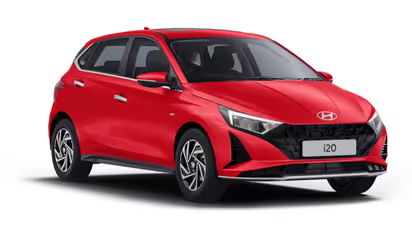
The new i20 looks completely different from the current generation. The hatchback now has a crossover-inspired design style. It features a sharp hexagonal grille, a redesigned split headlamp setup, Y-shaped LED DRLs, and a new connected LED light bar at the front. Moving to the side profile, the i20 looks longer than before and sports newly designed alloy wheels and squared-off wheel arches. At the back, it gets a full-width LED rear light bar.
Is it bigger than the current India-spec version?
Yes, it is. The Brazil-spec i20 is 135mm longer and 5mm wider than the current model sold in India. The new model measures 4,130mm in length, 1,780mm in width, and has a wheelbase of 2,580mm. For comparison, the current India-spec i20 is 3,995mm long and 1,775mm wide.
What about the boot space?
The fourth-generation i20 offers a boot capacity of 346 litres. This can be expanded to a massive 1,152 litres by folding down the rear seats.
What are the main interior updates?
In Brazil, the new-generation i20 is available with black and dual-tone grey cabin themes, depending on the variant. The hatchback now offers a new dual-screen cockpit layout, with each display measuring about 12.3 inches. A newly designed dashboard, a revised centre console, and premium upholstery options further enhance its cabin experience.
The new i20 is also packed with features like wireless smartphone connectivity, Hyundai's BlueLink connected car technology, OTA (over-the-air) updates, a rear-view camera display integrated into the screen, USB chargers for both front and rear passengers, and a wireless phone charger.
What engine options will be available?
The Brazil-spec i20 is powered by a 1.0L MPI naturally aspirated flex-petrol engine that produces 115bhp and 172Nm of torque. Transmission duties are handled by a 6-speed automatic gearbox. In India, the new i20 is expected to retain the current 1.2L naturally aspirated petrol and 1.0L turbo-petrol engine options.
Will Hyundai launch a hybrid version of the new i20 in India?
There is no official confirmation yet on whether a hybrid version will be available. However, the brand's new K3 platform is designed to support hybrid powertrains, which keeps the door open for this possibility in the future.
Will the fourth-gen Hyundai i20 come with ADAS technology?
Yes, it will. In Brazil, the fourth-generation i20 gets Hyundai's SmartSense ADAS technology for the first time. The ADAS suite offers features like Blind-Spot Collision-Avoidance Assist, Forward Collision-Avoidance Assist, Lane Keeping and Following Assist, Intelligent Speed Limit Assist, and Leading Vehicle Departure Alert.
What are the other safety features on the new Hyundai i20?
Hyundai has packed the new i20 with a host of advanced safety features. These include six airbags, Electronic Stability Control, Vehicle Stability Management, a Tyre Pressure Monitoring System, Hill Start Assist Control, a rear-view camera, and ISOFIX child-seat mounts.