Nine KCL players in India's squad for 2026 Asian Games: Khokhar
Synopsis
Dronacharya Awardee coach Rambir Singh Khokhar praised the KCL for its contribution to Indian kabaddi, with nine players from the league making it to the 2026 Asian Games squad. The league has also announced its second season with two new teams.
KCL's growing impact on Indian kabaddi
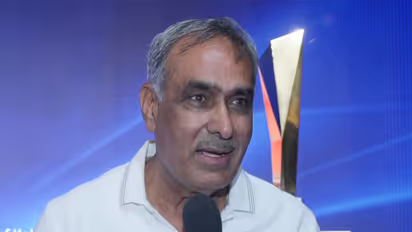
Dronacharya Awardee coach and former Indian men's kabaddi team coach Rambir Singh Khokhar highlighted the growing impact of the Kabaddi Champions League (KCL) on Indian kabaddi, pointing to the league's contribution to the national team ahead of the 2026 Asian Games in Japan.
The KCL has achieved a major milestone, with nine of the 12 players representing India at the 2026 Asian Games in Japan coming through the KCL ecosystem, highlighting the league’s growing role in Indian kabaddi. The KCL players set to represent India include Sunil Malik of Karnal Kings, Ayan Lauchab of Sonipat Stars, Devank Dalal of Bhiwani Bulls, Ashu Malik of Hisar Heroes, Rahul Setpal of Gurugram Gurus, Jaideep Dahiya of Faridabad Fighters and Ankit Jaglan of Panipat Panthers, among the KCL representatives.
Speaking on the sidelines of the KCL Season 2 unveiling ceremony on Monday, Khokhar said the league has emerged as an important platform for developing high-level kabaddi talent, with nine players from the KCL ecosystem set to represent India at the Asian Games. “Look, at the national camp that was held for the Asian Games, most boys were from KCL, and now nine boys are going into the Asian Games. And they're all top-level. Whether it's the defenders or the offence, it's the best platform. And there are a lot of Kabaddi leagues going around. Having nine players is a really, really big contribution in itself from KCL,” he told ANI.
KCL Season 2 expands with two new franchises
The KCL officially announced its second season on Monday, promising a bigger, better and more competitive edition of the franchise-based kabaddi league.
Building on the success of its inaugural season, KCL has also added two new franchises — Jind Jaguars and Kurukshetra Knights. Their inclusion further strengthens the league’s franchise ecosystem while creating an expanded platform for players and emerging kabaddi talent, according to a KCL press release.
The addition of the two franchises marks another significant milestone in KCL’s journey as the league continues to develop a strong and sustainable franchise-based structure around kabaddi.
Khokhar said that after a successful first season, the addition of two new teams will increase the league’s excitement and competition, making the second season even bigger and more appealing to fans and players. “The first season last year was really great on its own. And when even just one team is added, its charm and the competition go up. Now that two more teams have joined, I feel like this time, neither the fans nor the players will be able to even imagine it. I think this really needs to be highlighted well, and its glory will only grow,” he said.
From mud to mat: The evolution and future of kabaddi
Kabaddi has long been closely associated with India's rural sporting culture and is widely regarded as a traditional sport rooted in the country's villages. Traditionally played on mud, the sport has evolved over the years, transitioning to modern mats as the game has become faster, more technical and professional.
Reflecting on this evolution, the Dronacharya Awardee coach said the shift from mud to mat has significantly changed the nature of the game.
He stressed that greater exposure to mat-based kabaddi, along with access to proper equipment and training, will be crucial for India's Olympic ambitions.
He also expressed confidence that KCL Season 2 will be a success, particularly with the strong presence of players from Haryana.
“Look, I've actually been to many countries as a coach too. Way back in '88 and '87, I was the head coach of the Indian team at the Asian Championships and the Asian Games. Back then, it was still played on mud. It was played on mud in '90 in China, and then it was played on the mat in '94. So now we can't just call it a mud game anymore because Technology has advanced a lot and the game has gotten faster. Coming from the mud to the mat, there's a term called "mud to mat", so the players' techniques, skills, and all that on the mat,” he said.
“We'll only be able to make it to the Olympics if we put ourselves out there on the mat as much as possible. The mat, the mat shoes, the kit, the players—that's when this becomes a great platform to develop skills together. And in season two, because of the many players from Haryana, it's going to be really successful,” he added. (ANI)
(Except for the headline, this story has not been edited by Asianetnews Editorial staff and is published from a syndicated feed.)