Kaneria slams Pakistan's 'political' boycott of T20 WC India game
Synopsis
Danish Kaneria questions Pakistan's boycott of its T20 WC match against India, criticizing the government for mixing politics with sports and asking why they are supporting Bangladesh, which he feels has done nothing for Pakistan cricket.
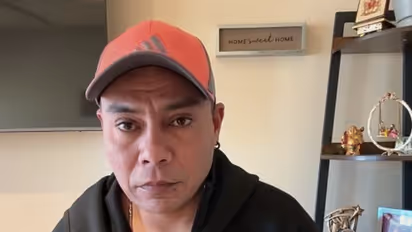
Former Pakistan cricketer Danish Kaneria questioned the Pakistan government for their boycott of group stage T20 WC clash against India, questioned them what Bangladesh Cricket Board (BCB) had done for Pakistani cricket that they are taking such a stand and why they opted against playing the game even when it is being played at a neutral venue as per a hybrid model.
Pakistan decided to boycott its group-stage match against India in the T20 World Cup after the Pakistan government posted on X that the Pakistan Team "shall not take the field" in the match against India without providing any reason. Pakistan Prime Minister Shehbaz Sharif on Wednesday as quoted by Dawn, reiterated the country's decision to boycott its T20 World Cup match against India, saying the country has taken a "clear stand" for the February 15 match in Sri Lanka, and "there should be no politics in sports" The country's government decision to boycott the match came after Bangladesh was replaced by Scotland just days before the tournament, when their request to have their matches relocated outside India were not agreed upon by the International Cricket Council (ICC). Bangladesh Cricket Board (BCB) had made such a request after the release of pacer Mustafizur Rahman by IPL franchise Kolkata Knight Riders (KKR) on instructions of BCCI in light of atrocities against minorities in Bangladesh.
Kaneria Questions Pakistan's Stance
Speaking to ANI, Kaneria said that sports should not be mixed with politics, irrespective of the country, and that issues have arisen from both governments, with the Indian government also refusing to travel to Pakistan and vice versa. "I always say that politics should not be involved in cricket. No matter which country it belongs to. It should be like sports. The sports officials should make the decisions. But such incidents have happened not only in Pakistan, but also in India. The Indian government had refused to play. So they did not play either (in Pakistan)," he said.
Kaneria said that while Bangladesh was told to do something and did not do it (stick to the original tournament schedule), he does not understand why the BCCI is being dragged into it and mixed with the ICC. "It is an ICC tournament. ICC makes the decision. The tournament does not belong to a country. The venues, fixtures, and everything else are handled by the ICC. ICC took a decision on the Bangladesh matter and gave them time (to make a final call), but they did not come (to India). Pakistan also refused to play. I do not understand this, but before the WC, Pakistan had requested of the ICC that they would not play in India due to X, Y, Z reasons, and the ICC agreed (thus creating the Hybrid model), and the India-Pakistan match was kept in Sri Lanka, keeping this in mind. No mistake was made; your request was fulfilled."
'What if India and Pakistan meet in the final?'
"But then you took a stand that what you (ICC) did with Bangladesh, we (Pakistan) will take a stand and support them. But I do not understand what Bangladesh Cricket has done for Pakistan Cricket. It would have made sense if they did something and supported you," he continued. Kaneria, the former Pakistan spinner, also pointed out that players are ready to play, with skipper Salman Ali Agha saying in the pre-tournament presser that they are just obeying and respecting something their government asked them to do, and that it is not the players' decision. "When India did not shake hands with Pakistan, and did not take the trophy (from Asian Cricket Council president Mohsin Naqvi, also PCB chair and a prominent Pakistan minister), I said that this matter will go in a different direction altogether and make problems further and further. We should think a little now, since it is an ICC event. Are you forfeiting the game right? The two points will go to India. You can respect the government's decision. But after that, if India and Pakistan meet in the semifinal or the final, what are you going to do? Say that 'Okay, India, you can take the cup'?" he continued.
'It is not a bilateral series': Kaneria Warns of ICC Consequences
Kaneria said that it is an ICC event and not a bilateral series, and Pakistan is going against ICC, which looks after Pakistan's revenue, allocating them games under future tour programmes and other stuff. He added that this has its share of consequences, which will not do Pakistan cricket any good. "Authority is ICC, there are rules and regulations. It is not a bilateral series. When Pakistan was playing a game in Sri Lanka, they should not have had any problem. There are also people on social media claiming India is playing next-level T20I cricket, and that is why Pakistan boycotted. You have to see that there could be consequences, ICC has their powers too. It is not a bilateral series. Also, cricket is the only sport which is doing well in Pakistan. Hockey did well at one point, but now only cricket is left. The larger picture should also be looked after since cricket unites Pakistan. If you take such a step, you could put the future generation of players in trouble, lose money, and players can lose money," he continued.
Suggests Alternative Protest
The ex-spinner suggested that instead, Pakistani players "could have worn a black arm band". "You could have protested in a different way. This is a very game for the broadcasters and fans as it generates revenue and has a lot of popularity. This angle should have been looked after too, that people in Sri Lanka want to watch India-Pakistan in their country for the first time too. But the way you are going, I do not think anyone will find it acceptable," he concluded.
ICC, PCB in Talks to Resolve Impasse
ICC and Pakistan Cricket Board (PCB) are holding back-channel discussions to find a solution for the highly anticipated group-stage match between Pakistan and India, according to ESPNcricinfo. While the PCB has not publicly commented on the boycott, the ICC responded via its official channels, urging the board to "explore a mutually acceptable resolution, which protects the interests of all stakeholders."
Efforts to resolve the situation have involved ICC deputy chair Imran Khwaja and Mubashir Usmani of the Emirates Cricket Board, both of whom have engaged with PCB chairman Mohsin Naqvi and Salman Naseer, head of the Pakistan Super League (PSL) and senior advisor to Naqvi. These discussions began even before the boycott was officially announced, after Naqvi had raised concerns over Pakistan's participation, citing government directives as decisive.
Naqvi, during a visit to the UAE, reportedly sought guidance from officials there and met with Khwaja. Subsequent talks have continued with Khwaja coordinating from Singapore and Naqvi from Pakistan.
Initial discussions included potential sanctions against Pakistan for withdrawing from the tournament, but the PCB has indicated that its stance is driven by principles rather than financial considerations. Naqvi had earlier criticised the ICC's exclusion of Bangladesh, accusing the body of "double standards" and doing an "injustice" to the team. Since the boycott announcement, the ICC's focus has shifted to addressing PCB grievances to ensure the marquee clash proceeds. Khwaja has acted as a mediator in previous disputes involving the PCB, the BCCI, and the ICC.
Pakistan are slotted in Group A with the defending champions India, the Netherlands, Namibia and the USA. The ICC Men's T20 World Cup 2026 will be held from February 7 to March 8. (ANI)
(Except for the headline, this story has not been edited by Asianet Newsable English staff and is published from a syndicated feed.)