Caught Between War and World Cup: Iran, Host Nation US and FIFA's Moment of Truth
Synopsis
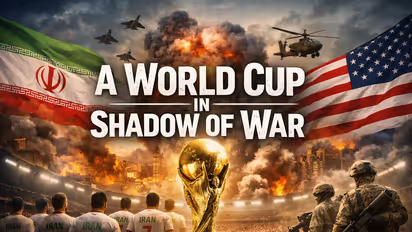
Iran’s World Cup fate hangs in the balance amid US-Israel conflict, FIFA’s tough stance, and Trump’s warning. Can football survive war as politics threatens to derail the global showpiece?
The world’s biggest sporting spectacle has rarely felt so fragile. Just months before kickoff, the 2026 FIFA World Cup—set to be hosted across North America—is facing an unprecedented geopolitical crisis. At the centre of it lies Iran, a qualified team now staring at the very real possibility of missing the tournament, not because of footballing failure, but because of war.
Also read: Infantino confirms WC 2026 schedule amid Iran-US conflict fears
“No Possibility”: A Minister’s Stark Warning
On March 11, Iran’s Sports Minister Ahmad Donyamali delivered a blunt assessment: there was “no possibility” of Iran’s men’s national team participating in the World Cup.
His remarks came against the backdrop of escalating conflict following US and Israeli military strikes on Iran—an escalation that has sent shockwaves through the Middle East and beyond.
This is uncharted territory. Never before has a World Cup host nation been in active conflict with a participating country. The implications stretch far beyond sport—impacting oil flows, trade routes, and now, the integrity of a global tournament meant to unite.
A “Peace Prize” Under Fire
The irony is difficult to ignore.
In 2025, FIFA president Gianni Infantino introduced the inaugural “FIFA Peace Prize,” meant to honour those who “unite people, bringing hope for future generations.”
In January 2026, the award went to US President Donald Trump.
The decision raised eyebrows even then. Critics pointed to US involvement in the Gaza conflict alongside Israel and what they described as a “rapid authoritarian shift” domestically.
Two months later, the US partnered with Israel in military action against Iran—fueling calls for the award to be revoked.
Welcome… or Warning?
After meeting Infantino on March 10, Trump initially struck a conciliatory tone, assuring that Iran would be “welcome to compete.”
But the message quickly shifted.
On his Truth Social platform, Trump wrote:
“I really don’t believe it’s appropriate that they be there, for their own life and safety.”
The statement, widely seen as a veiled warning, drew a sharp response from the Iranian camp. The team insisted: “No individual could exclude a country from the World Cup”
They also emphasized that ensuring security is the host nation’s responsibility.
Players Ready, Politics Not
Despite the uncertainty, Iran’s players are pressing ahead.
Friendly matches against Nigeria and Costa Rica in Turkey remain scheduled as part of their World Cup preparations. On the pitch, at least, the focus remains intact.
Off it, however, complications continue to mount.
Iran is slated to play group-stage matches in California and Seattle—both in the United States. That’s a major sticking point.
“Boycott the United States, Not the World Cup”
Iranian Football Federation president Mehdi Taj has made the country’s stance clear:
“We will prepare for the World Cup. We will boycott the United States but not the World Cup.”
The solution Iran hopes for? Relocation.
Co-host Mexico has already signaled openness. President Claudia Sheinbaum stated: “The nation stands prepared to host Iran’s group-stage matches should circumstances require”.
Canada, too, remains a theoretical option.
But FIFA has so far refused to budge, insisting it will not move Iran’s matches out of the US.
FIFA’s Balancing Act
Publicly, FIFA is holding its line.
Infantino reiterated: “FIFA is looking forward to all teams participating at the World Cup to compete in a spirit of fair play and mutual respect.”
He added: “We have a schedule. We will soon have the 48 competing teams confirmed, and we want the World Cup to go ahead as scheduled.”
Behind the scenes, though, contingency plans are taking shape.
Options reportedly include:
- Leaving Iran’s slot vacant, resulting in walkovers Replacing Iran with another team, possibly Iraq or the UAE
- Each option carries its own complications, from qualification fairness to political optics.
Also read: Iran 'Negotiating' With FIFA to Move World Cup 2026 Matches From US to Mexico
A Tournament Unlike Any Other
If Iran does withdraw—or is effectively excluded—it won’t be without precedent, but it will be without parallel in context.
History offers examples:
- 1950: India, Turkey, and France withdrew due to travel costs
- 1958: Indonesia refused to play Israel
- 1994: Yugoslavia was banned amid UN sanctions
But none involved a direct conflict between host and participant.
The Risk of Sanctions
Should Iran pull out, FIFA could impose penalties.
A “yellow card” might mean financial sanctions. A “red card” could even see Iran excluded from the 2030 World Cup.
Yet FIFA also has discretion—and given the extraordinary geopolitical circumstances, it may choose leniency.
Football Caught in the Crossfire
FIFA has long claimed political neutrality. Yet its actions—such as banning Russia from qualifiers—suggest otherwise.
This time, the stakes feel even higher.
Iran’s participation is no longer just about football. It’s about diplomacy, safety, symbolism—and the limits of sport in a fractured world.
As the countdown to kickoff continues, one question looms:
Can the “beautiful game” survive when geopolitics takes centre stage?