Indian football lacks pride, players love money more: Armando Colaco
Synopsis
Ex-India coach Armando Colaco criticises the current state of Indian football, citing a lack of national pride in players. He points to issues with the ISL, the striker crisis, and advocates for promotion/relegation and promoting Indian coaches.
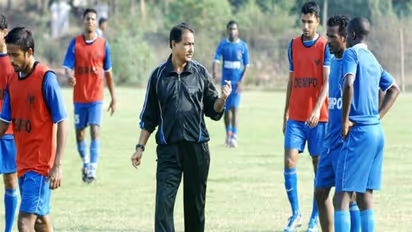
Former national India football coach Armando Colaco shared his views regarding the current state of Indian football, highlighting the decline of national pride, the lack of opportunities for Indian players, the importance of promotion and relegation, putting Indian coaches at the helm, and the growing positives in women's football. During his tenure with the national team, India recorded memorable results against strong Asian sides, including the historic 2-1 victory over Qatar in 2011.
A Decline in National Pride
Reflecting on India's present standing as a footballing nation and what is needed to regain consistency, Colaco pointed to a fundamental shift in the mindset of players. "I don't differentiate between the old and the new generation, but those players, whoever played for the national team, they had pride in them. They never bothered about the money. They played for the love of the country. So there lies the difference. Your love for the nation counts first," he told ANI.
Colaco questioned whether the Indian Super League (ISL) structure has genuinely benefited Indian players: "Has ISL really improved our Indian players? I'm not against ISL. Those old players were golden players who could deliver themselves. The new generation has everything at its disposal. Still, football doesn't come out from the heart, especially for the national team; but if it's for the club, where they get all the money, they'll do anything."
"Maybe the players are also getting frightened. Who's going to take care of us if we get injured or something of that sort? But then, leaving everything aside, you must have pride to play for the country. If you don't have pride, that love to play for the country, it's finished," he added.
"I will put my first step to the country and then to the clubs. Of course, clubs support you, encourage you, they give you everything, but then there was only I-League, there was Santosh Trophy earlier and all of us wanted to do well for the Santosh Trophy so that the scouts could pick us and take us to the national team; and then we had to prove ourselves and get into the national team," he recounted.
Absence of promotion, weak competitiveness
Colaco also blamed the absence of promotion and relegation for weakening competitiveness. "Now, with no promotion and demotion, there's no fighting spirit. When there's promotion or demotion, you have to fight for it. I have to win it. I have to give my best. I have to stay on top," Colaco asserted.
Refraining from naming any individuals, Colaco noted, "If I lose, I come down, my greed goes down, and my salary also comes down. So that's a reason. Those were the great players. I can name so many national players of the past, but I don't want to be a critic. The love for the country is no longer there in most players."
The Striker Crisis
Indian football's long-standing striker crisis was another major concern raised by Colaco. Icons like Bhaichung Bhutia and Sunil Chhetri have carried the goal-scoring burden for decades; the lack of successors has become evident. "Bhaichung is Bhaichung, Chhetri is Chhetri. Like Ronaldo is Ronaldo, Messi is Messi. They have their different aura, different qualities in them," he said of the iconic players, indicating they are incomparable.
He recalled making difficult decisions during his national team tenure to phase out senior players and invest in youth. "Pele, Eusebio, they were different. With due respect, with high respect to Bhaichung Bhutia and Renedy (Singh), the two senior players, I realised and I felt that I should give them a break because they were playing for so many years and let's groom the young ones. I had Sushil (Kumar Singh), Sunil (Chhetri), I had Jeje (Lalpekhlua)."
However, he believes the system today no longer allows Indian strikers to develop. "Every club in the ISL plays with foreign strikers. So, where will Indian strikers get a chance to play? Where is that confidence? Everyone says I can't get a place because foreign strikers are there. Now, how many of the club owners in ISL or I League want an Indian coach to coach their team? I was lucky because my boss had faith in me and I proved my worth. Like this, there are also many Indian coaches who can prove their worth. There are also many Indian players, strikers who can prove their worth, but are they given a chance? They are not given a chance because they believe in foreign players. Earlier, there were only four or three foreigners, one Asian. But now there are six or seven at a time playing. So most of the Indian players don't get an opportunity to play, and every team club wants to have foreign strikers upfront," he said.
Colaco strongly advocated getting foreign players, but also ensuring that one of the strikers is an Indian. He said, "In this way, we can create. There's Under 17, Under 23; they have good, very good strikers. The only way of developing Indians is by giving them a chance in the striker's position. They are doing a beautiful job. It's not easy to run a team, to spend so much of money. What matters to the (club) owners when they spend a lot of money, and the coach, is winning, winning at all costs. But you are winning also is by sacrificing our own local talent."
"Now, when there was no promotion, demotion in the ISL for so many years, they could have tried our Indian strikers also. This is my opinion. So when each and every club has foreign strikers, where will the Indian strikers get a chance?" he questioned.
Confidence comes through opportunity
Colaco explained how confidence comes only through opportunity. "The confidence when you play is the confidence that we have to give it to the players, our Indian players," he said.
Back to Basics: Fundamentals and Youth Development
Drawing from his experience, Colaco also underlined the importance of strong fundamentals: "Under 17, there are no foreigners. Under 23, there are no foreigners. That's why they are doing well. There was a time when Zambia's national team came to Goa, India. My boss, Mr Dempo (Shrinivas Dempo), told me to take three or four players from there. So I said, I've got foreign players, but they are playing well because they gel. They understand each other. If you bring one or two, they will find it difficult because our ways and their ways are totally different. They start right from the word go. The basics are taught at a young age. Our basics are not taught properly. That's why the young coaches play an important part in the development of a player. How to receive, how to pass, how to run in open space, how to shield, how to shoot, how to carry the defender away, all those things."
"That's why I always praise those players whose basics are stronger. At the senior level, its just about gelling. Making them understand how we should play, what our philosophy is, and all. So I hope now, at least, most of these club owners try to understand because everyone wants to win. Mohun Bagan has spent a lot of money on getting the best players. This year it was a bit of a problem, but then, to achieve something in life is easy, but to maintain it is quite difficult because everyone in India wants to be the best," he said.
"So that's the reason I hope more and more coaches and more and more club owners give preference to our Indian strikers at least one of them if there are twelve teams and twelve strikers. Then you're promoting Indian striking balance," he reiterated, adding, "I had Jeje, I had Sushil Singh, I had Chhetri, but now there is no one. Of course, Bhutia and Renedy Singh, I have great respect for them. What they've proven, nobody can take away. They're worth it, but then I took a chance, and I don't know whether it worked or not, but everybody said it was good."
He shared moments that validated his approach with the national team. "To beat Qatar in Qatar with Sushil Kumar (Singh) and Chhetri scoring, it's something okay. Carlos Queiroz came to Maldives to see the staying formalities for the team and we played against the Maldives. He was very impressed. He said this team was really playing well. So that's what I want. That's what all the coaches should look forward to. Why do people spend a lot of money to come and watch the game? Because beautiful football. Not kick and run," he said.
On young Indian talent, Colaco praised coaches like Bibiano Fernandes and Naushad Moosa and emphasised continuity. "I was especially invitee for one of the All India Football Federation meeting. Where I told to keep the Under 17 and Under 23 teams, put them together under Bibiano and Naushad Moosa, and give them a chance to play in the I-League. Because in football, gelling is important, understanding each other is important," he recounted.
"Not much in Goa. There was only Brandon (Fernandes). Now our FC Goa player, Brison (Fernandes), is doing well. I hope more and more Brisons, Mahesh Gowlis, and Clifford Mirandas will come," he noted.
"They have taken a different route now. They've become coaches. So I hope the way I have groomed them, they will also try to groom these players. Bibiano is doing well. Naushad Moosa is doing well, and I hope my players who are coaches now like Samir Naik, Clifford Miranda, go on producing players and start raising the standard of Indian football high," said former India football team coach.
Believe in Indian coaches
Colaco also voiced his firm support for Indian coaches, including current national team coach Khalid Jamil. "Every coach has got their different aspects, different views, different philosophies. I was one of the members who promoted Khalid Jamil because we tried with foreign coaches, but things were not going on well. So for some time at least, give some time to the Indian coach," he said.
"The problem is not the Indian coach. The problem is that some of the Indian players don't believe in Indian coaches. They think they don't know football. Khalid Jamal has proven himself with all the clubs here. So it needed a push in the national team. Now, I've been given to understand there was a discussion also to continue or not to continue Khalid Jamil by All India Football Federation, but then they did the right thing of continuing because every coach needs time. Like I said, different national players, different club members, they have to come and gel together," Colaco said.
"I'm happy that Khalid Jamil has got more time and should be given time. You're promoting one of the Indian coaches. I believe in that. I was given an opportunity, and I proved my worth, and I'm sure that the tenure was less for me. If the tenure was more, I think I could have. I don't know if it's for the people to decide, but I needed more time. By the time you come, your first year is gone, only by you bringing them together. The second year, you impart your views. Third year, you get the best. One year was too less for me, but even then, God is great to beat Qatar in Qatar with this friendly, practice or whatever it is and to play those exhibition matches," he added.
"There are some players who don't respect our Indian coaches. That attitude has to be changed," Colaco emphasised.
The Promotion-Relegation Debate
On the recent turmoil surrounding the ISL and its delayed start, Colaco defended the AIFF's stance on promotion and relegation: "To be honest, I don't criticise or talk anything bad about anyone, but then who is the supreme authority of football in India? It's All India Football Federation (AIFF). Where in the world is there a league where there is no promotion and demotion?"
"Now everybody is blaming AIFF. Our cricket model doesn't work for football model. All India Football Federation has to take care of everyone, all the teams. Whether it's ISL, whether it's I-League, your second division, your third division, whether it's a state association league, everywhere. They have to support and encourage. Cricket, it works, but football, it doesn't work. So there has to be a demotion-promotion. Now everybody is blaming AIFF, all this turmoil and all these things, but did anyone realise and understand why? AIFF did not continue the agreement with FSDL (Football Sports Development Limited). It's because FSDL did not agree to the promotion and demotion," he added.
However, he acknowledged FSDL's financial contribution but remained firm. "They brought in a lot of money, hats off to FSDL. They tried to promote football, and on the way, but there has to be a promotion and demotion. Then only football will improve. Only then will other teams try to work harder. We are talking only about ISL and I-League. What about the second division league? What about the third division league? Why should the team practice when there is nothing for them? Having said this, AIFF also has had in so many ways, which they have to try to rectify and come back to its own way. The functioning of AIFF was not good because they had a problem in the ISL, I-League, and deregistration of a player was registered again, so all these problems, they must sit and talk but there has to be a promotion. The money came in. FSDL had put in a lot of money but somehow the turmoil was only because of the promotion and demotion," he said.
Club Culture and Patience
Discussing East Bengal's progress, Colaco pointed to patience as the missing ingredient. "In football, anything can happen. It's beautiful, and it's also cruel. Having the best players in your squad, and if you don't utilise the chances you get, then you're in trouble. I mean, this problem is faced all over the world. You get so many chances and don't score, and the opponent gets one chance, and they score. Then that's the difference in a game of football. So they do have, they're trying to do their best to emulate Mohun Bagan. I was there with them for some time. They asked my opinion. I said, okay, go push, do whatever it is," said the former East Bengal manager.
"The only thing in Bengal is that they don't have patience. They don't give more and more time to a coach. The coaching is beautiful. It's an art. It's a difficult job. What can a coach do if the players make silly mistakes at the back of the goal and then upfront instead of putting the ball into the shootout? Ultimately, the blame falls on the coach and the coaches are responsible for it. The players' ego and attitude play differently. It's always the coach who suffers, but then what to do? I hope East Bengal comes to the level of Mohun Bagan as far as winning the trophies when ISL comes. So they're trying their best," he added.
Trust, relationships, freedom & success
Reflecting on his golden years at Dempo, Colaco acknowledged that trust, relationships, and freedom defined that time. "In Dempo, I had the players who would listen. We had a different style, a different type of style. We used to sit together. The beautiful thing in me and them was that there are so many coaches, but my relationship with the players is totally different," he said.
"I used to treat them as friends. I used to sit with them, fool with them, talk with them, dine with them, have parties with them and then all of us together, we used to take decision," he noted.
That philosophy, he believes, created sustained success. "I believe in the philosophy of holding the ball, keeping the ball pushed, and these players understood but the duty in me was that, at this season, I used to bring six of my junior players to train with the seniors so that they could understand the philosophy. The boss was also was too good, never used to interfere, Mr Srinivas Dempo and then when I had that confidence that my boss, whatever I do is ready to promote and support me. So I put those same views into the players. Don't worry, just go on out and play and express yourself. Enjoy the game and that's how it started," Colaco said.
"That's why I could win year after year, so many trophies, so many players joining the Indian national team. So something beautiful," he added.
Women's Football: A Beacon of Hope
Armando Colaco's club coaching legacy remains legendary, particularly with Dempo Sports Club, he guided Dempo to multiple National Football League and I-League titles (2004-05, 2006-07, 2007-08, 2009-10, 2011-12), establishing the club as a dominant force domestically. He believes women's football is currently leading the way, "Today who has made us proud at the moment in Indian football are the women's team."
"You see, when men couldn't do anything, all three (women's) teams - Under17, Under 21 and the senior team--have done wonderfully. So we have to blame ourselves. We used to say football is only for men, not for ladies, but then you see all over the world, women are coming into the action. Our own Goa through Vedanta Sesa Goa, they're coming into the game, and it is helping Indian football go higher," he spotlighted.
At present, India's men's team stands at 142, while the women's team is at 67 as per FIFA ranking.
The way forward
Armando Colaco highlighted the need for changing mindsets and regional growth for the sport to thrive. "So now people have realised and understood, and even the girls started coming out practising, especially Manipuri girls--they are showing the way for everyone now to come and join football. In fact, in all the sports, Manipuris are doing very well. Vedanta played an important part in helping GFA to carry on with those activities. So it's really good. Community service Vedanta says it's very good and I'm proud that at least for some time I was a part of Vedanta Sesa Goa group," he noted.
On women's football, Colaco expressed pride in Sesa Football Women's Academy qualifying for the Indian Women's League. "Goa was good earlier, but Vedanta Sesa Goa coming in. There was a lot of improvement, scope for the girls to express themselves to show their value and that's how Goan girls started playing, started improving themselves. It's Vedanta, they stepped in to give them the platform to express themselves, helping GFA (Goa Football Association). So something good is happening. They're proving worthy. It will take time, but we have to be patient. We have to build it on a regular basis so that they come out strong," he said. (ANI)
(Except for the headline, this story has not been edited by Asianet Newsable English staff and is published from a syndicated feed.)