Real Madrid’s Pressing Revolution: The Numbers Behind Xabi Alonso's Lethal System
Synopsis
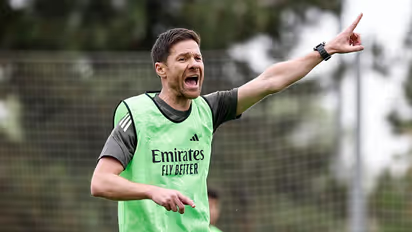
Xabi Alonso has turned Real Madrid from patient passers to ruthless pressers. In just eight games, Los Blancos have become Europe’s most dangerous high-pressing side — hunting, biting, and scoring with precision under their new boss.
Eight matches into the new La Liga season, and Real Madrid don’t just play differently — they feel different. There’s an electricity about them now. Gone is the patient, sit-and-strike rhythm of the Carlo Ancelotti years. In its place stands a side that presses, swarms, and bites. Under Xabi Alonso, Real Madrid have turned from waiting to hunting — and they’re doing it with frightening precision.
Alonso’s Mark: From Control to Chaos
When Alonso walked into Valdebebas, the expectation was that he’d bring intensity — but few expected it to transform Real Madrid this quickly.
His Madrid is no longer content with possession; it’s obsessed with recovery. The hallmark of his Leverkusen side — fast, coordinated pressing — has become the new identity at the Bernabeu.
The shift is not just aesthetic. It’s statistical. Madrid now ranks among Europe’s most aggressive and effective high-pressing sides, proving that Alonso’s football philosophy is both adaptable and scalable at the elite level.
From a Tame Press to Tactical Predation
This evolution was on full display in the 3-1 win over Villarreal, especially the third one netted by Kylian Mbappe. It was Real Madrid’s sixth goal this season born directly from a high recovery — a staggering figure considering Barcelona and Levante sit far behind, with just two apiece.
Structured Chaos: The Alonso Blueprint
The press is not blind aggression. Alonso’s men don’t chase shadows; they wait for triggers.
Often sitting in a mid-high block, they allow the opponent’s first pass before pouncing in unison. The second goal against Oviedo in Matchday 2 perfectly illustrated this. That’s the new Real Madrid — a side that’s as strategic as it is savage.
The Numbers Behind the Bite
The transformation isn’t just visual — it’s measurable.
According to Opta and Driblab, Real Madrid now register:
- 8.8 high recoveries per game, among the top 10 in Europe.
- 2.5 recoveries per match leading to shots, more than double the Big 5 average (1.07).
- 28.57% of those recoveries leading to shots, compared to the continental average of 16.86%.
That makes them the sixth most efficient pressing side in Europe, and second in La Liga — only behind Elche, and tied with Real Sociedad.
Under Ancelotti, that efficiency hovered around 20%.
In simpler terms, Real Madrid aren’t just pressing more — they’re pressing smarter.
From Press to Goal: A Lethal Conversion Rate
Real Madrid’s ability to convert recoveries into goals is what sets them apart.
They’re currently scoring 0.75 goals per match from high recoveries — the best figure in Europe’s top leagues. The next-best team, Inter Milan, averages one such goal every two games.
That means Madrid score almost once a game through pressing alone — a staggering leap from the Ancelotti era, where the figure was three to four times lower.
A Higher Line, A Higher Purpose
The tactical shift extends to positioning too. Madrid’s average pressing height has climbed to 44.2 meters — about four meters higher than under Ancelotti.
Their defensive line now operates 1.5 meters higher, averaging 35.3 meters from their own goal. It may sound minor, but at the elite level, that extra meter is the difference between waiting and winning.
This elevated shape allows Madrid to suffocate opponents, recover faster, and transition instantly into attack — all central tenets of Alonso’s footballing gospel.
The End of the Ancelotti Era’s Balance Act
Carlo Ancelotti’s Madrid was built on balance and belief in individual brilliance. His side alternated between pressing and containment, rarely sustaining pressure for long. When early pressing experiments led to goals conceded, he reverted to deeper lines — and success followed.
But Alonso’s Madrid is different. It’s bolder, braver, and less dependent on moments. Every movement feels rehearsed, every recovery feels rehearsed. It’s a collective machine operating at high rhythm, not an orchestra waiting for a solo.
Yes, it’s early days. Eight games don’t make a dynasty. But even at this stage, one thing is clear — Real Madrid’s football is evolving faster than anyone expected.