FIFA World Cup 2026: Why Amnesty Calls It a Potential 'Stage for Repression'
Synopsis
Amnesty warns the 2026 FIFA World Cup could become a “stage for repression,” citing US immigration crackdowns, safety fears for fans, and a widening gap between FIFA’s promises and reality.
As excitement builds for the 2026 FIFA World Cup, a stark warning from Amnesty International has cast a shadow over the tournament, cautioning that the global spectacle risks becoming a “stage for repression” rather than celebration.
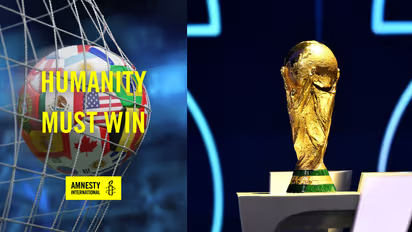
In a report titled “Humanity Must Win,” the London-based rights group has urged FIFA and the three host nations — the United States, Canada, and Mexico — to take immediate steps to safeguard the rights of fans, players, and local communities.
A Promise vs Ground Reality
FIFA has repeatedly pledged that the tournament will be one where everyone “feels safe, included and free to exercise their rights.” But Amnesty’s findings paint a very different picture.
According to the report, this promise stands in “stark contrast” to realities on the ground — particularly in the United States, which will host nearly three-quarters of the tournament’s 104 matches.
Amnesty went as far as to describe the situation in the US as a “human rights emergency” under the administration of Donald Trump, citing concerns such as mass deportations, arbitrary arrests, and “paramilitary-style” operations by immigration authorities.
Immigration Fears and Security Concerns
At the heart of the controversy is the role of Immigration and Customs Enforcement (ICE). The agency’s acting director recently confirmed it would be “a key part of the overall security apparatus for the World Cup.”
This has sparked unease, especially following protests earlier this year in Minneapolis that turned deadly. Amnesty highlighted that host city plans fail to clearly address how fans and residents would be protected from such enforcement actions during the tournament.
The implications are already being felt. Supporters from countries like Ivory Coast, Haiti, Iran, and Senegal face US travel restrictions, while several LGBTQ+ fan groups in Europe — particularly from England — have indicated they may skip matches in the US altogether, citing safety concerns for transgender supporters.
“Fans Cannot Be Made to Pay the Price”
Amnesty’s report delivers a blunt assessment of the risks surrounding the tournament:
“This World Cup is very far from the 'medium risk' tournament that FIFA once judged it to be, and urgent efforts are needed to bridge the growing gap between the tournament's original promise and today's reality,” the report said.
Despite the concerns, FIFA has maintained that the expanded 48-team tournament will proceed “as scheduled,” even as geopolitical tensions — including uncertainty over Iran’s participation — linger.
The governing body is also expected to generate a staggering $11 billion from the World Cup cycle, intensifying scrutiny over its responsibilities.
Steve Cockburn, Amnesty’s head of economic and social justice, underscored the human cost behind the spectacle:
“While FIFA generates record revenues from the 2026 World Cup, fans, communities, players, journalists and workers cannot be made to pay the price,” said Steve Cockburn. “It is these people -- not governments, sponsors or FIFA -– to whom football belongs, and their rights must be at the centre of the tournament.”
Countdown to Kickoff
The World Cup is scheduled to begin on June 11, 2026, at Mexico City’s iconic stadium, with the final set for July 19 at MetLife Stadium in New Jersey.
But as the countdown continues, the focus is no longer just on football. For many, the tournament now raises a deeper question — whether the world’s biggest sporting event can truly live up to its ideals, or whether it risks leaving behind those it claims to unite.