CWG 2026: India finishes 4th with 39 medals; Jaismine is flag-bearer
Synopsis
India finished its Commonwealth Games 2026 campaign in fourth place with 39 medals (13 gold, 17 silver, 9 bronze). Boxer Jaismine Lamboria was the flag-bearer for the closing ceremony as Ahmedabad is set to host the 2030 edition.
India wrapped up a memorable Commonwealth Games 2026 campaign by finishing fourth in the overall medal standings with 39 medals, as newly-crowned boxing champion Jaismine Lamboria was named the country's flag-bearer for the closing ceremony, where the Commonwealth Games baton and flag will officially be handed over to Ahmedabad, host of the 2030 edition.
India concluded the Glasgow Games with 13 gold, 17 silver and nine bronze medals from a 122-member contingent, matching the fourth-place finish achieved in Birmingham four years ago despite competing in a significantly trimmed programme that excluded several sports in which the country traditionally wins medals, according to ESPN.
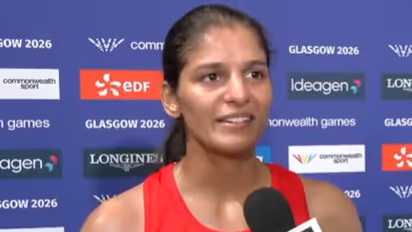
The closing ceremony will also mark the formal transition to India, with Gujarat Deputy Chief Minister Harsh Sanghavi and Sports Ministry Secretary Hari Ranjan Rao representing the country during the handover as Ahmedabad prepares to welcome the Commonwealth sporting family in 2030. Jaismine, who clinched the women's 57 kg boxing gold after defeating defending champion Michaela Walsh in the final, will carry the Indian flag during the ceremony, capping a Games that saw boxing once again emerge as the nation's biggest medal contributor.
Although India's tally was lower than the 61 medals won in Birmingham in 2022, the context tells a different story. Thirty of those medals had come in sports that were dropped from the Glasgow programme. With only 122 athletes compared to 210 four years ago, India still managed to maintain its fourth-place finish while producing an even better medal conversion rate, with 38 athletes returning home with medals. Long-distance runner Gulveer Singh was the only Indian to win two medals.
India's Medal Tally and Standings
Australia dominated the Games with a staggering 171 medals, including 70 gold, while England finished second with 110 medals and Canada claimed third place with 62 medals. India ended level with hosts Scotland on 39 medals but finished fourth courtesy of a stronger gold-medal count.
Sport-Wise Medal Breakdown
Boxing: The Biggest Contributor
The campaign was headlined by boxing, where India reinforced its growing supremacy at the Commonwealth Games by collecting 10 medals, including seven golds. World champion Jaismine Lamboria led the charge, while Sakshi Chaudhary (51kg), Preeti Pawar (54kg), Priya Ghanghas (60kg), Arundhati Choudhary (70kg), Sachin Siwach (60kg) and Ankush Panghal (80kg) also stood atop the podium. Lovlina Borgohain, Jadumani Singh and Narender Berwal added silver medals to complete an outstanding campaign for the Indian boxers.
Weightlifting Delivers Again
Weightlifting once again delivered consistently for India, with Olympic champion Mirabai Chanu continuing her remarkable Commonwealth Games dominance by winning a third consecutive gold medal in the women's 48kg category. Silver medals followed through Rishikanta Singh, Raja Muthupandi, Gyaneshwari Yadav, V. Ajaya Babu, Harjinder Kaur and Lovepreet Singh, while Bindyarani Devi added a bronze to extend her impressive record at the Games.
Historic Breakthrough in Judo
Judo provided one of India's biggest breakthroughs as Asmita Dey scripted history by becoming the country's first-ever Commonwealth Games judo gold medallist after winning the women's 48kg title. Harsh Singh quickly followed by capturing gold in the men's 60kg division, giving India an unprecedented double celebration in the sport. Yamini Mourya claimed silver, while Unnati Sharma secured bronze.
Landmark Performances in Athletics
Athletics produced several landmark performances and emotional stories throughout the Games. Olympian Neeraj Chopra returned to the Commonwealth podium with silver in the men's javelin after a season-best throw of 85.83m, an encouraging result in his comeback from injury. Yash Vir Singh joined him on the podium with a personal-best effort to take bronze. Murali Sreeshankar continued his consistency by winning silver in the men's long jump with an 8.09m leap, while Sarvesh Kushare secured India's first athletics medal of the Games with silver in the men's high jump.
Tejaswin Shankar created history by becoming India's first Commonwealth Games medallist in the men's decathlon, claiming bronze after an outstanding performance across two demanding days of competition. Distance runner Gulveer Singh emerged as one of India's standout performers, winning silver in the men's 10,000m before adding bronze in the 5,000m to become the country's only double medallist in Glasgow.
India also enjoyed consecutive podium finishes in the men's triple jump, where Praveen Chithravel earned redemption with silver after narrowly missing a medal in Birmingham, while Selva Prabhu took bronze. Seema Kaliramna rounded off the athletics medal haul with bronze in the women's discus throw.
Para Athletics Highlights India's Progress
Para athletics underlined the remarkable progress India has made in disability sport, producing multiple historic moments and three double podium finishes. Sharmila Dhankar won gold in the women's shot put F57 with a season-best effort, while Shilpa K. Shyla secured bronze in the same event.
India achieved a memorable one-two finish in the men's 100m T47 as Dilip Mahadu Gavit stormed to gold in a Games record time of 10.71 seconds, with Mohammed Basil M taking silver. Another Indian clean sweep followed in the men's shot put F57, where Soman Rana won gold ahead of compatriot Shubham Juyal, who claimed silver.
India's opening medal of the Games had come through para powerlifter Jhandu Kumar, whose bronze medal set the tone for an impressive campaign.
Not every event ended with a podium finish. On the final day, judokas Ishroop Narang, Avtar Singh and Yash Ghanghas bowed out without medals, while the track cycling contingent fell short of qualification. Sixteen-year-old para cyclist Lisha Das finished sixth in the women's C4-C5 1000m time trial, bringing India's competitive campaign to a close.
Looking Ahead: From Glasgow to Ahmedabad
If Glasgow showcased India's established strengths, it also revealed the country's growing depth. Beyond the familiar excellence in boxing and weightlifting came historic judo golds, milestone performances in athletics, and dominant displays in para sport, reflecting an expanding medal base despite a reduced sporting programme.
The focus now shifts quickly to the Asian Games, just weeks away, while the closing ceremony signals the beginning of India's journey towards hosting the Commonwealth Games once again. As the baton and Commonwealth Games flag pass from Glasgow to Ahmedabad, India leaves Scotland with 39 medals, countless breakthrough performances and renewed confidence that the country's next chapter on the Commonwealth stage may be even bigger on home soil in 2030.
(Except for the headline, this story has not been edited by Asianet Newsable English staff and is published from a syndicated feed.)