India vs Pakistan could happen THRICE at Asia Cup 2025: Should Men in Blue even play after Pahalgam bloodshed?
Synopsis
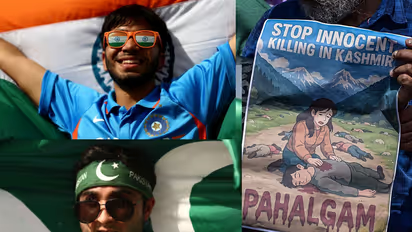
The Asia Cup 2025 is reportedly set to proceed in the UAE despite rising India-Pakistan tensions post-Pahalgam attack, with three potential high-voltage clashes between the arch-rivals in just 21 days.
Cricket fans across the subcontinent may soon be treated to one of the sport's biggest rivalries—not once, but possibly three times—in the span of just three weeks. The Asia Cup 2025, which was in serious doubt following the April terrorist attack in Pahalgam and India's subsequent military response through Operation Sindoor, now appears to be going ahead.
According to The Times of India, the tournament is likely to begin on Friday, September 5, with a mouth-watering India vs Pakistan clash scheduled for Sunday, September 7. If both teams qualify for the Super Four stage, they could face off again on September 14, and, should they make it to the summit, one final showdown could take place on September 21.
But this isn’t just about cricket anymore.
A Game Shadowed by Bloodshed
The upcoming tournament is taking shape under the heavy shadow of one of the deadliest terror attacks on Indian civilians in recent years. The Pahalgam assault, which left 26 people dead, wasn't just a random act of violence. It targeted Indian tourism, disrupted Kashmir’s fragile peace, and, according to government officials, was designed to ignite communal tensions.
External Affairs Minister S Jaishankar, speaking in New York on Tuesday, pulled no punches. Addressing a gathering at Newsweek's office near Ground Zero, he said: “This was not an accident. It was an act of economic warfare. It was meant to destroy tourism in Kashmir, which was the mainstay of the economy.”
Even more chilling was his account of the terrorists’ actions during the attack: “It was also meant to provoke religious violence because people were asked to identify their faith before they were killed.”
India Strikes Back: Operation Sindoor
India’s response came swiftly. In what has described as a precision retaliatory strike, Indian forces carried out Operation Sindoor, targeting multiple terror camps and launchpads deep inside Pakistan and Pakistan-occupied Kashmir. The move signalled a marked shift from India’s older stance of strategic restraint.
“We are very clear there will be no impunity for terrorists,” Jaishankar said. “We will not deal with them any longer as proxies and spare the government which supports and finances and in many ways, motivates them.”
He also pointed to a recurring pattern of international responses that had previously urged India to “show restraint” because of nuclear risks in the region.
Jaishankar rejected that logic: “We've also heard this for too long... that both India and Pakistan are nuclear countries and therefore the other guy will come and do horrible things, but you mustn't do anything because it gets the world worried.”
“Now we are not going to fall for that. If he is going to come and do things, we are going to go there and also hit the people who did this.”
Asia Cup Logistics: Format, Venue, and Teams
In the midst of this geopolitical tension, the cricketing world has quietly been preparing for the Asia Cup 2025, a tournament that was originally supposed to be hosted by India.
But given the mutual decision by both India and Pakistan to not travel to each other’s territory, the United Arab Emirates has emerged as the likely neutral venue. The format will mirror recent editions, with a Group Stage followed by Super Four, all played in the T20 format to serve as a warm-up for next year’s ICC T20 World Cup.
The participating teams include:
- India
- Pakistan
- Sri Lanka
- Bangladesh
- United Arab Emirates
- One team still to be confirmed (likely from qualifiers)
The Asian Cricket Council (ACC), currently headed by Pakistan's Interior Minister Mohsin Naqvi, is expected to officially release the tournament schedule in the first week of July, according to Cricbuzz. However, insiders suggest that no final decision has been made yet, and discussions are still ongoing.
The Bigger Question: Should India Be Playing Pakistan?
With every announcement about the Asia Cup schedule, a deeper question emerges—should India even be playing Pakistan at this moment in time?
The public sentiment, especially among families affected by the Pahalgam attack, is raw. Many believe that participating in a bilateral contest—even under the garb of a multi-nation tournament—amounts to business as usual with a state accused of facilitating terror.
Jaishankar’s words resonate here more than ever: “Terrorism is actually a threat to everyone... there should be zero tolerance... no circumstances, no excuse, no justification under which a country would allow, support, finance or sponsor terrorist acts.”
“These are terrorist organisations who have the equivalent of their corporate headquarters in the populated towns of Pakistan. Everybody knows what is the headquarters of organisation A and organisation B—and those are the buildings that India destroyed.”
In light of that, cricket fans and political analysts alike are questioning whether a high-profile cricket match—watched by millions and commercialised with glitzy promotions—should proceed at all.
Between Diplomacy and Drama
India and Pakistan have always had a complicated cricketing history. Matches between the two countries have often been described as war without weapons, or as sporting diplomacy. But this time, the context is darker, the wounds fresher.
Unlike previous editions of the Asia Cup, this one comes at a time when the Indian government has taken a firm stand: no impunity, no appeasement, and no illusions about who is responsible for violence.
And yet, the tournament reportedly remains on track.
There’s no denying the excitement, the hype, and the immense public interest around an India-Pakistan clash. It sells tickets, grabs eyeballs, and becomes the stuff of prime-time drama.
But this time, the stakes go far beyond cricket.
Whether India ultimately takes the field against Pakistan will be a call not just made in cricketing boardrooms, but in the corridors of power. It will be a decision shaped by national sentiment, security considerations, and foreign policy signals.
Because sometimes, a match isn’t just a match. It’s a message. And in the case of Asia Cup 2025, it could be the loudest one yet.