‘Career Had Become a Burden’: Yuvraj Singh Reflects on Losing the Joy of Playing Cricket
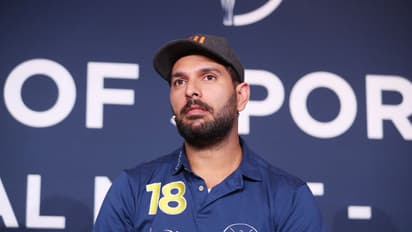
Synopsis
Former Indian all-rounder Yuvraj Singh looked back on his illustrious career, defined by World Cup triumphs and a courageous battle with cancer. He revealed that toward the end, cricket felt like a burden, leading him to retire.
Former all-rounder Yuvraj Singh’s name still resonates even today in Indian cricket, as he played a crucial role in the team’s success, including the 2007 T20 World Cup and the 2011 ODI World Cup wins. The kind of impact Yuvraj had on Team India was immense, shaping matches and defining an era of Indian cricket, which few players matched in terms of flair, consistency, and the ability to win crucial matches.
Having played under Sourav Ganguly and MS Dhoni, two of India’s most successful captains, Yuvraj Singh developed into a versatile match-winner, learning to balance aggression with composure, and became a key figure in high-pressure games for Team India.
The flamboyant all-rounder’s India career trajectory looked unstoppable until cancer struck in 2011, forcing him to face the toughest battle of his life, one that sidelined his career almost completely but also showcased his resilience and determination on and off the field. The disease had almost ended his peak career, which saw him dominate world cricket with match-winning performances across formats.
‘I Was Not Feeling Respected’
Yuvraj Singh made his comeback to Team India in 2012, but he struggled to regain his pre-illness form consistently, with mixed performances in limited-overs cricket and fewer opportunities in major tournaments, eventually phasing him out of the setup.
Yuvraj knew that his days in the Indian team were nearing when former captain MS Dhoni candidly told him that the selectors were no longer looking at him for the future World Cups, especially 2019, giving him clarity on his fading role in the team. That time, the all-rounder began to experience a disconnect from the sport he once loved.
Speaking to former Indian tennis star Sania Mirza on her YouTube channel, ‘Serving it Up with Sania’, Yuvraj Singh stated that his career reached a point where it felt like a burden, as he was no longer enjoying the sport and felt neither respected nor supported, prompting him to question why he was still playing cricket.
“I got to that stage where my career had become a burden. So, I was not enjoying my game. It’s a very thin line,” Yuvraj said.
“I had a feeling that ‘why am I playing cricket when I’m not enjoying it?’ I was not feeling supported. I was not feeling respected. And I feel ‘Why do I need to do this when I don’t have it?' he added.
After making India's comeback in 2012, Yuvraj Singh played for five more years, featuring in the 2014 and 2016 T20 World Cups and 2017 Champions Trophy, with his last appearance in the Indian jersey coming in an ODI match against West Indies in 2017.
‘The Day I Decided to Stop, I Was Myself Again’
Between 2014 and 2017, Yuvraj Singh endured a tough period of his career, as he scored just one century and a fifty and averaged 27.24 in 35 matches. The rough patch in the final three years of his career further deepened his mental struggle.
Reflecting on his decision to step away from the game, the former all-rounder stated that continuing to play no longer made sense when the joy was again, adding that once he chose to walk away from the sport, he felt himself again.
“When the game has given me so much, I’ve given my best. So why am I lingering on to something that I’m not enjoying? Why do I need to play? To prove what? I can’t do more than this, mentally or physically. It was hurting me, so I decided to stop. The day I decided to stop, I was myself again.” Yuvraj Singh said.
Two years after his last appearance in the Indian jersey, Yuvraj Singh announced his retirement from all forms of cricket in June 2019.
In his international career. Yuvraj amassed 11139 runs, including 17 centuries and 71 fifties, at an average of 34.98 in 399 matches. He also picked 147 wickets, including two four-wicket hauls and a fifer, at an average of 35.87 and an economy rate of 4.98.