Gen Z Buys More, Trades Less: New Data Challenges the Stereotype

Synopsis
Gen Z is challenging its reputation as a generation of speculative investors. New trading data shows they buy and hold more, trade less frequently than older cohorts and are increasingly putting money into ETFs and other diversified investments.
For ten years the story about young investors has been the same one. They chase meme stocks, they buy crypto, they treat the market like a casino. The evidence behind it was always thin. It came from what they held and from surveys asking how much risk they would take, not from how often they actually bought and sold. Nobody could count that, because a young person's stocks, options and crypto usually sat with three different firms behind three different logins.
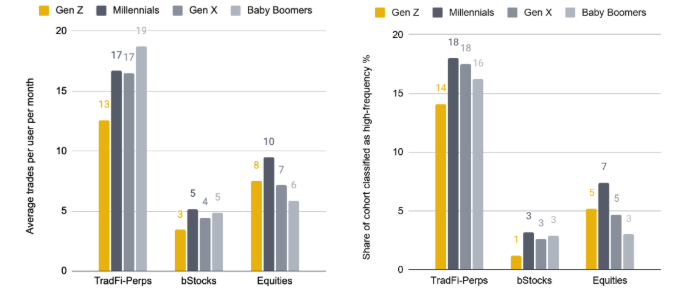
Put all three behind one login and you can count. The result does not flatter the stereotype. Gen Z accounts trading perpetual futures on traditional assets averaged 13 trades a month in early August, according to Binance Research. Millennials averaged 17, Gen X 16.5, and Baby Boomers 19.
The generation everyone calls the speculators is the one trading least.
The Stereotype Is a Behavioral Claim, and Behavior Leaves Records
The case against this cohort has almost always been built from portfolio composition. Holding digital assets, or holding volatile equities, gets treated as proof of a speculative mindset, and the conclusion follows without anyone checking the next step. Composition describes what an investor bought. It says little about what they did afterward.
Those two questions collapsed into one for a practical reason: equities, derivatives and digital assets lived at different firms under different regulators, so watching the same person across all three was rarely possible. The first cross-product measurements point toward holding rather than trading.
Binance Research found 76% of Gen Z tokenized-equity accounts were net accumulators in August 2026, ahead of Millennials at 67%. The pattern carries across products: 77% accumulated in direct equities against 74% for Gen X and 68% for Baby Boomers, and 60% did so in traditional-finance perpetuals.
"Our data shows that 76% of Gen Z tokenized-equity accounts are net accumulators, the highest share of any cohort we serve," says Eowyn Chen, Interim CMO at Binance. "Now that they have access, they're not just trading. They're building positions and holding for the long term."
A net-buying majority on a derivatives book carries less weight than it first sounds, since the average net flow ratio there sits under 1% of gross volume. Conceding that is what makes the direct-equity reading worth attention, where the Gen Z net flow ratio reached 26.5% and average net inflow ran to $1,898 per account.
Turnover Is the Number Nobody Self-Reports
Risk tolerance is self-assessed. Sentiment is arguable. Trade count is a fact about an account, and it comes closer than anything else in retail investing to an objective behavioral measure. It is also where a speculative reputation should be most visible, since churn is what people usually mean by the label.
Young investors are also arriving earlier. Charles Schwab's Modern Wealth Survey puts the average age at 19 for Gen Z, against 25 for Millennials and 35 for Baby Boomers, and the World Economic Forum finds roughly a third started in university or early adulthood, about double the Millennial rate at the same stage. Early entry normally predicts high turnover. Here the order flow runs the other way.

Alongside those 13 monthly trades in perpetual futures, the Gen Z median sits at four, roughly one a week, and in direct equities the cohort averages eight monthly trades against 10 for Millennials.
Tokenized shares are slower still. "In bStocks, Gen Z averages just three trades a month, the lowest of any cohort, with a clear tendency to accumulate," Chen says. "They may be coming in through crypto, but they're approaching traditional assets with a longer-term investment mindset."
The tail matters more than the average. Only 14% of Gen Z perpetuals accounts fall into the high-frequency bucket against 18% for Millennials and 18% for Gen X as well as 16% for Baby Boomers. The visible, highly active minority that shapes public perception of young traders is proportionally smaller inside this cohort than inside the generations above it, which makes this a claim about sampling rather than character.
Where the New Money Actually Goes
Net buying gives direction and turnover gives pace. Neither settles what kind of investor someone is. Destination comes closer, because an allocator concentrates in pooled, diversified instruments and then leaves them alone, and a trader rarely does.
Independent retirement data points the same way. Fidelity reports 95% of Gen Z contributions to individual retirement accounts in the third quarter of 2025 went into Roth accounts, against 75% for Millennials, and Vanguard finds 47% of Gen Z workers on track to be ready for retirement, ahead of Millennials at 42%.
The same profile shows up in how new capital gets routed on the platform. Unleveraged ETF funds took 18.5% of Gen Z net equity inflow in June and 21.9% in July while the single-stock share fell from 77.0% to 74.2%.
On volume the shift is sharper, moving from 14.6% in June to 21.4% in July and 25.0% in the first days of August against 9.5% for Millennials over that same window.
July showed how allocations changed as Gen Z’s net equity inflows slowed. Total Gen Z net equity deployment fell 17.4% that month, but net inflow to unleveraged ETFs slipped only 2.0%, against a 20.4% drop in single stocks and a 28.5% decline in leveraged products. Gen Z was the only cohort whose ETF holder base grew, up 2.9% against declines of 4.5% and 5.9% above it, and its ETF buyers traded least of anyone, at 7.9 times against 10.3 for Millennials. "Even so, the early pattern of more ETF and less single stock usage, runs counter to a pure speculation thesis," Binance Research notes.
Two months of order flow in a rising market does not establish a trend, and the direct-equity product only reached scale in June 2026. This is also the generation that posted the lowest score of any cohort on the TIAA Institute-GFLEC personal finance index, at 38%.
Measured, Not Assumed
The argument over how this generation invests has run for a decade on survey data and anecdote. The useful development is subtler than a winner: the question became measurable, through order flow rather than questionnaires. Whether the pattern survives a market that stops rising is what the coming quarters will answer.