XPEV Jumps In Hong Kong: Xpeng Flips The Switch On Humanoid Robot Mass Production — And Says Margins Could Beat EVs
Synopsis
XPeng says its new robot, IRON, is slated for mass production by year-end as the Chinese automaker takes on Tesla’s Optimus ambitions.
- XPeng says IRON is the first humanoid robot to complete assembly and walk off its automated production line, with more than 80% of core manufacturing processes automated.
- The company expects humanoid robots to generate significantly higher gross margins than EVs and recently raised $900 million for its robotics business at a $6.3 billion valuation.
- XPEV is down more than 45% in 2026, and retail sentiment remains “bearish,” despite Wall Street maintaining a ‘Strong Buy’ consensus and seeing roughly 79% upside.
Xpeng, Inc.'s stock rose nearly 1.5% in Hong Kong after the Chinese EV maker claimed it had switched on the world's first automated production lines for advanced humanoid robotics, which it expects to be more profitable than electric vehicles.
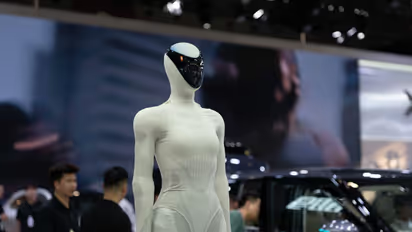
Its robot, called IRON, became the first to walk off the line under its own power after completing the assembly, the company said. Xpeng is positioning this as the moment humanoid robotics moves from laboratory prototype to actual manufactured product.
What Is Xpeng’s IRON?
IRON is Xpeng's flagship humanoid robot, designed to move and look like a human and driven by onboard AI, meaning it can perform complex tasks autonomously without remote control. The company claims IRON has 76 degrees of freedom, with 21 degrees of freedom in each hand alone, giving it unusually fine dexterity as it aims to implement human-like joint flexibility.
The robot runs on three proprietary AI chips delivering substantial onboard computing power, and Xpeng says its AI models will run directly on the robot rather than in the cloud.
Xpeng is leaning heavily on its EV manufacturing expertise to build robots at scale. The company said in a statement that production lines are built to automotive-grade quality standards, with over 80% of core processes automated. Xpeng argues that the discipline and precision required to mass-produce electric vehicles translates directly into an advantage in robot manufacturing, something pure robotics startups currently lack.
On the social media platform X, where the launch video was gaining heavy buzz, XPeng CEO Xiaopeng He called it "uncharted territory" and said, "We solved it from scratch." He hopes that this robot gains "true generalization ability to take on dangerous, repetitive, or undesirable tasks and ultimately make life better."
Could XPENG's IRON Actually Be Profitable?
In its press release, Xpeng made a pointed claim about profitability, saying that since advanced humanoid robots are technically complex and supply is limited, it expects gross margins per robot to be significantly higher than those on its electric vehicles. Given that EV margins across the industry are notoriously thin, that statement carries more weight.
Xpeng’s robotics unit has already attracted serious investor interest, having recently closed a $900 million private funding round at a post-money valuation of $6.3 billion, which the company said was the largest single round raise in China's embodied AI sector to date.
Did Xpeng Just Beat Tesla To The Punch On Humanoids?
Xpeng's robotic themes overlap a lot with those of Tesla's. The general-purpose humanoid angle is literally the same as what Musk has said about Optimus: vision models, custom AI chips, and using factory know-how from cars to robots.
Musk has repeatedly called Optimus Tesla's future and potentially the biggest product of all time, and has even talked about converting the Fremont factory space to robot lines and floated million-unit-per-year ambitions. But earlier this year, he flipped from aggressive volume talk to saying Optimus is "the hardest product to scale manufacturing that we've ever made."
Musk has also acknowledged that China will be by far the toughest rival in humanoids because it can scale manufacturing and AI. Xpeng is now claiming a finished production event, whereas Musk has claimed production starts, line photos, and a huge future volume, but later conceded that Optimus was still in R&D mode and not doing useful factory work in material volume.
Regarding the business of humanoid robots, Musk did say in 2022 that Optimus has the potential to be more significant than Tesla's vehicle business over time. Three years later, he said Optimus would be roughly 80% of Tesla's value. In successive earnings calls and interviews, he said Tesla's humanoid robot could have long-term revenue "north of $10 trillion."
Xpeng says IRON will enter mass production by the end of 2026, with initial deployments in its own stores and facilities. A full commercial launch in China and overseas markets is planned next year.
XPEV Stock: Wall Street Vs Retail Street
The company's U.S.-listed stock has tumbled hard this year, after soaring over 71% in 2025. It is down more than 45% year to date and on a streak of 52-week lows, as widening losses and a weaker-than-expected delivery outlook prompted price target cuts from several analysts.
The mood on retail street has been gloomy, to say the least. On Stocktwits, sentiment for XPEV has been bearish for the past few weeks, and message volumes over the past three months indicate that interest in the stock, among the worst 10 performing auto equities this year, has been dipping.
Traders on the platform have been disappointed with fundamentals and technicals.
“The goal of 500,000 car deliveries in 2026 is no longer realistic. They would have to deliver 64,000 each month for the rest of the year,” said one user.
View this Stocktwits post
“Congrats to those that sold at $25+ 10 months ago, you were smart. I was dumb rookie,” posted another user. “I thought things were looking good and we will be over $30 this year; now we might not see $30 even by the end of next year the way things are going”
View this Stocktwits post
On Wall Street, however, XPeng has managed to retain bullishness overall: 26 analysts covering the stock have a consensus rating of ‘strong buy’, while their average price target indicates that XPEV stock is trading at a whopping 79% discount to fair price.
For updates and corrections, email newsroom[at]stocktwits[dot]com.<
Stay updated with all the latest Business NewsShare Market NewsIPOsGold PriceDA Hike8th Pay CommissionAsianet News Official App