WMT Vs TGT: Walmart Has The Scale, Target Has Turnaround Momentum — Which Retail Stock Looks Better Now?

Synopsis
Walmart and Target showed different trends, with Walmart facing weaker U.S. sales and valuation concerns, while Target’s stronger customer traffic and improving business boosted investor confidence.
- Walmart reported strong overall revenue growth, but slowing U.S. comparable sales and weaker store traffic raised concerns about consumer demand.
- Target, meanwhile, showed stronger traffic and comparable-sales growth, suggesting its turnaround is gaining traction.
- Wall Street is growing cautious on Walmart as slower U.S. sales challenge its premium valuation.
Walmart Inc. (WMT) and Target Corp. (TGT) are showing different trends in the U.S. retail market. Walmart’s latest earnings print shows slower store sales despite strong online growth, while Target’s business continues to improve, boosting its turnaround story. Both raised their full-year outlooks, but investors are closely watching Walmart’s valuation and Target’s recovery.
Two Very Different Outcomes For TGT And WMT Stocks
Target and Walmart delivered sharply different stock-market reactions to their fiscal second-quarter earnings results this week. Target stock climbed to a 52-week high on Wednesday and is on track for a fourth straight week of gains, while Walmart stock tumbled over 8% on Thursday post-earnings, clocking its worst day in over four years as investors focused on softer sales growth. The stock si also headed toward its worst week infour years.
Both companies are using online sales, advertising and memberships to increase profits while passing tariff savings on to customers. However, Walmart’s higher stock valuation meant investors expected more, while Target’s lower valuation made its improving results more attractive.
Walmart's U.S. Sales Weakness Faces Off With Target's Turnaround
Walmart’s sales rose 5.9% to $186.1 billion, and the company raised its outlook, but weaker U.S. sales worried investors. Comparable sales increased just 2.6%, the slowest growth since 2020, while in-store sales fell by low single digits for the third straight quarter.
Net income fell 9.4% to $6.37 billion due to equity-investment losses, and CFO John David Rainey's own framing that store comparable sales are becoming "a legacy fixation" as e-commerce and store-fulfilled digital orders reiterates that the core physical retail business is not performing well. A raised full-year outlook (4-5% sales growth, up from the previous 3.5-4.5%) wasn't enough to offset the fact that the one number investors watch most closely — core U.S. demand is visibly losing momentum just as fuel costs and pharmacy deflation squeeze the model further.

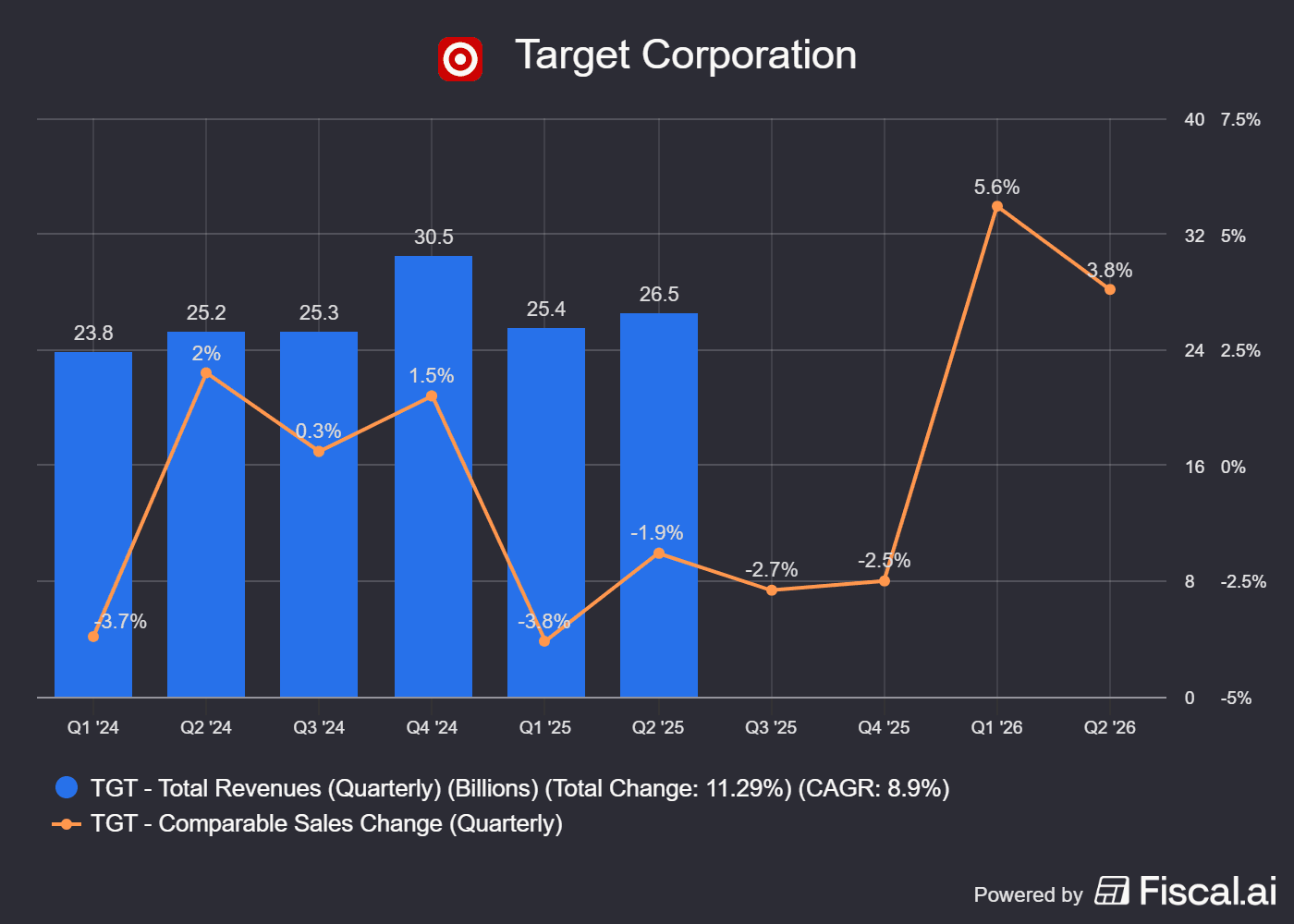
Meanwhile, Target's Q2 gives the clearest signal yet that a three-year sales slump is ending. Comparable sales rose 3.8% on higher traffic and the company raised full-year sales guidance to around 5% growth along with adjusted EPS guidance of $9.90-10.90. New CEO Michael Fiddelke's merchandise overhaul — new exclusive products, a packaged-food refresh that drove double-digit snack growth, and back-to-school sales up nearly 20% — is starting to show up in the traffic numbers.
Tariff Refund Booster – But Market Action Showed Divergence
Both Walmart and Target used tariff refunds to support lower prices, but investors reacted differently.
Walmart’s $2.9 billion refund helped its results but failed to offset weaker comparable sales. Target’s $994 million refund boosted earnings while stronger traffic signaled a real recovery, making its results more convincing to the market.
Wall Street Reasseses WMT’s Premium, While Raising TGT Targets
Walmart is facing growing scrutiny from Wall Street after a slowdown in U.S. sales growth raised questions about whether its premium valuation can be sustained. Gordon Haskett downgraded WMT to ‘Accumulate’ from ‘Buy’ and assigned a $110 price target, pointing to another quarter of slower U.S. comparable sales.
The firm remains bullish on Walmart's longer-term position but argues that weaker customer traffic and a lofty valuation create a tougher near-term setup.
Wells Fargo also reduced its Walmart price target, taking it to $120 from $140 while maintaining an ‘Overweight’ rating. The firm continues to view Walmart as having a powerful competitive moat, but said the recent comparable-sales performance complicates the investment case.
On the other hand, Target is gaining Wall Street’s support as analysts raise their price targets. Telsey Advisory and RBC Capital both see evidence that Target's turnaround is gaining traction, with improving consumer response strengthening the case for further gains.
Telsey Advisory analyst Joseph Feldman lifted his price target to $182 from $170 while maintaining an ‘Outperform’ rating, implying a 15% upside to teh stock’s last closing price. RBC Capital also increased its Target price target, moving it to $178 from $166 while retaining an ‘Outperform’ recommendation.
According to Koyfin data, Walmart is trading at a higher forward price-to-earnings (P/E) multiple of roughly 33.8. Target trades at a multiple of 17.1, offering investors greater upside as its turnaround gains traction.
TGT, WMT Stocks: Retail Is Bullish
On Stocktwits, retail sentiment around Target remained in ‘extremely bullish’ territory while Walmart’s sentiment improved to ‘extremely bullish’ from ‘bullish’ territory the previous day.
A user said, “Walmart still looks great. Lower prescription costs are all that changed.”
Another user said, “$TGT Holding steady at a point a day!! Yea new CEO and two great earnings reports!! to 175-200!”
So far this year, while WMT stock has gained over 1%, TGT stock has surged over 60%.
For updates and corrections, email newsroom[at]stocktwits[dot]com.<
Stay updated with all the latest Business NewsShare Market NewsIPOsGold PriceDA Hike8th Pay CommissionAsianet News Official App