US Stock Market This Week: Are SPY, QQQ Beating Asian Equities?

Synopsis
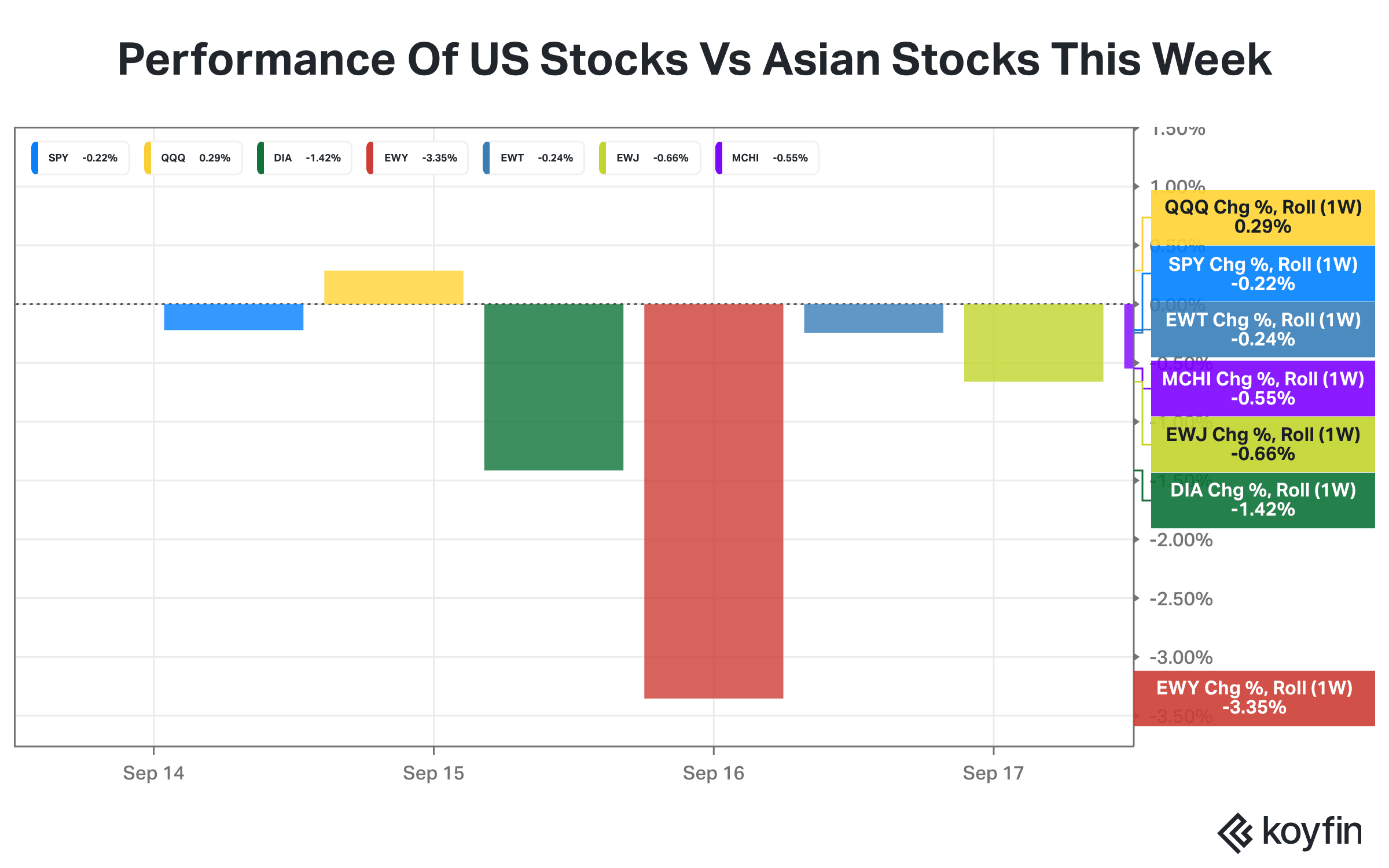
The Nasdaq index in the U.S. is set to post weekly gains, while the Dow and S&P 500, along with Asian markets including China, Japan, Taiwan, and South Korea, are on track to end the week in the red.
- The Nasdaq is on track to end the week higher amid a tech-led rebound in the U.S.
- Asian markets trailed U.S. markets this week, also pressured by higher oil prices, a global rise in bond yields, and tighter monetary policy expectations.
- However, Asian stocks rebounded on Friday after Wall Street’s tech-led rally and easing oil prices.
U.S. stock markets saw a volatile week through Sept. 17 as the Federal Reserve's key interest rate decision, along with rising oil prices and long-dated Treasury yields, weighed on investor sentiment.
Meanwhile, top Asian markets, including China, Japan, Taiwan and South Korea stocks, also trailed U.S. markets in volatility to trend lower.
However, the tech-heavy Nasdaq index is the only one on track to post gains this week, outperforming its U.S. counterparts and Asia-indexed funds.
US Markets Vs Asia Markets
The Invesco QQQ Trust (QQQ), which tracks the Nasdaq, is on track to post gains this week, while the SPDR S&P 500 ETF Trust (SPY) and SPDR Dow Jones Industrial Average ETF (DIA) are on track to end the week lower.
Meanwhile, the iShares MSCI China ETF (MCHI), iShares MSCI Japan ETF (EWJ), iShares MSCI Taiwan ETF (EWT), and iShares MSCI South Korea ETF (EWY) are also on track to end the week lower.
What’s Driving Nasdaq Higher?
The Nasdaq is on track to end the week higher amid a tech-led rebound in the U.S. following the Federal Reserve’s first interest rate hike in three years, which led to a decline in oil prices and long-dated U.S. Treasury yields that had been climbing to multi-year highs earlier in the week.
On Thursday, the index jumped 1.69%, its steepest climb in more than six weeks. Semiconductor stocks buoyed the index, with top chipmakers like Nvidia Corp. (NVDA), Micron Technologies (MU), and Advanced Micro Devices (AMD) posting gains at the close, as markets appeared to dismiss recent fears about AI's rapid growth. Software stocks also posted significant gains.

Rebecca Walser, CEO of Walser Wealth Management, said in an interview with Schwab Network that markets “have to be invested in the technology revolution,” despite potential volatility ahead of the mid-term elections.
What’s Happening In Asian Markets?
Asian markets trailed the U.S., also pressured by higher oil prices, global rise in bond yields, and tighter monetary policy expectations.
However, the markets rebounded on Friday after Wall Street’s tech-led rally and easing oil prices.
South Korea’s KOSPI was up more than 2.6% at the time of writing, led by Samsung Electronics and SK Hynix, as lower oil prices eased inflation concerns and boosted sentiment toward chip stocks.
Japan’s Nikkei rose about 1.4% after the Bank of Japan raised rates from 1.00% to 1.25%, a 31-year high. However, the decision passed 7-2, with Toichiro Asada and Ayano Sato dissenting from the hike as markets viewed the split decision as less aggressive than those of global peers.
Taiwan’s TAIEX jumped nearly 2% higher, also benefiting from the global tech rebound, while its central bank kept rates unchanged for a tenth consecutive quarter at 2.000%.
Chinese stocks also gained amid optimism around potential U.S.-China trade talks, as markets watch for the central bank’s September policy decision. China is widely expected to leave benchmark lending rates steady for a 16th consecutive month, as per a Reuters survey.
Retail Stance: US Vs Asia Markets
On Stocktwits, retail sentiment around SPY and QQQ was ‘bearish’ at the time of writing, while it was ‘extremely bearish’ for DIA.
Meanwhile, retail sentiment around MCHI and EWJ was ‘bullish ’, while it was ‘neutral’ for EWT and EWY.
For updates and corrections, email newsroom[at]stocktwits[dot]com.<
Stay updated with all the latest Business NewsShare Market NewsIPOsGold PriceDA Hike8th Pay CommissionAsianet News Official App