US Reportedly Considers 7.5% Tariffs On Chinese Goods Ahead Of Trump-Xi Meeting Next Month
Synopsis
According to a Bloomberg report on Monday, the proposed tariff would raise the duties on Chinese goods to about 20%.
- The final rate has not been decided and could still change, the report read.
- On Monday, Trump said that U.S. tariffs on Canadian cars, trucks, automotive parts and steel will rise to 50% on Jan. 1, 2027.
- Canada announced retaliatory tariffs that will take effect in September.
The U.S. is reportedly preparing to impose a 7.5% tariff on Chinese goods amid concerns about excess manufacturing capacity, while President Donald Trump has announced 50% tariffs on certain Canadian goods.
According to a Bloomberg report on Monday, the proposed tariff would raise the duties on Chinese goods to about 20%, which would remain within the limits of its trade agreement with the U.S., according to China’s earlier statement.
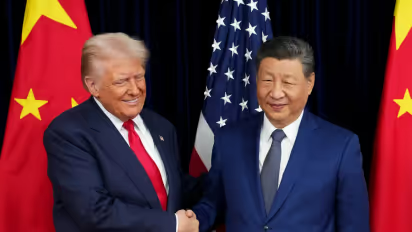
Trump and Chinese President Xi Jinping are set to meet next month in Washington.
The final rate has not been decided and could still change. One option is to announce a higher tariff but temporarily pause part of it, meaning Chinese goods would face an effective rate of 7.5%, according to one source cited by Bloomberg.
New Legal Route For Trump’s Trade Agenda
In March, the U.S. Trade Representative, Jamieson Greer, opened an investigation into whether China and other countries are producing excess capacity in manufacturing sectors. Washington argued that the excess production can lead to cheap exports that hurt U.S. manufacturers.
The probe used Section 301, a trade law that could provide stronger legal support for new tariffs.
Officials reportedly want to finish the China review before Trump meets Xi next month, with the two countries considering extending their trade truce beyond its Nov. 10, 2026 expiration date.
Canada Faces 50% Tariffs
On Monday, Trump said that U.S. tariffs on Canadian cars, trucks, automotive parts and steel will rise to 50% on Jan. 1, 2027. In a Truth Social post, Trump accused Canada of taking advantage of the U.S. and pointed to a $60 billion trade deficit.
“On January First, 2027, Tariffs on all Cars, Trucks, both large and small, Automotive Parts, and Steel, will be increased to 50%,” Trump said.
U.S. Trade Representative Jamieson Greer said negotiations collapsed after Canada sought bigger tariff relief, including for heavy trucks. Washington said it had already offered concessions covering automobiles, steel, aluminum and softwood lumber.
Canada has announced retaliatory tariffs that will take effect in September.
At the time of writing, the SPDR S&P 500 ETF (SPY) was down 0.17%, and the Invesco QQQ Trust (QQQ) dropped over 0.7%. Meanwhile, the SPDR Dow Jones Industrial Average ETF (DIA) traded around 0.2% higher. Retail sentiment around SPY on Stocktwits remained in ‘bearish’ territory over the past 24 hours.
Also read: SLS Traders Eye This Important Resistance Zone Ahead Of Key AML Data Readout
For updates and corrections, email newsroom[at]stocktwits[dot]com.<
Stay updated with all the latest Business NewsShare Market NewsIPOsGold PriceDA Hike8th Pay CommissionAsianet News Official App