Trump May Have Scored A 'Self-Goal' With Tariffs, Says Ex-Indian Central Bank Chief Rajan: 'US Consumers Will Not Be Able To...'
Synopsis
He said that since the tariffs are sweeping and almost all-pervading, their overall impact on the Indian economy is smaller relative to what would have been if they had been unilaterally levied on the country alone.
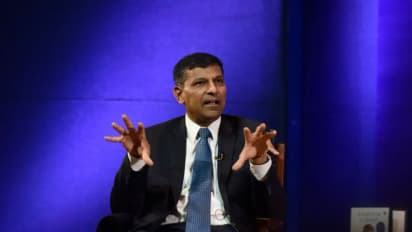
Former Reserve Bank of India Governor Raghuram Rajan downplayed the impact of President Donald Trump's "Liberation Day" tariffs on India even as the financial markets swooned in response to the measures.
Rajan, a former IMF chief economist, called Trump's tariffs on about 60 countries a "self-goal," the Press Trust of India reported.
"Let us recognize that in the short run, this will adversely affect the U.S. economy first and foremost — it is a self-goal, as footballers would say," the economist said.
Rajan said the direct effect of the tariffs on goods exported to the U.S. from India will be a rise in prices for U.S. consumers, which will temper demand for the goods and hurt India's growth.
Trump announced a 26% "discounted reciprocal" levy on India, which is lower than the 34% rate applicable to China.
Rajan said that since the tariffs are sweeping and almost all-pervading, their overall impact on the Indian economy is smaller relative to what would have been if they had been levied on the country alone.
"U.S. consumers will not be able to substitute away to non-tariffed producers," the economist said.
Rajan, who now serves as a Katherine Dusak Miller Distinguished Service Professor of Finance at the University of Chicago's Booth School of Business, said the reciprocal tariffs will likely be disinflationary for India as the country consumes more domestically and exports less.
He said India will likely receive imports from other countries, such as China, in a tariff regime, helping to keep prices down. Rajan added that it pays to build strong relations with China and SAARC nations, a coalition of South Asian countries.
Trump's tariff announcement on Thursday sent the financial markets into a tailspin, but analysts and economists are hopeful the U.S. president will relent and thrash things out.
Former Treasury Secretary Larry Summers said the best estimate of the loss for the U.S. from tariff policy is now about $30 trillion or $300,000 per family of four.
The iShares MSCI India ETF (INDA) exchange-traded fund ended Thursday’s session down 0.74% at $51.18. The ETF is down merely 2.8% year-to-date compared to the 8% drop by the SPDR S&P 500 ETF Trust (SPY).
For updates and corrections, email newsroom[at]stocktwits[dot]com.<
Stay updated with all the latest Business NewsShare Market NewsIPOsGold PriceDA Hike8th Pay CommissionAsianet News Official App