Trump Administration Plans Post-War Middle East Strategy To Contain Iran, Expand Normalization Between Israel And Regional Neighbors — SPY, QQQ, DIA In Focus
Synopsis
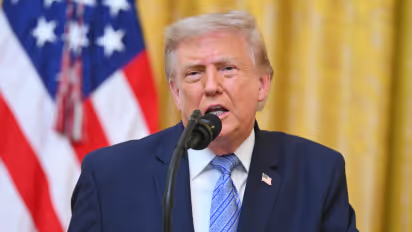
Donald Trump has reportedly discussed the emerging strategy with senior advisers in two meetings in recent weeks.
- Trump has held two meetings with senior advisers to discuss the emerging Middle East strategy, reported Axios.
- The plan could involve a U.S.-backed regional coalition aimed at countering Iran.
- Washington is also considering steps involving Gaza, Israel-Syria ties and the Israel-Lebanon agreement.
The Trump administration is reportedly drawing up a post-war Middle East strategy aimed at limiting Iran’s influence, strengthening regional partnerships and advancing the normalization of ties between Israel and neighboring countries.
The strategy remains in its early drafting phase and is expected to shape Washington’s Middle East policy once the war with Iran ends and during the final two years of President Donald Trump’s term, Axios reported, citing two U.S. officials and two other people familiar with the matter.
The planning comes ahead of Israel’s October 27 elections and the U.S. midterm elections in November.
Trump Discusses Broader Middle East Strategy
The strategy is being developed at both the senior political level of the Trump administration and across various government agencies, according to U.S. officials.
Trump has discussed the plan with senior advisers in two meetings in recent weeks, during which potential ideas were considered. He has also privately indicated that he is working on “something much bigger” for the Middle East once the war with Iran ends, Axios reported.
Three Areas Under Consideration
According to the sources, three main elements have emerged as possible parts of the strategy.
One would involve building a regional coalition of U.S. allies to counter Iran, with Washington acting as its guarantor.
The second is seeking to bring the regional fallout from the October 7, 2023, Israel attacks closer to a conclusion. That could include securing the next phase of Trump’s Gaza plan, reaching a security agreement between Israel and Syria and implementing the Israel-Lebanon agreement.
The third would seek to broaden the Abraham Accords and pursue a normalization deal between Saudi Arabia and Israel.
Israel Election Could Shape Strategy
The Trump administration hopes that any new Israeli government formed after the October 27 elections will be willing and able to cooperate with the post-war strategy, according to Axios.
A source briefed on the process said it could take several more weeks to complete the strategy, adding that the broader goal is to bring multiple regional issues together and create a new regional alignment after the war.
SPY, QQQ, DIA: Retail Sentiment
At the time of writing on Friday afternoon, U.S. equities were mixed. The SPDR S&P 500 ETF (SPY), which tracks the S&P 500 index, was down 0.38%, and the SPDR Dow Jones Industrial Average ETF Trust (DIA) had declined by 0.48%. Meanwhile, the Invesco QQQ Trust ETF (QQQ) was marginally higher by 0.04%.
Retail sentiment on Stocktwits for SPY and DIA was ‘bearish,’ while it was ‘neutral’ for QQQ.
For updates and corrections, email newsroom[at]stocktwits[dot]com.<
Stay updated with all the latest Business NewsShare Market NewsIPOsGold PriceDA Hike8th Pay CommissionAsianet News Official App