Trump Administration Can Replicate Most Of The Tariffs, Says Goldman Sachs Following Supreme Court Rebuke: Report
Synopsis
The firm reportedly said the Trump administration could use Section 122 to impose tariffs of 10% to 15% on most countries.
- The Supreme Court ruled against Trump tariffs on Friday in a 6-3 verdict, saying that the President exceeded his authority by invoking an emergency-powers law.
- However, the court did not specify the extent to which importers were entitled to refunds.
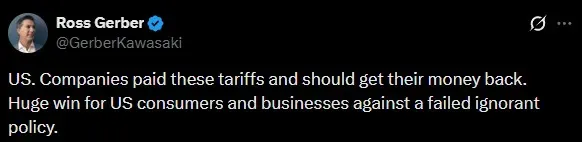
- Ross Gerber, CEO and President of Gerber Kawasaki, said that U.S. companies paid tariffs and they should get their money back.
The Trump administration can replicate most of the tariffs struck down by the U.S. Supreme Court, analysts at Goldman Sachs reportedly stated in a recent note.
According to a post by Zerohedge citing a note from the firm, the Supreme Court ruling will not be the end of President Donald Trump’s tariffs.
“This won’t be the end of tariffs… the administration will almost certainly roll out alternative legal frameworks. Net result is probably slightly fewer tariffs, materially more trade uncertainty, and some incremental deficit concerns,” Goldman Sachs said.
The firm noted that using Section 122 to impose 10% to 15% tariffs on most countries would allow the Trump administration to replicate most of the tariffs imposed under the International Emergency Economic Powers Act (IEEPA), even as Section 301 investigations for unfair trade practices are currently underway.

The Supreme Court ruled against Trump tariffs on Friday in a 6-3 verdict, saying that the President exceeded his authority by invoking an emergency-powers law. However, the court did not specify the extent to which importers were entitled to refunds.
Experts React To Supreme Court Ruling Against Trump Tariffs
Ross Gerber, CEO and President of Gerber Kawasaki, said that U.S. companies paid tariffs, and they should get their money back.
“Huge win for US consumers and businesses against a failed ignorant policy,” he said in a post on X. In another post, Gerber called tariffs a “stupid policy.”
Dan Ives, Global Head of Tech Research at Wedbush, said that the tariff ruling will be a net positive for the technology sector and the AI trade.
“We believe this would act as a net positive for tech with financial relief for many companies while creating greater supply chain visibility,” he added.
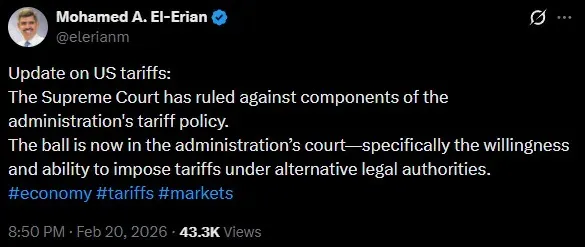
Mohamed El-Erian, Chief Economic Advisor at Allianz, said in a post on X that the “ball is now in the administration’s court,” especially with respect to using alternative legal authorities to impose tariffs.
Justin Wolfers, professor of economics and public policy at the Gerald R. Ford School of Public Policy at the University of Michigan, pointed out in a post on X that the Supreme Court did not state that the U.S. cannot impose tariffs, but that the Trump administration needs Congress’ assent.
“The Court didn't say that the US can't issue tariffs, simply that the President has to convince (the Republican-controlled) Congress first. If tariffs are a great idea, that should be an easy argument to win,” he said.
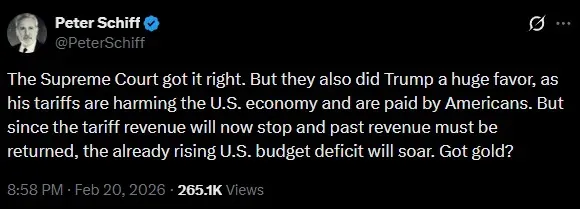
Economist Peter Schiff said that the Supreme Court “got it right” with the tariff ruling, adding that the levies are harming the U.S. economy.
“But since the tariff revenue will now stop and past revenue must be returned, the already rising U.S. budget deficit will soar,” he said.
Meanwhile, U.S. equities were mixed in Friday morning’s trade. At the time of writing, the SPDR S&P 500 ETF (SPY), which tracks the S&P 500 index, was up by 0.05%, the Invesco QQQ Trust ETF (QQQ) rose 0.27%, while the SPDR Dow Jones Industrial Average ETF Trust (DIA) declined 0.32%. Retail sentiment around the S&P 500 ETF on Stocktwits was in the ‘neutral’ territory.
The iShares 20+ Year Treasury Bond ETF (TLT) was down by 0.34% at the time of writing, while the iShares 7-10 Year Treasury Bond ETF (IEF) fell 0.07%.
For updates and corrections, email newsroom[at]stocktwits[dot]com.<
Stay updated with all the latest Business NewsShare Market NewsIPOsGold PriceDA Hike8th Pay CommissionAsianet News Official App