International Markets Are Pulling Ahead Of US Stocks In 2026: These 4 ETFs Have Left SPY, QQQ, DIA In The Dust
Synopsis
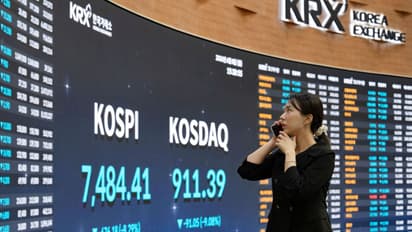
An artificial intelligence boom, varied macroeconomic policies, and a volatile foreign exchange market have contributed to gains in markets outside the U.S.
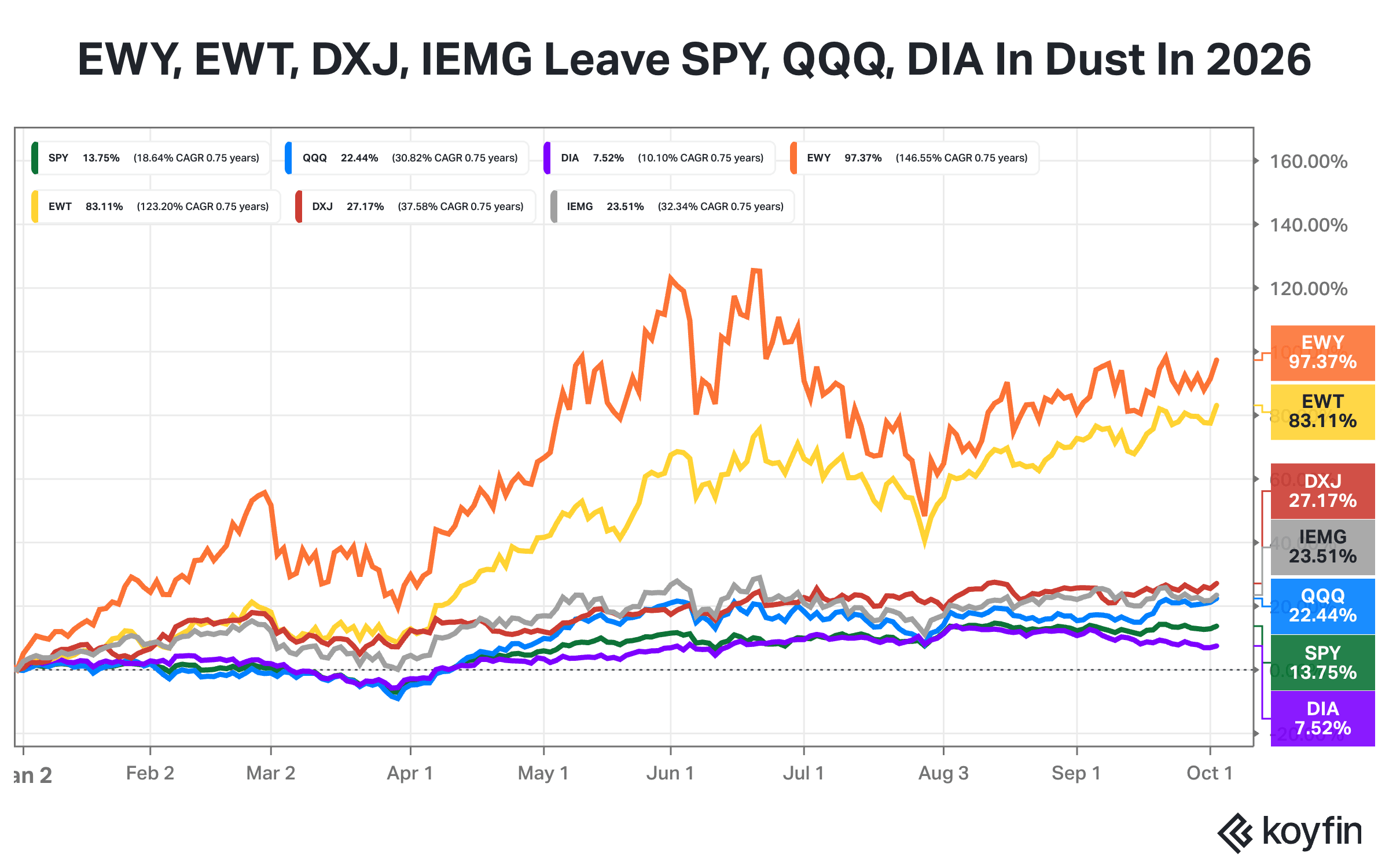
- The iShares MSCI South Korea ETF has surged more than 97% year-to-date, while the iShares MSCI Taiwan ETF (EWT) has gained about 83%.
- The WisdomTree Trust - WisdomTree Japan Hedged Equity Fund (DXJ) has gained 27%, and the iShares Core MSCI Emerging Markets ETF (IEMG) has risen 23.5% so far in 2026.
- Meanwhile, SPY, QQQ, and DIA have gained 13.75%, 22.44%, and 7.52%, respectively.
U.S. equity markets have had a strong run in 2026 so far, but international markets, including those in Asia and emerging markets, have surged past domestic returns.
While the SPDR S&P 500 ETF (SPY), the SPDR Dow Jones Industrial Average ETF Trust (DIA) and the Invesco QQQ Trust (QQQ) have all posted gains so far this year, exchange-traded funds linked to South Korea, Taiwan, Japan and other emerging markets have surged past U.S. gains.
SPY, QQQ, and DIA have posted gains of 13.75%, 22.44%, and 7.52%, respectively.
Meanwhile, the iShares MSCI South Korea ETF (EWY), which tracks large- and mid-cap equities in South Korea, has surged more than 97% year-to-date. Meanwhile, the iShares MSCI Taiwan ETF (EWT) has gained about 83%.
The WisdomTree Trust - WisdomTree Japan Hedged Equity Fund (DXJ), which invests in dividend-paying Japanese stocks, has gained 27% over the same period, while iShares Core MSCI Emerging Markets ETF (IEMG), which invests in stocks across global emerging economies including Brazil, China, and India, has risen 23.5%.
What’s Driving Asian And Emerging Equities Higher?
An artificial intelligence boom, varied macroeconomic policies, and a volatile foreign exchange market have contributed to gains in markets outside the U.S.
In South Korea, the AI-driven High Bandwidth Memory boom has strengthened shares of Samsung and SK Hynix, while corporate-governance reforms have also contributed to a broader market re-rating and boosted equities.
In Taiwan, Taiwan Semiconductor Manufacturing Company (TSMC), the world's leading dedicated semiconductor foundry, has seen record revenues and earnings amid the AI boom, contributing significantly to the market’s strong performance.
Meanwhile, Japan’s corporate governance reforms, rising buybacks and dividends, and improving profitability have driven shares higher, even as the DXJ's yen hedge has helped it gain momentum.
Emerging Markets have benefited largely from the chip boom in South Korea and Taiwan, while a weaker dollar at the start of the year and political uncertainty in America also gave them an advantage over U.S. equities.
In September, the International Monetary Fund (IMF) pointed out that historical tailwinds for U.S. asset returns are fading amid a weakening dollar, a ballooning federal deficit, persistent inflation, and quantitative tightening.
“But emerging market and developing economies offer the most opportunity by far,” the IMF said at the time.
Where Is The Dollar Headed?
The U.S. dollar had a weak start to the year, but has recovered in recent months and is up about 4% year-to-date.

However, experts forecast the dollar will weaken again in the coming months. The IMF said in its article that evidence points to a turn in the strong-dollar cycle, which has been an important tailwind for U.S. equities over the past decade and a half.
“Expectations of further weakening have driven up the demand for, and the price of, hedging dollar exposures, making the tailwind a headwind. A weaker dollar also increases the relative attractiveness of emerging market and developing economies and has been a strong driver of their significant outperformance since early last year,” it said.
A Reuters poll from last week also indicated that the greenback is set to give up most of its recent gains over the coming year, based on FX strategists polled.
While a 80% majority reportedly said that the U.S. dollar was likelier to beat their three-month forecasts than fall short, the FX strategists still held on to their bearish view in the latest poll.
"The dollar can remain a little bit on the stronger side in the very near term....But beyond that in a six-month to one-year horizon, we are still in a bearish-dollar regime," Jayati Bharadwaj, head of FX strategy at TD Securities, reportedly told Reuters.
Last week, J.P.Morgan Asset Management said in a report that it sees potential for a broad-based decline in the U.S. dollar against other G10 currencies.
“Increased domestic spending by the public and private sectors, the global AI capex build-out and the lofty valuation of the US dollar all support our fixed income team’s view that the greenback could weaken from here,” it said.
However, it added that a further increase in energy prices amid the U.S.-Iran war and the choked Strait of Hormuz could lead to renewed dollar strength.
Should Investors Refrain From Investing In The US?
Experts largely believe international equities offer more diversified returns at present than U.S. equities, given the concentration risk.
The IMF pointed out that in the last three years, just seven companies have accounted for 55% of total S&P 500 returns, mostly due to the AI boom, while the top 10 companies presently make up 40% of the index. “This is not broad-based growth, but a narrow and increasingly fragile bet on a single sector in a single economy,” it said.
However, it said that this did not automatically require “a sudden rush for the exit” or a “sell America” trade.
“The sensible question is not whether investors should own US assets, but how much they should own. When expected returns fall, and risks rise, the logic of reallocation becomes inevitable for institutional investors bound by a fiduciary duty to invest money wisely—aiming for the highest possible return without taking unnecessary risk,” it said.
Meanwhile, State Street Investment Management, in a report last month, stressed the importance of diversification as correlation between the U.S. and major international markets has been declining.
“Macroeconomic drivers such as inflation and monetary policy, as well as local experiences of global phenomena (supply shocks, tech growth) can create dispersed outcomes across countries,” State Street said.
“The combination is expanding the opportunity set outside the US. While regional performance is becoming more differentiated, AI remains a shared catalyst across many markets, allowing investors to broaden their geographic exposures without losing access to a defining structural growth trend.”
US Vs International Equities: Retail Stance
On Stocktwits, retail sentiment around SPY was ‘bullish’ at the time of writing, while it was ‘extremely bullish’ for QQQ and DIA.
One user said, “$SPY just open the throttle. Markets bullish right up until Midterms.”
Meanwhile, retail sentiment for EWT and IEMG was ‘neutral’ at the time of writing, while it was ‘bearish’ for EWY and DXJ.
For updates and corrections, email newsroom[at]stocktwits[dot]com.<
Stay updated with all the latest Business NewsShare Market NewsIPOsGold PriceDA Hike8th Pay CommissionAsianet News Official App