Fed’s Waller Anticipates More Rate Hikes Ahead If Economic Data Holds Up — Says Moves Need Not Come Consecutively
Synopsis
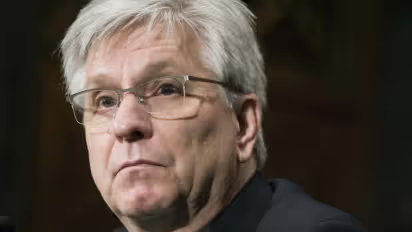
Fed governor Christopher Waller said the labor market remained stable and that he was concerned the recent acceleration in inflation could lead consumers, investors and businesses that set prices to raise their expectations for future inflation.
- For at least the near term, policy will focus on the inflation side of the Fed’s mandate, Waller said.
- He also said evidence had mounted that the AI buildout was significantly driving up high-tech consumer prices.
- Continuing trade conflicts threaten new tariffs that could put upward pressure on inflation again, said Waller.
Federal Reserve Governor Christopher Waller said Thursday that if economic data continue to come in as expected, he anticipates additional rate hikes to support a timelier return of inflation to the Fed’s 2% goal.
Speaking at the Istanbul Economic Forum, Waller said there is some flexibility about when those hikes will occur. “The hikes do not need to come at consecutive meetings, but they should be in place in an acceptable period of time.”
The Federal Open Market Committee raised the federal funds rate by 25 basis points in September to a range of 3.75% to 4%, after holding the rate steady for nine months.
Inflation Remains Above Fed’s Target
Waller said August data showed monthly core personal consumption expenditures (PCE) inflation of 0.25%, with the 12-month rate at 3%. “This is obviously above our target, and not showing sufficient progress,” he said.
The labor market remained stable and “inflation is too high,” Waller said, adding that, “for at least the near term, policy will be focused on the inflation side of our mandate.”
Waller said his September decision to change policy stance was not based on a single inflation reading. Instead, he said it reflected a “preponderance of evidence over several months,” including a strengthened labor market and a range of persistent inflationary forces.
Strengthening economic activity in the second half of the year left Waller less concerned that tighter monetary policy would cause a damaging slowdown, the Fed governor said, adding that he was concerned that the recent acceleration in inflation could lead consumers, investors and businesses that set prices to raise their expectations for future inflation.
Waller Points To Energy, AI And Tariffs
Waller said hopes for a quick end to the Middle East conflict had faded, while experts warned that low inventories and damaged infrastructure could keep oil prices high through 2027.
Evidence had mounted that “the artificial intelligence buildout was significantly driving up high-tech consumer prices,” while continuing trade conflicts threatened new tariffs that could put upward pressure on inflation again, the Fed governor noted.
Those forces were “swamping the fleeting signs of progress toward 2 percent inflation,” Waller said.
The Summary of Economic Projections can provide a signal about the likely direction of monetary policy, Waller said while stressing that “the course of monetary policy is not predetermined” and depends on incoming data and what they imply for the Fed’s dual mandate.
US Stock Futures Under Pressure, Treasury Yields Climb
U.S. stock futures fell Thursday as rising Treasury yields, oil prices and concerns over AI spending weighed on sentiment. At the time of this writing, Dow futures fell 0.8%, Nasdaq futures declined 0.5%, and S&P 500 futures were down 0.4%.
On Stocktwits, retail sentiment for the SPDR S&P 500 ETF (SPY) and Invesco QQQ Trust (QQQ) stayed ‘extremely bullish.’
U.S. Treasury yields climbed higher ahead of a closely watched long-dated bond auction later. The benchmark 10-year Treasury yield was 4 basis points higher at 5.322%, while the 30-year Treasury bond yield rose over 4 basis points to 5.705%.
At the time of this writing, the iShares 7-10 Year Treasury Bond ETF (IEF) was down 0.38%, while the iShares 20+ Year Treasury Bond ETF (TLT) was down 0.76%. On Stocktwits, retail investors’ sentiment for TLT remained in the ‘bullish’ territory, while sentiment around IEF flipped to ‘bearish’ amid high message volume.
See Also: Why Are Nasdaq, Dow Futures Falling Premarket? MU, TSM, APLD, IONQ, HOOD, BULL, SLS In Focus
For updates and corrections, email newsroom[at]stocktwits[dot]com<
Stay updated with all the latest Business NewsShare Market NewsIPOsGold PriceDA Hike8th Pay CommissionAsianet News Official App