Fed, Oil, Yields Or Trump? Retail Traders Pick Their Biggest Portfolio Risk – And The Answer Could Surprise You
Synopsis
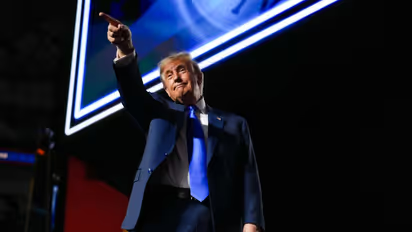
According to a Stocktwits poll, retail traders think the biggest threat to their portfolios comes from U.S. President Donald Trump’s policies.
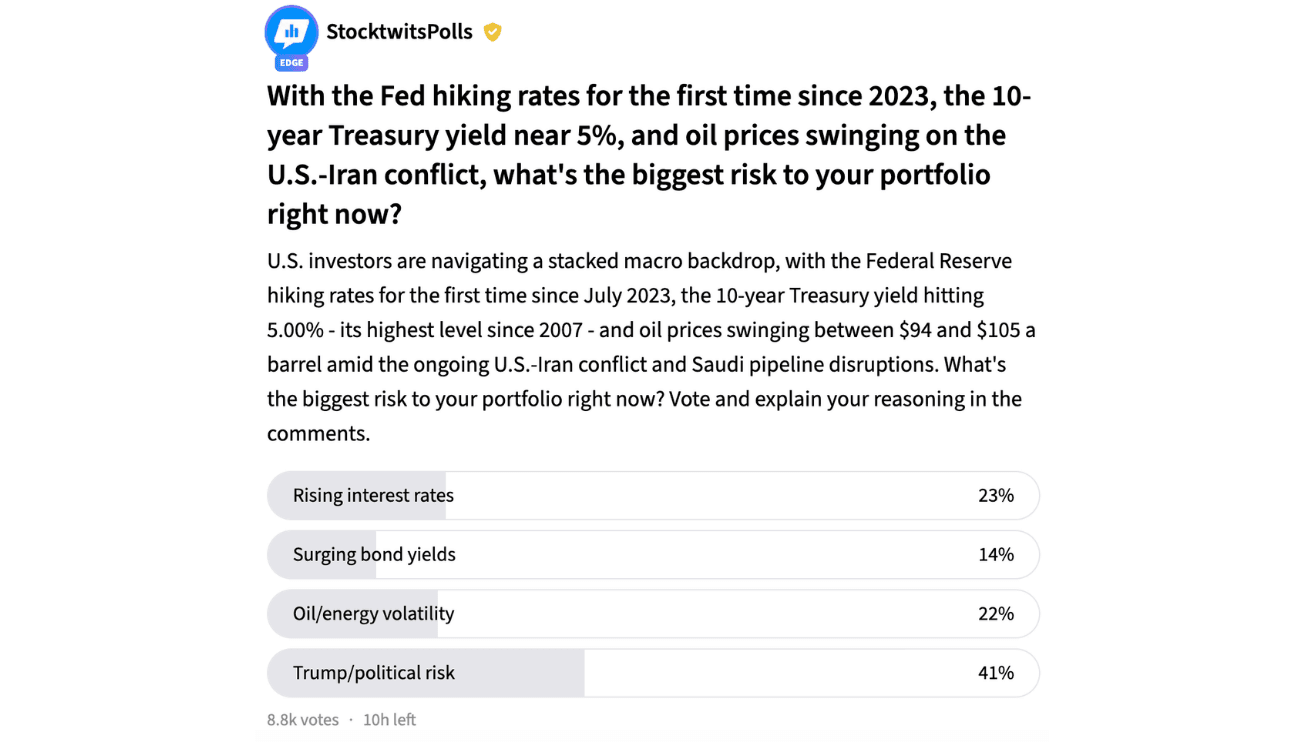
- Of those who voted, 41% said Trump and political risks were the greatest threat to their investment portfolios.
- Interest rate risks took second place, with 23% of votes.
- Meanwhile, 21% of polled participants voted for oil volatility, and the remaining 14% attributed the greatest risk to rising long-term yields on U.S. Treasuries.
U.S. markets have been plagued by volatility in recent weeks amid a series of catalysts, including a 25-basis-point hike in key interest rates by the Federal Reserve, rising oil prices due to the U.S.-Iran conflict, and soaring yields on long-dated bonds.
Yet retail traders think the biggest threat to their portfolios comes from U.S. President Donald Trump’s policies.
Why Is Trump A Threat To Stock Markets?
A Stocktwits poll gauging what retail investors see as the biggest threat to their investment portfolios found that 41% of voters picked Trump and political risks as the top choice.
The second spot, at 23% of votes, went to interest rate risks, while 21% of polled participants voted for oil volatility and the remaining 14% attributed the greatest risk to rising long-term yields on U.S. Treasuries.
One user said, “The problem with Trump is that the market shows the appearance that it is not evolving based on natural objective events. Instead, it is being manipulated based on the whims of a powerful person and perhaps some people around him for his/their own interests. Every investor not in their circle is at risk.”
Another user said, “For sure to me it is Trump and his crappy administrations, but you can kind of put all politicians in this group.”
However, one optimistic user said, “Nothing is a risk to this insanely bullish market..”
U.S. Market Volatility
U.S. investors have found themselves in the thick of multiple macroeconomic catalysts that have weighed on stock markets.
Last week, the Fed hiked benchmark rates to a target of 3.75% to 4.00%, its first upward move since 2023.
Meanwhile, the ongoing conflict in the Middle East has elevated oil prices. At the time of writing, Brent crude futures expiring in November were trading at $101.71 a barrel, while WTI crude futures expiring in October were trading at $96.86 per barrel.
Rising inflationary concerns and a stacked macro picture has also pushed U.S. long-term yields higher, with the 10-year Treasury yield hitting 5% last week, its highest level since 2007.
At the time of writing, the U.S. 10-year Treasury yield slipped from its 5% threshold to 4.951%, while the U.S. 30-year Treasury yield traded at 5.28%.
“For now, markets appear willing to look through the geopolitical noise and instead price two more supportive developments,” said Patrick Munnelly, market strategist at Tickmill Group, said in a note, according to The Wall Street Journal. These are “progress in U.S.-China talks ahead of this week’s Trump-Xi meeting, and signs that oil and gas shipments through the Strait of Hormuz are improving under U.S. naval protection,” he said.
The U.S. Central Command said on Monday in a post on X that, “USS Rafael Peralta (DDG 115) sails in regional waters as the guided-missile destroyer continues strict enforcement of the U.S. blockade against Iran, preventing commerce from entering or departing Iranian ports and coastal areas. As of Sept. 21, U.S. forces have redirected 110 commercial vessels to ensure compliance.”
On Monday, a rebound in artificial intelligence stocks pushed U.S. benchmark indexes higher, reviving the technology trade.
However, the conflict between the U.S. and Iran is yet to reach a resolution, and rising oil prices remain a concern after Trump has repeatedly said Iran must accept a deal and warned of further escalation.
Meanwhile, among ETFs tracking benchmark indexes, the SPDR S&P 500 ETF (SPY) was up about 0.2%, and Invesco QQQ Trust (QQQ) was trading flat, both amid ‘neutral’ sentiment at the time of writing.
The SPDR Dow Jones Industrial Average ETF Trust (DIA) traded 0.05% lower amid ‘bearish’ sentiment.
For updates and corrections, email newsroom[at]stocktwits[dot]com.<
Stay updated with all the latest Business NewsShare Market NewsIPOsGold PriceDA Hike8th Pay CommissionAsianet News Official App