Fed Just Changed The Game, Says George Noble: Has Warsh's Higher-For-Longer Policy Displaced Hormuz Concerns?
Synopsis
In a Substack post, George Noble said Fed Chair Kevin Warsh’s refusal to provide a dot plot in the latest policy statement was a deviation from the Fed’s long-term approach.
- Noble said that Warsh has shown the Fed can tighten financial conditions without raising interest rates, simply by reducing guidance and allowing markets to reprice risk on their own.
- The investor also warned that the change in the regime’s stance would make investors concentrated in long-duration technology stocks and passive index funds vulnerable.
- Meanwhile, on Stocktwits, retail investors debate the impact of monetary policy on markets, even as it seems to be replacing geopolitics as a primary concern.
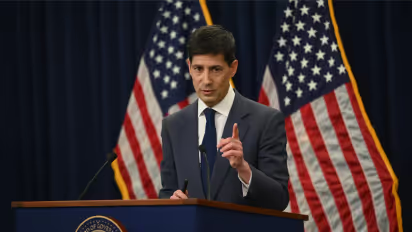
Veteran investor George Noble believes Federal Reserve Chair Kevin Warsh's first policy meeting marked a major shift in the central bank’s approach and “nobody is paying attention.”
In a Substack post, the former associate of Fidelity’s Peter Lynch said Warsh’s refusal to provide a dot plot, a chart that shows where the central bank’s top policymakers think the short-term interest rates are headed, is a deviation from the Fed’s long-term approach.
“For 15 years, investors have been spoonfed forward guidance by a Fed that practically held their hand through every meeting. That era ended in a single afternoon,” Noble said.
What This Implies For Markets
In its latest policy meeting, the Federal Reserve left key interest rates unchanged at 3.50% - 3.75%, with the latest projections indicating one rate increase in 2026, although Warsh did not provide his projections to the dot plot. According to Noble, this was significant.
“Without lifting a finger on the short term rate, Warsh sent 10 year TIPS yields spiking the moment he stopped talking,” Noble said. “This is the higher for longer regime made explicit.”
Noble argued that Warsh has shown the Fed can tighten financial conditions without raising interest rates, simply by reducing guidance, and allowing markets to reprice risk on their own. He also said that he expects inflation to remain elevated while economic growth broadens through manufacturing and reshoring, with the Fed relying more on communication than rate hikes to curb speculation.
“None of this is bearish for the market but it is absolutely bearish for the parts of the market that have feasted on cheap money and forward guidance for the last fifteen years,” he said.
The investor also warned that the change in the regime’s stance would make investors concentrated in long-duration technology stocks and passive index funds vulnerable. “If your portfolio is still built around long duration tech and passive index exposure, you are positioned for a regime that ended on Wednesday afternoon,” he said.
Noble’s Investment Take
Instead of investing in the AI-heavy S&P 500, Noble said that businesses with strong free cash flow, pricing power, durable competitive advantages, and tangible assets are better positioned for a market environment shaped by higher real yields and less Fed support.
“You want businesses that throw off real cash flow without needing to spend their entire operating budget on the next round of GPUs. You want tangible assets that cannot be disrupted by an AI startup with a clever prompt. You want pricing power, limited competition, and long duration cash flows that compound regardless of what the front end of the curve does,” he added.
Has The Market’s Focus Shifted?
Noble's comments come as retail investors debate the impact of monetary policy on markets, even as it is seemingly beginning to replace geopolitics as a primary concern.
Until last week, markets were largely focused on the U.S.-Iran conflict, the Strait of Hormuz and the potential impact of oil prices on inflation and growth. However, after Warsh's first meeting, some investors are saying that the focus is shifting back toward interest rates.
One user on Stocktwits said, “this is just comical watching. Now everything is saying that the market doesn’t care about the war but now it’s focused on the federal reserve. The reserve is the new war and issue is they barely say or do anything.”
View this Stocktwits post
Another user said, “The hotter this market gets, the hawkish’r the Fed will get.”
View this Stocktwits post
Meanwhile, at the time of writing, the SPDR S&P 500 ETF (SPY), which tracks the S&P 500 index, was down 0.08% amid ‘bullish’ sentiment. The Invesco QQQ Trust ETF (QQQ) declined 0.14% and the SPDR Dow Jones Industrial Average ETF Trust (DIA) was down by 0.08%.
On the credit side, the iShares 10-20 Year Treasury Bond ETF (TLH) was down 0.17% amid ‘neutral’ sentiment, while the iShares 20+ Year Treasury Bond ETF (TLT) fell 0.28% amid ‘bullish’ sentiment.
For updates and corrections, email newsroom[at]stocktwits[dot]com.<
Stay updated with all the latest Business NewsShare Market NewsIPOsGold PriceDA Hike8th Pay CommissionAsianet News Official App