Ed Yardeni Says Fast Move In 10-Year Treasury Yield To 6% Could Cause ‘Real Cracks’ In Financial System
Synopsis
Yardeni told Bloomberg that a strong economy, growing AI-related borrowing and an extremely large deficit help explain the rise in U.S. yields.
- Yardeni said the bond vigilantes concept would be a "real concern" if the 10-year Treasury yield got to 6% or higher.
- Once yields rise above nominal GDP growth, which is running at 6% to 6.5%, they start to slow the economy, he said.
- The unwinding of the Yen carry trade is probably behind the global rise in bond yields, Yardeni noted.
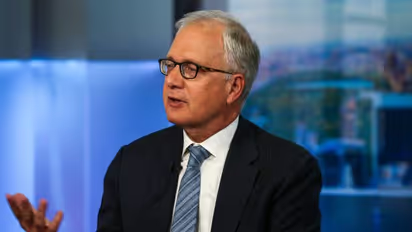
Yardeni Research President Ed Yardeni warned Thursday that a rapid rise in the 10-year U.S. Treasury yield could expose vulnerabilities in the financial system and prompt the Federal Reserve to consider liquidity facilities.
In a conversation with Bloomberg, Yardeni said, “If we get to 6% very quickly, we could start to see some real cracks in the financial system.”
The economist distinguished that scenario from yields reaching the same level “in a leisurely fashion,” which he believes would cause less damage.
Treasury yields continued to climb Thursday, with the benchmark 10-year Treasury yield rising more than 5 basis points to 5.331%, around levels not seen since 2002. The 30-year Treasury yield rose more than 4 basis points to 5.702%, remaining near a 24-year high.
Yardeni Sees A Spectrum Of Bond Yield Outcomes
Asked whether a “danger zone” had been reached, where higher yields beget higher yields without some sort of fiscal solution, Yardeni said, “we're certainly heading in the direction of the danger zone.”
He described a spectrum of bond yield scenarios. The good end of the spectrum, he said, is better-than-expected economic growth leading to an increase in neutral interest rates.
Yardeni said the explanation for the increase in bond yields around the world is “probably the unwind of the carry trade,” as the Bank of Japan has been raising interest rates.
When Could Bond Vigilantes Become A Concern?
Yardeni identified yields of 6% or higher as a level where bond vigilantes could become a “real concern.”
He assessed the risk against nominal gross domestic product (GDP) growth, which he said was running around 6% to 6.5% year over year. The Yardeni Research president believes that yields exceeding nominal GDP growth could start to slow economic activity.
In an October 5 briefing, Yardeni Research said the selloff did not yet qualify as the “Revenge of the Bond Vigilantes,” pointing instead to an upward repricing of the neutral interest rate.
Strong US Growth And AI Borrowing Push Yields Higher
Yardeni described the U.S. economy as one “that's really on fire,” citing resilient consumer spending, continued spending by retiring baby boomers and booming capital expenditure.
The strategist also pointed to growing borrowing by artificial intelligence (AI) hyperscalers. Pointing to TIPS (Treasury Inflation-Protected Securities), he said real rates have driven the rise in nominal yields rather than inflation.
Yardeni said the Federal Reserve matters less than it used to, partly because the economy is less interest rate sensitive, and added that "the problem is fiscal policy."
Yardeni Research had turned more cautious on the market in mid-September, citing "higher and longer oil prices," stronger-than-expected economic growth and demand for credit. "We could have a problem in the bond market, and we do," he told Bloomberg on Thursday.
As of this writing, the iShares 7-10 Year Treasury Bond ETF (IEF) and iShares 20+ Year Treasury Bond ETF (TLT) were trading marginally in the red. On Stocktwits, retail investors’ sentiment for TLT remained ‘bullish’, while sentiment around IEF flipped to ‘bearish’ amid high message volume.
See Also: Dow Falls Nearly 200 Points, S&P 500 And Nasdaq In Red As Treasury Yields Stay Near 24-Year Highs, Oil Prices Jump
For updates and corrections, email newsroom[at]stocktwits[dot]com<
Stay updated with all the latest Business NewsShare Market NewsIPOsGold PriceDA Hike8th Pay CommissionAsianet News Official App