Dan Ives Sees Cash Flow Rebound In MSFT, META, GOOGL, AMZN: Says AI Bubble Fears Thrown Out The Window

Synopsis
Ives expects debt and equity financing, including at-the-market stock offerings, to decline by about 25% over the next year.
- Ives sees the recovery gathering pace in 2028, followed by a much larger increase in free cash flow in 2029 and 2030.
- The tech bull said he now expects Big Tech and hyperscaler capital expenditure growth to peak in 2027, earlier than his previous outlook of 2028 or 2029.
- He estimated that Microsoft, Google, Amazon, and Meta could still spend more than $1 trillion on capital expenditure in 2027, even as the rate of spending growth moderates.
Yorkville Ives managing partner Dan Ives said on Thursday that he sees a rebound in free cash flow for Microsoft (MSFT), Meta (META), Alphabet (GOOG, GOOGL) and Amazon (AMZN), with heavy investment in artificial intelligence infrastructure starting to translate into stronger free cash flow from the second half of 2027.
In a post on X, the tech bull said he expects free cash flow for the four Big Tech companies to reach a trough in the first half of 2027, then begin to recover over the following six months. He sees that improvement gathering pace in 2028, followed by a much larger increase in 2029 and 2030.
“Worries about AI overbuild and bubble now thrown out [the] window, good for tech names/winners,” he wrote.
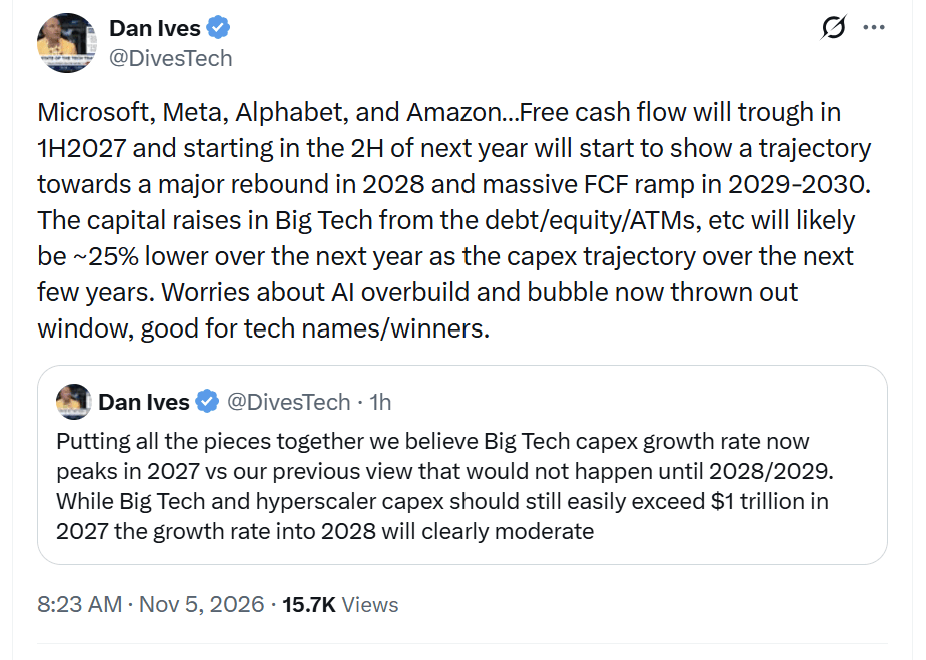
Ives also said he expects the pace of capital expenditure growth to peak earlier than he previously anticipated. According to him, Big Tech and hyperscaler capex growth would likely peak in 2027, revising his earlier view that the turning point would not arrive until 2028 or 2029.
The Roundhill Magnificent Seven ETF (MAGS) was down 1.5% as markets opened on Thursday. On Stocktwits, retail sentiment toward the fund improved to ‘neutral’ from ‘bearish’ over the past day, accompanied by ‘high’ chatter levels.
Big Tech Capex Growth Could Peak In 2027
Ives said the four companies could still spend more than $1 trillion on capital expenditure in 2027, even if the growth rate begins to moderate the following year.
Ives said the change in spending trajectory should also reduce the need for companies to raise outside capital. He expects debt and equity financing, including at-the-market stock offerings, to be about 25% lower over the next year.
According to him, financing pressures will ease as the pace of investment moderates and companies begin generating more cash from their AI businesses.
Ives Previously Warned Of A Slowdown In AI Infrastructure
The more constructive outlook follows earlier warnings from Ives that political and financing pressures could slow the pace of AI infrastructure investment in the U.S.
On Tuesday, Ives warned of a potential 10% to 12% correction in the Philadelphia Semiconductor Index (SOX), amid pressure on technology stocks following a Democratic sweep in the midterm elections.
His concerns centered on investors becoming less willing to give companies time to generate returns from their AI spending. Some companies could face pressure to limit borrowing and data center expansion, with Oracle (ORCL) cited as a potential example. Ives nevertheless remained constructive on select companies, including Microsoft and Alphabet.
In a Wednesday post on X, Ives estimated that 10% of planned data centers might not be built.
Ives attributed the potential slowdown to what he called a Democratic “blue tidal wave across the Senate and House,” which he said could bring about a “seismic shift” with a negative impact on the pace of AI infrastructure development in the U.S. over the next few years.
In morning trade on Wednesday, the iShares Semiconductor ETF (SOXX) dropped over 6%, while the Direxion Daily Semiconductor Bull 3X Shares (SOXL) fell nearly 20%.
SOXL was among the top trending tickers on Stocktwits at the time of writing. Retail sentiment on the platform around the ETF trended in ‘bullish’ territory over the past day, accompanied by high levels of chatter.
Read also: AMD Faces Nvidia Software Hurdle, While Intel Could Reclaim PC Market Share, Morningstar Says
For updates and corrections, email newsroom[at]stocktwits[dot]com.<
Stay updated with all the latest Business NewsShare Market NewsIPOsGold PriceDA Hike8th Pay CommissionAsianet News Official App