$1.2 Trillion Added To US Stocks After Midterms: Is A Slower AI Buildout Part Of The Blue Tidal Wave?
Synopsis
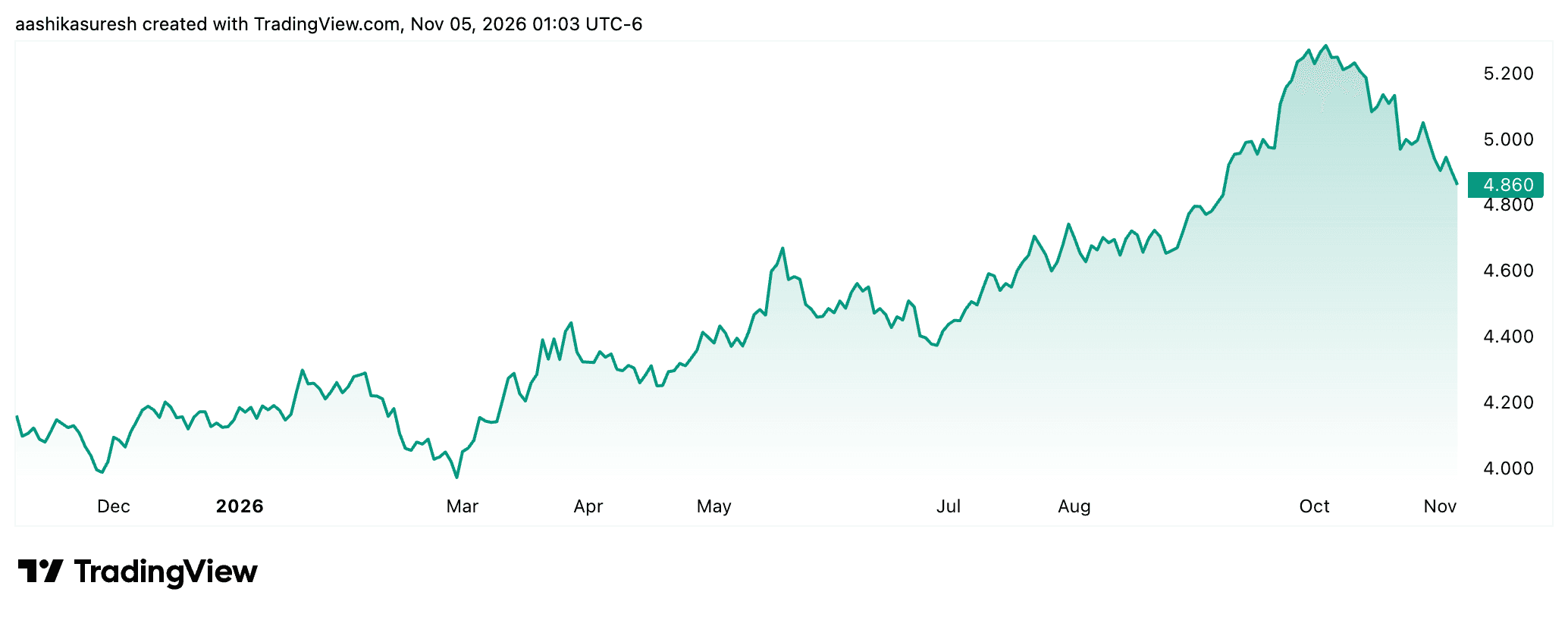
The relief rally spilled over to the bond markets as well, with the 10-year Treasury yield falling below the 5% threshold to around 4.90%.
- Markets are concerned that a potential slowdown in the massive AI infrastructure buildout is on the horizon under Democrats.
- Yardeni Research said in a post on Wednesday that even if the Democrats slow the AI buildout, profits and free cash flow for hyperscalers will ultimately increase.
- Fundstrat’s Tom Lee said in an interview with CNBC that Democratic gains in the midterms could prove positive for stocks and dismissed the selloff in data-center and AI-related names as a short-term reaction.
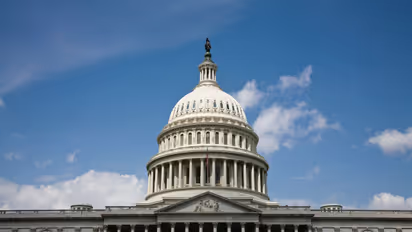
On Wednesday, Democrats captured both chambers of Congress, flipping at least seven Senate seats, 24 House districts, five governorships, and twelve state legislative chambers, securing an early reported majority of at least 231–141 in the House and 54–44 in the Senate.
After an initial dip, markets reversed green on the blue tidal wave. According to The Kobeissi Letter, U.S. stocks added more than $1.2 trillion in market capitalization in their first day of trading after the midterms.
The relief rally spilled over to the bond markets as well, with the 10-year Treasury yield falling below the 5% threshold to around 4.90%, back in what Yardeni Research called the "old normal" range of 4% to 5%.
However, markets were concerned that a potential slowdown in the massive artificial intelligence infrastructure buildout was on the horizon with the Democrats at the helm.
Will AI Buildout Slowdown?
Experts are divided on how the midterm election results will affect the AI rally that has been building for the better part of three years.
Yorkville Advisors partner and managing director Dan Ives said in a post on X, “Democratic blue tidal wave across the Senate and House was a seismic shift that will have a negative impact on the pace of the AI Revolution buildout in the US over the next few years. Will slow the pace of the planned 800 to 1,000 datacenters across the US fueling the AI Revolution…some investors will like the “slower pace”…others view it as adding risk. We estimate 10% of datacenters will not happen now.”
However, Yardeni Research said in a post on Wednesday that even if the Democrats slow the AI buildout, profits and free cash flow for hyperscalers will ultimately increase and “fewer AI-related bond issues would also help keep a lid on bond yields.”
In recent months, a flood of bond issuances from AI hyperscalers has pushed corporate borrowing rates higher, pressuring bond markets and stoking concerns about the sustainability of the AI trade. According to a Reuters report, technology-related debt issuance in the U.S. has surged more than $250 billion so far this year, up 81% from the same period last year.
However, Fundstrat’s Tom Lee said in an interview with CNBC that Democratic gains in the midterms could prove positive for stocks and dismissed the selloff in data-center and AI-related names as a short-term reaction. He said the AI trade remains intact, noting that rising compute demand as more users adopt AI tools would likely lead many states to still welcome the investment, even if on stricter terms.
James E. Thorne, Chief Market Strategist at Wellington Altus, said that the blue wave would likely lead to a shift in the “doomer narrative,” adding that it was wrong to assume that America won’t build data centers, and that the AI trade is over.
“For the record. Slowing Data Centre build out and stopping the Iran war will be good for bringing inflation down,” he said in a post on X.
Carson Group’s Ryan Detrick also doubled down on his bullish thesis for the AI trade, saying in an episode of ‘The Glass Half Full’ that despite recent volatility, the “AI wave is real” and that “this is an economy that's going to surprise to the upside. We still think this bull market's alive and well.”
Legislative Gridlock Is On The Cards
Beyond the AI slowdown, markets are also anticipating legislative gridlock, as Democrats will likely seek to challenge Trump's policy agenda, raising the risk of debt-ceiling standoffs and government shutdowns.
“Beyond the occasional deal on must-pass legislation, the next two years will likely be characterized by gridlock, with the White House increasingly focused on foreign policy while Democrats concentrate on ‘messaging bills’ and investigations in order to set the narrative ahead of the 2028 presidential elections,” Morningstar DBRS analysts led by Michael Heydt, senior vice president, sector lead, global sovereign ratings, reportedly said.
“However, an inter-branch standoff could set the stage for government shutdowns and brinksmanship over the debt ceiling … the outgoing Republican-led Congress will need to pass another [continuing resolution] to fund the government until the incoming Democratic-led Congress is sworn in on January 3, 2027, or run the risk of a government shutdown. The debt ceiling will also need to be raised in 2027.
We expect the executive and legislative branches will reach an agreement to raise the debt ceiling in a timely manner. However, failure to lift the debt ceiling would have adverse implications for the economy and could, if the Treasury materially delays non-debt payments, result in a downgrade of the US credit rating,” they added.
SPY, QQQ, DIA: Market Reaction
At the time of writing, the SPDR S&P 500 ETF (SPY) and the Invesco QQQ Trust (QQQ) were down, while the SPDR Dow Jones Industrial Average ETF Trust (DIA) edged higher.
Retail sentiment around SPY and QQQ was ‘bearish,’ while it was ‘extremely bullish’ for DIA.
The iShares 20+ Year Treasury Bond ETF (TLT) was up 0.50% amid ‘bearish’ sentiment.
One user said, “$SPY Dems will force big tech to the negotiating table and ruin the plan for privatized gains. Ai will continue but government will have massive stakes in it.”
Another user said, “IF LAST NIGHTS 4% V RALLY DIDNT MAKE YOU BELIEVE, IM SURE TONIGHTS WILL $SPY $QQQ.”
For updates and corrections, email newsroom[at]stocktwits[dot]com.<
Stay updated with all the latest Business NewsShare Market NewsIPOsGold PriceDA Hike8th Pay CommissionAsianet News Official App