Almost Extinct: 5 critically endangered species
Synopsis
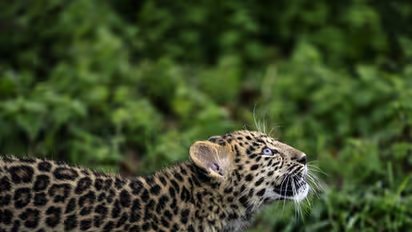
Amur Leopard: Found in the borders of northeast China and southeastern Russia, this rare cat is hunted for its soft coat and bones for medicines. It’s also known as the Far eastern leopard. Unlike the other leopard species, its rosettes are spread more wider; its fur is short during summers, and grows during winter to keep them warm. According to the WWF, a survey in 2013 reported an increase from around 35 in 2007 to around 45 adult Amur leopards in the wild.
Western Lowland Gorilla: Native to Central Africa such as Cameroon, Gabon, and Equatorial Guinea among others, these elusive gorillas habitat are in the dense rainforests. As a result, scientists have been rather unsuccessful in finding an accurate number in the wild according to a National Geographic report. A rough estimate of the population is said to be 100,000 in the wild. These gorillas are, instead, more commonly found in zoos. They tend to live in small groups of around 4-8, with an alpha male leading the troop. The troop's alpha male is known for its distinct silverback. However, it seems like these rare gorillas don’t have a chance at survival in the zoos, either, as evident in the case.
Black Rhinoceros: Also known as the hook-lipped rhinoceros, they were sought after by poachers for their prized horn. But before they were targeted by poachers, they were often killed for sport and food, by early European settlers. These black rhinos are generally found in south and east Africa like Mozambique, Tanzania, Zimbabwe, Kenya and Botswana among others. At one point, there were about 70,000 in the 1960s - a dismal number then, only to falter further to 2,475 in 1993. In 2011, the IUCN declared three subspecies of the black rhino extinct. However, conservation efforts have marginally revived its current condition with 4,880 black rhinos in 2010 as per WWF report.
Sumatran Elephant: A subspecies of the Asian Elephant (the other two, being Indian and Sri Lankan), the Sumatran elephant is native to the forests of Borneo and Sumatra. Unlike its larger Asian counterpart, these Sumatran elephants are almost pygmy-like in stature coming in at a shoulder height between 5-9 feet. Their population over the years has dwindled thanks to poaching and loss of natural habitat, resulting in an 80% loss. Their population in the wild now stands anywhere between 2, 400 - 2, 800 says WWF. Some of their defining characteristics include: small ears, curved spine and light skin tone.
Leatherback Turtle: Otherwise referred to as the Leatherback Sea turtle, these reptiles are so called because of its leathery shell as opposed to a hard tough one. What's interesting about these leatherbacks, as per WWF reports, is that they are the largest species and most migratory between the Atlantic and Pacific ocean. The sub-populations, namely southwest Atlantic and Pacific, are deemed critically endangered, with just 2,300 female leatherbacks remaining. Globally, however, they remain classified as 'vulnerable' by the IUCN states WWF. A major reason for their decline is because of their eggs that are used for human consumption, and accidental killing by netting whilst hunting for other fish by fishermen.
Some food for thought: An alarming infographic that shows the dwindling numbers among other species.